







Question: I need help understanding why each answer is correct (step by step explanations) Thank you so much! Questions #12)-#16) rely on the following information: Consider
I need help understanding why each answer is correct (step by step explanations) Thank you so much!
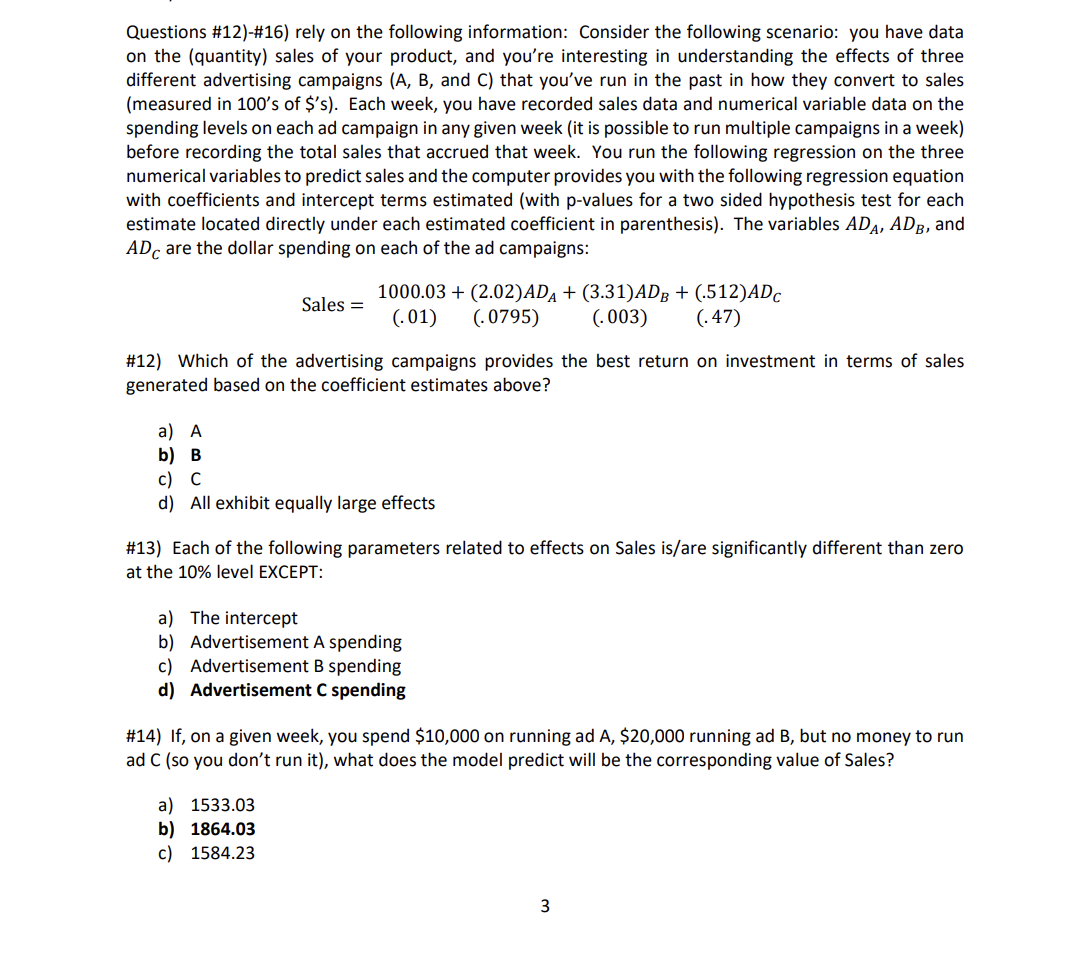
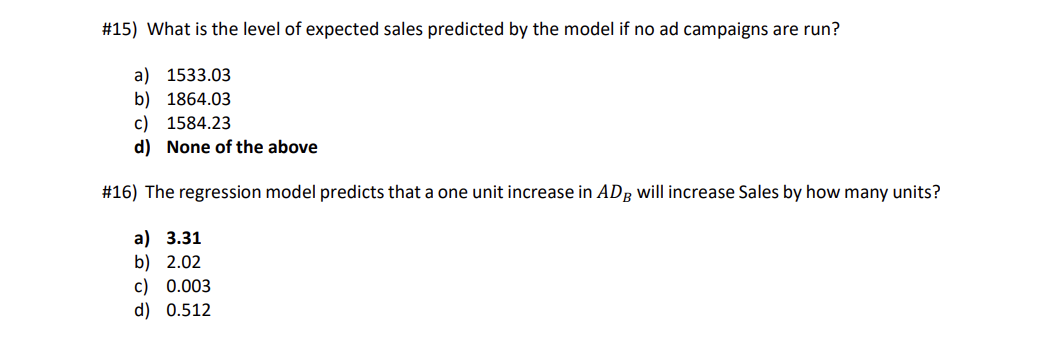
Questions \#12)-\#16) rely on the following information: Consider the following scenario: you have data on the (quantity) sales of your product, and you're interesting in understanding the effects of three different advertising campaigns (A, B, and C) that you've run in the past in how they convert to sales (measured in 100's of \$'s). Each week, you have recorded sales data and numerical variable data on the spending levels on each ad campaign in any given week (it is possible to run multiple campaigns in a week) before recording the total sales that accrued that week. You run the following regression on the three numerical variables to predict sales and the computer provides you with the following regression equation with coefficients and intercept terms estimated (with p-values for a two sided hypothesis test for each estimate located directly under each estimated coefficient in parenthesis). The variables ADA,ADB, and ADC are the dollar spending on each of the ad campaigns: Sales=1000.03+(2.02)ADA+(3.31)ADB+(.512)ADC(.01) \#12) Which of the advertising campaigns provides the best return on investment in terms of sales generated based on the coefficient estimates above? a) A b) B c) C d) All exhibit equally large effects \#13) Each of the following parameters related to effects on Sales is/are significantly different than zero at the 10% level EXCEPT: a) The intercept b) Advertisement A spending c) Advertisement B spending d) Advertisement C spending \#14) If, on a given week, you spend $10,000 on running ad A,$20,000 running ad B, but no money to run ad C (so you don't run it), what does the model predict will be the corresponding value of Sales? a) 1533.03 b) 1864.03 c) 1584.23 \#15) What is the level of expected sales predicted by the model if no ad campaigns are run? a) 1533.03 b) 1864.03 c) 1584.23 d) None of the above \#16) The regression model predicts that a one unit increase in ADB will increase Sales by how many units? a) 3.31 b) 2.02 c) 0.003 d) 0.512
Step by Step Solution
There are 3 Steps involved in it

Get step-by-step solutions from verified subject matter experts
 Study Help