







Question: I need help with 78-91 please? 087: Based on your evaluation of the null in Q85 and your conclusion is Q86, as a researcher you
I need help with 78-91 please?
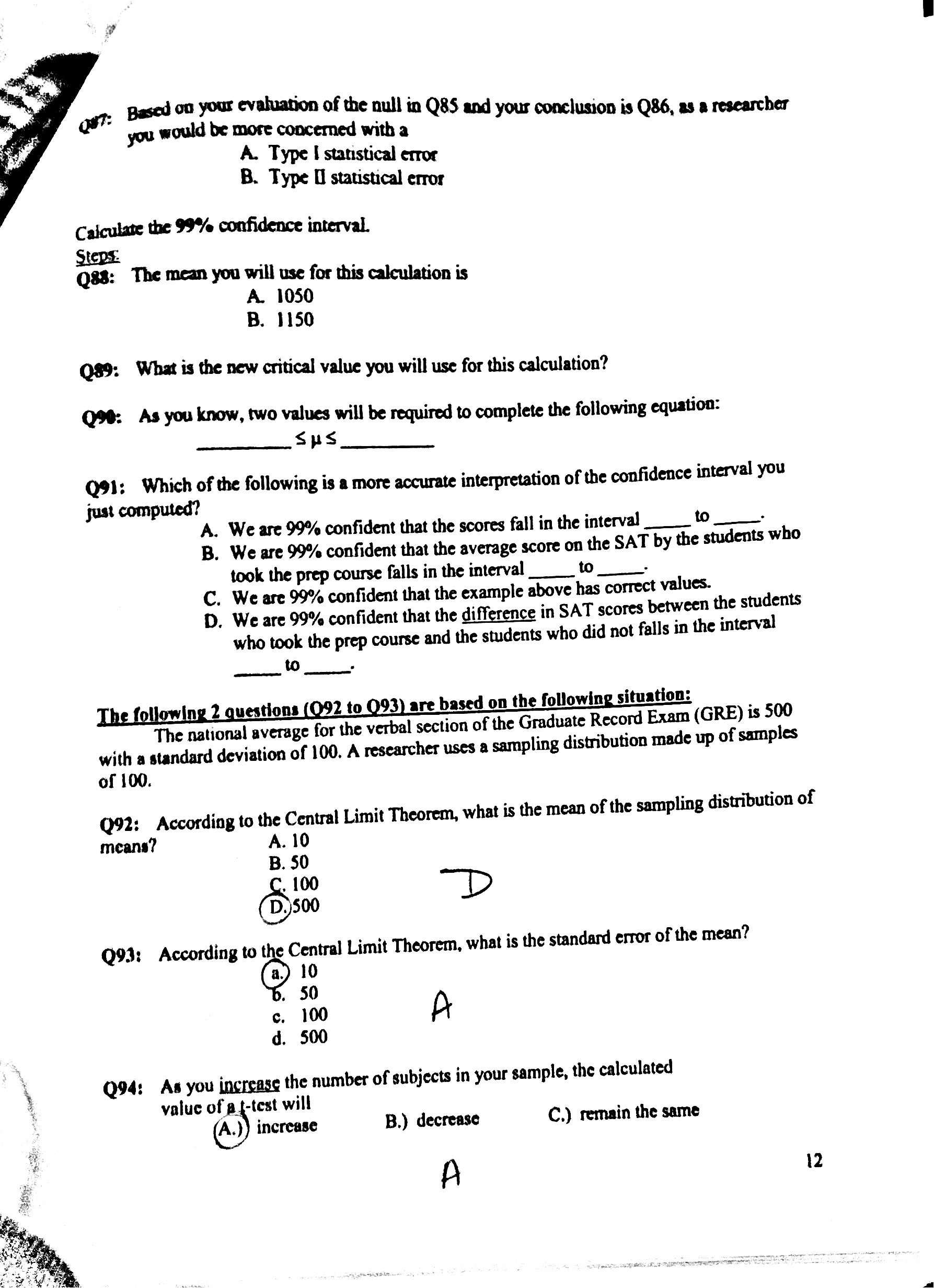
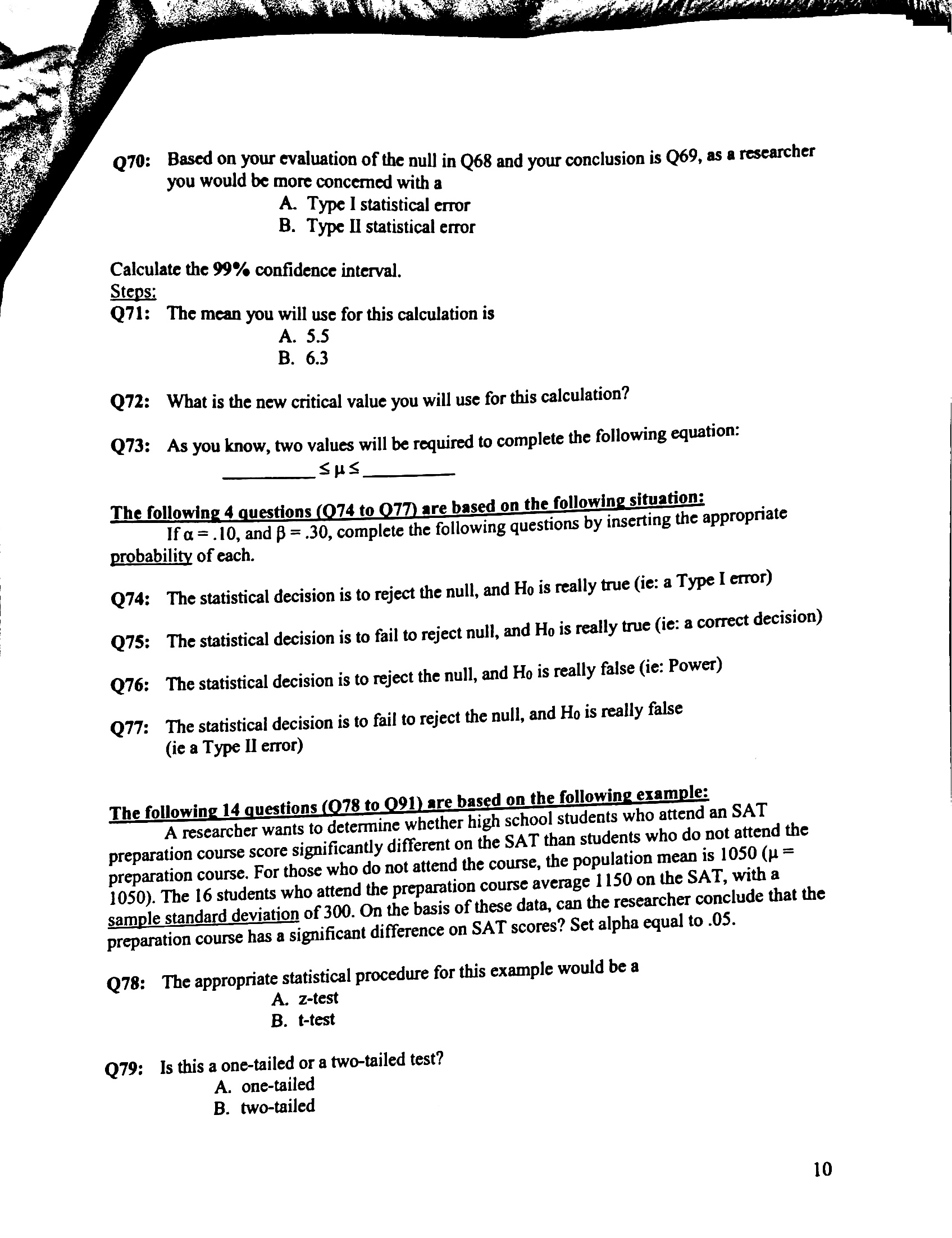
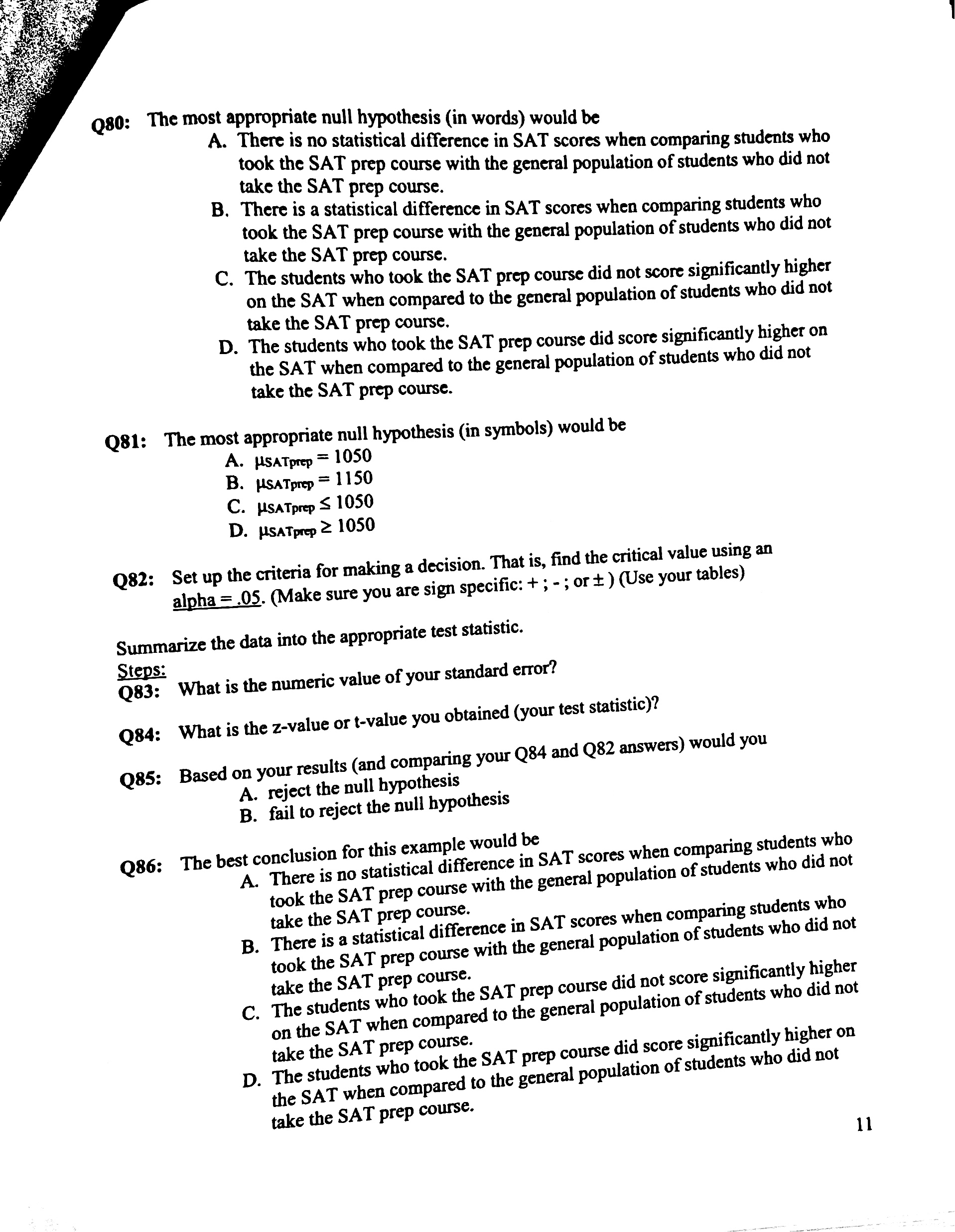
087: Based on your evaluation of the null in Q85 and your conclusion is Q86, as a researcher you would be more concerned with a A. Type I statistical error B. Type U statistical error Calculate the 99% confidence interval. Steps 088: The mean you will use for this calculation is A. 1050 B. 1150 Q89: What is the new critical value you will use for this calculation? Qos: As you know, two values will be required to complete the following equation: SHS just computed? Q91: Which of the following is a more accurate interpretation of the confidence interval you A. We are 9% confident that the scores fall in the interval B. We are 99% confident that the average score on the SAT by the students who to took the prep course falls in the interval to C. We are 99% confident that the example above has correct values. D. We are 99% confident that the difference in SAT scores between the students who took the prep course and the students who did not falls in the interval to The following 2 questions (092 to (93) are based on the following situation: The national average for the verbal section of the Graduate Record Exam (GRE) is 500 with a standard deviation of 100. A researcher uses a sampling distribution made up of samples of 100. Q92: According to the Central Limit Theorem, what is the mean of the sampling distribution of means? A. 10 B. 50 C. 100 D. 500 D Q93: According to the Central Limit Theorem, what is the standard error of the mean? a. 6. 10 50 c. 100 A d. 500 Q94: As you increase the number of subjects in your sample, the calculated value of a f-test will (A.)) increase B.) decrease C.) remain the same A 12070: Based on your evaluation of the null in Q68 and your conclusion is Q69, as a researcher you would be more concerned with a A. Type I statistical error B. Type II statistical error Steps Calculate the 99% confidence interval. Q71: The mean you will use for this calculation is A. 5.5 B. 6.3 Q72: What is the new critical value you will use for this calculation? Q73: As you know, two values will be required to complete the following equation: SUS The following 4 questions (074 to (77) are based on the following situation: If a = .10, and B = .30, complete the following questions by inserting the appropriate probability of each. Q74: The statistical decision is to reject the null, and Ho is really true (ie: a Type I error) Q75: The statistical decision is to fail to reject null, and Ho is really true (ie: a correct decision) Q76: The statistical decision is to reject the null, and Ho is really false (ie: Power) Q77: The statistical decision is to fail to reject the null, and Ho is really false (ie a Type II error) The following 14 questions (078 to (91) are based on the following example: A researcher wants to determine whether high school students who attend an SAT preparation course score significantly different on the SAT than students who do not attend the preparation course. For those who do not attend the course, the population mean is 1050 (H = 1050). The 16 students who attend the preparation course average 1 150 on the SAT, with a sample standard deviation of 300. On the basis of these data, can the researcher conclude that the preparation course has a significant difference on SAT scores? Set alpha equal to .05. Q78: The appropriate statistical procedure for this example would be a A. z-test B. t-test Q79: Is this a one-tailed or a two-tailed test? A. one-tailed B. two-tailed 10Q80: The most appropriate null hypothesis (in words) would be A. There is no statistical difference in SAT scores when comparing students who took the SAT prep course with the general population of students who did not take the SAT prep course. B. There is a statistical difference in SAT scores when comparing students who took the SAT prep course with the general population of students who did not take the SAT prep course. C. The students who took the SAT prep course did not score significantly higher on the SAT when compared to the general population of students who did not take the SAT prep course. D. The students who took the SAT prep course did score significantly higher on the SAT when compared to the general population of students who did not take the SAT prep course. Q81: The most appropriate null hypothesis (in symbols) would be A. HSATprep = 1050 B. USATprep = 1150 C. HSATprep $ 1050 D. HSATprep 2 1050 Q82: Set up the criteria for making a decision. That is, find the critical value using an alpha = .05. (Make sure you are sign specific: + ; - ; or + ) (Use your tables) Summarize the data into the appropriate test statistic. Steps Q83: What is the numeric value of your standard error? Q84: What is the z-value or t-value you obtained (your test statistic)? Q85: Based on your results (and comparing your Q84 and Q82 answers) would you A. reject the null hypothesis B. fail to reject the null hypothesis Q86: The best conclusion for this example would be A. There is no statistical difference in SAT scores when comparing students who took the SAT prep course with the general population of students who did not take the SAT prep course. B. There is a statistical difference in SAT scores when comparing students who took the SAT prep course with the general population of students who did not take the SAT prep course. C. The students who took the SAT prep course did not score significantly higher on the SAT when compared to the general population of students who did not take the SAT prep course. D. The students who took the SAT prep course did score significantly higher on the SAT when compared to the general population of students who did not take the SAT prep course. 11
Step by Step Solution
There are 3 Steps involved in it

Get step-by-step solutions from verified subject matter experts
 Study Help