







Question: i need help with a b and c and this is one whole problem Suppose these data show the number of gallons of gasoline sold
i need help with a b and c and this is one whole problem 
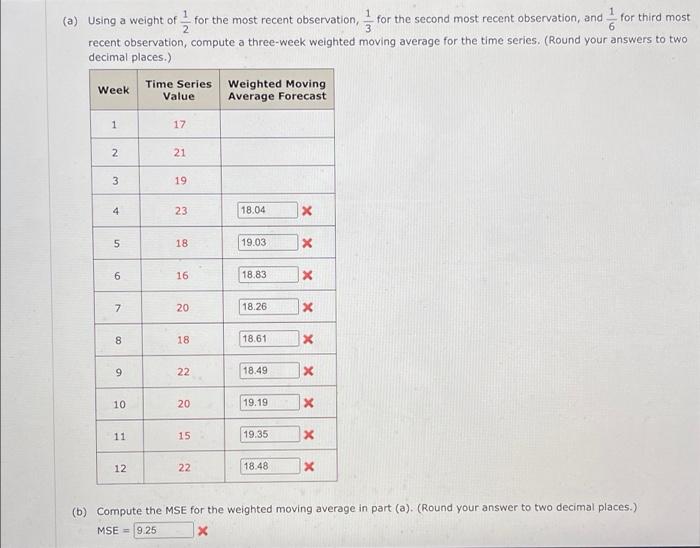
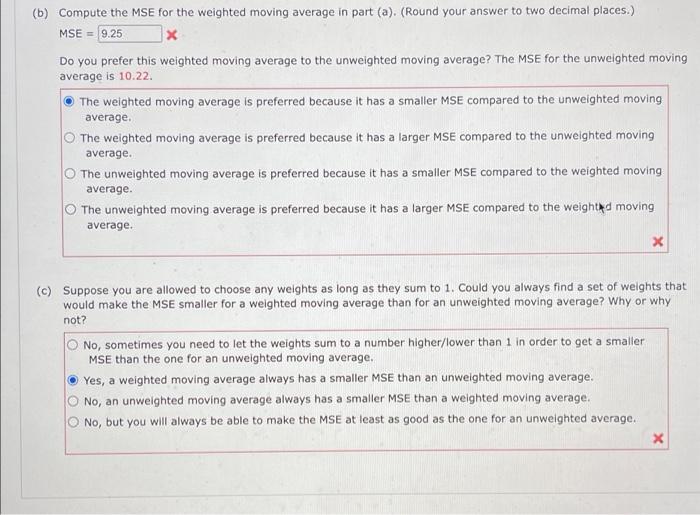
Suppose these data show the number of gallons of gasoline sold by a gasoline distributor in Bennington, Vermont, over the past 12 weeks. Week Sales (1,000s of gallons) 1 17 2. 21 19 4 23 5 18 6 16 7 20 7 8 9 8 18 9 22 10 20 11 15 12 22 (a) Using a weight of for the most recent observation, for the second most recent observation, and for third most recent observation, compute a three-week weighted moving average for the time series. (Round your answers to two decimal places.) Time Series Weighted Moving Average Forecast Week Value 1 17 2 21 3 19 4 4 23 18.04 X 5 18 19.03 X 6 16 18.83 X 7 20 18.26 X 00 8 18 18.61 X 9 22 18.49 X 10 20 19.19 X 11 15 19.35 X 12 22 18.48 x (b) Compute the MSE for the weighted moving average in part (a). (Round your answer to two decimal places.) MSE 9.25 X (6) Compute the MSE for the weighted moving average in part (a), (Round your answer to two decimal places.) MSE = 9.25 x Do you prefer this weighted moving average to the unweighted moving average? The MSE for the unweighted moving average is 10.22 The weighted moving average is preferred because it has a smaller MSE compared to the unweighted moving average. The weighted moving average is preferred because it has a larger MSE compared to the unweighted moving average. O The unweighted moving average is preferred because it has a smaller MSE compared to the weighted moving average. The unweighted moving average is preferred because it has a larger MSE compared to the weighted moving average. X (C) Suppose you are allowed to choose any weights as long as they sum to 1. Could you always find a set of weights that would make the MSE smaller for a weighted moving average than for an unweighted moving average? Why or why not? O No, sometimes you need to let the weights sum to a number higher/lower than 1 in order to get a smaller MSE than the one for an unweighted moving average. Yes, a weighted moving average always has a smaller MSE than an unweighted moving average. No, an unweighted moving average always has a smaller MSE than a weighted moving average, No, but you will always be able to make the MSE at least as good as the one for an unweighted average. O
Step by Step Solution
There are 3 Steps involved in it
1 Expert Approved Answer
Step: 1 Unlock

Question Has Been Solved by an Expert!
Get step-by-step solutions from verified subject matter experts
Step: 2 Unlock
Step: 3 Unlock
 Study Help