



Question: I need help with a few questions. All the Qs must be answered. Please answer the Qs in the order that they are provided because
I need help with a few questions.
All the Qs must be answered. Please answer the Qs in the order that they are provided because they are topically sequenced and often interrelated.
The next 3 Questions on Aliya Saperstein's video lecture "The Social Constructions of Race"
here is the link to the video = https://www.youtube.com/watch?v=jiwieME2tis
Q1. The Source you are to use for answering this Q: Video Source: Aliya Saperstein "The Social Construction of Race"; Utilize minutes: 0:06- 6:21 (the entire assigned minutes).
Please read the following thoroughly before answering the Q (important): 1st watch the entire 6+ minutes. Then, based on the contents of Saperstein's illuminating arguments and specific examples (case studies and those interviewed/observers), explain detailed (thoroughly) and accurately : What exactly Saperstein is arguing about how whiteness and blackness are perceived; The stigmas she points out that are associated with blackness; The specific scenarios (case studies) that Saperstein uses to support her claims regarding how a white person and black person are perceived differently in various scenarios (meaning at different stages of the candidate's life, and changes in their status); And finally, to show her viewers (us) how her specific case studies/experiments confirm that 'race' is not fixed (because of changes in how the selected white observers were classifying/judging the black and white candidates in each scenario, and when there were changes). Your answer must be focused and reflect only what is addressed by Saperstein in the assigned minutes. Explain the examples (the scenarios).
Note that Saperstein describes whiteness and blackness as poles of spectrum, with whiteness being the pole of privileges such as success, high income, education, employed, and so on. *However, Saperstein is not suggesting that all white Americans enjoy those privileges. She is just pointing out how 'Whiteness' is automatically associated with those attributes.
Requirements for the answer to Q1: Your answer should be at least one para. You are required to cite 4-6 different minutes throughout your answer to support your arguments and claims. And, using proper format, show/cite the source as (Saperstein the minute number), e.g., (Saperstein 3:20). No range of minutes in the citations; No Comma needed. For instance, (Saperstein 3:00-4:00) is incorrect. Place the citation before the period at the end of the sentences. 9 points
Please write in your answer after the colon punctuation mark at the end of this sentence (the space expands as you write):
Q2. The Source you are to use for answering this Q: Video Source: Aliya Saperstein "The Social Construction of Race"; Utilize minutes: 5:50- 6:15 (the entire assigned minutes). Link to the source in the Week 1 module.
Please read the following thoroughly before answering the Q (important): In addition to arguing, and showing, that 'race' not being a fixed phenomenon, Saperstein argues that race is also an output of the same stereotyping system, showing that race is not static. For instance,
A. Once a person has experienced upward mobility or downward mobility, that then reflects back on how people perceive that person by race [a wealthy successful black person can be perceived as white, by some]. "It [meaning race] isn't stable over time. We can't simply talk about gaps in wages between whites and blacks, or gaps in test scores between whites and blacks, as if those are not two separate, mutually exclusive groups of people."
B. Once a person has experienced no chance of upward mobility or downward mobility, that then reflects back on how people perceive that person by race [a wealthy successful black person can be perceived as white, by some]. "It [meaning race] isn't stable over time. We can't simply talk about gaps in wages between whites and blacks, or gaps in test scores between whites and blacks, as if those are two separate, mutually exclusive groups of people."
C. Once a person has experienced upward mobility or downward mobility, that then reflects back on how people perceive that person by race [a wealthy successful black person can be perceived as white, by some]. "It [meaning race] isn't stable over time. We can't simply talk about gaps in wages between whites and blacks, or gaps in test scores between whites and blacks, as if those are two separate, mutually exclusive groups of people."
3 points
Please select the correct answer and write only the Corresponding Letter, after the Colon punctuation mark at the end of this sentence (do not write the entire answer):
Q3. The Source you are to use for answering this Q: Use the correct answer to Q2 above. (Aliya Saperstein "The Social Construction of Race"; Minutes: 5:50- 6:15).
Please read the following thoroughly before answering the Q (very helpful): *Based on the correct answer to Q2, explain what exactly is Saperstein arguing here (see the correct answer to Q2). See the specific Requirements below for the answer to this Q.
Requirements for the answer to this Q: Your answer should show your thorough knowledge of what Saperstein has argued in minutes 5:50-6:215 (which is reflected in the correct answer to Q2), be meaningful, and clearly articulated. The answer should be in sentences more than 4. No need to cite/show the source. 5 points
Please write in your answer after the colon punctuation mark at the end of this sentence (the space expands as you write):
_________________________________________________________________________________________________-
The next 7 Questions are on Peggy McIntosh, "White Privilege-Unpacking the Invisible Knapsack"
Q4. The Source you are to use for answering this Q: Peggy McIntosh "White Privilege- Unpacking the Invisible Knapsack" page 1. Here is page 1:
I think whites are carefully taught not to recognize white privilege, as males are taught not to recognize male privilege. So I have begun in an untutored way to ask what it is like to have white privilege. I have come to se white privilege as an invisible package of unearned assets which I can count on cashing in each day, but about which I was 'meant' to remain oblivious. White privilege is like an invisible weightless backpack of special provisions, maps, passports, codebooks, visas, clothes, tools and blank checks.
.
Please read the following thoroughly before answering the Q (important): Peggy McIntosh argues that for the most part white Americans are taught (whether consciously or unconsciously) not to see their white privilege. She also tell us that by thinking about male privilege, which is a phenomenon that is almost always denied (and protected by the male population), she herself began to realize the racial hierarchy in America, and why and how white privilege is denied. To support her arguments on why and how to become cognizant of white privilege, Peggy McIntosh offers her own perspective and experiences,
A. "I think whites are carefully taught not to recognize white privilege, as males are taught not to [or, are not taught to] recognize male privilege. So I have begun in an untutored way to ask [myself] what it is like to have white privilege. I have come to see white privilege as an invisible package of unearned assets which I can count on cashing in each day [not literally]," yet at the same time to understand it. White privilege, she describes, is like having "an invisible weightless backpack" that contains many special provisions, such as maps, passports, codebooks, visas, clothes, tools and blank checks.
B. "I think whites are carefully taught not to recognize white privilege, as males are taught not to [or, are not taught to] recognize male privilege. So I have begun in a strange way to ask [myself] what it is like to have white privilege. I have come to see white privilege as an invisible white package of unearned assets which I can count on cashing in each day [not literally]," yet at the same time to remain oblivious about it. White privilege, she describes, is like having "an invisible weightless backpack" that contains many special provisions, such as maps, passports, codebooks, visas, clothes, tools and blank checks.
C. "I think whites are carefully taught not to recognize white privilege, as males are taught not to [or, are not taught to] recognize male privilege. So I have begun in an untutored way to ask [myself] what it is like to have white privilege. I have come to see white privilege as an invisible package of unearned assets which I can count on cashing in each day [not literally]," yet at the same time to remain oblivious about it. White privilege, she describes, is like having "an invisible weightless backpack" that contains many special provisions, such as maps, passports, codebooks, visas, clothes, tools and blank checks.
3 points
Please select the correct answer and write only the corresponding letter after the colon punctuation mark at the end of this sentence (not the entire answer):
Q5. The Source you are to use for answering this Q: Peggy McIntosh "White Privilege- Unpacking the Invisible Knapsack" page 1. Here is page 1:
After I realized the extent to which men work from a base of unacknowledged privilege, I understood that much of their oppressiveness was unconscious. Then I remembered the frequent charges from women of color that white women whom they encounter are oppressive. I began to understand why we are justly seen as oppressive, even when we don't see ourselves that way. I began to count the ways in which I enjoy unearned skin privilege and have been conditioned into oblivion about its existence.
Please read the following thoroughly before answering the Q (very helpful in formulating your answer): Continuing with Q4. Peggy McIntosh explains how, understanding why men do not acknowledge their privileges and much of their oppressiveness seems unconscious, has helped her recognize the charges (complaints) that American women of color make about white American women. 1st read the entire assigned content. Then, based on its contents explain detailed, and accurately, what exactly McIntosh argues about the charges that American women of color make about white American women; What exactly did McIntosh begin to understand about the charges (and about what); And finally, what exactly did McIntosh begin to count (as she points out; what she had been oblivious to)?
Please be accurate and very specific. No general personal knowledge or comments. No Direct Quotes please (see page 2 above on using Direct Quotes when not instructed). See the Requirements below for the answer to this Q.
Requirements for the answer to Q5: Your answer should be no less than one para. No penalty for longer answers (relevant to the source and the Q). You are required to cite the source at least twice throughout the answer, and using proper format, show/cite the source as (McIntosh the page number), e.g., (McIntosh 200). No Comma needed. 5 points
Please write in your answer after the colon punctuation mark at the end of this sentence (the space expands as you write):
Q6. The Source you are to use for answering this Q: Peggy McIntosh "White Privilege- Unpacking the Invisible Knapsack" page 2 nd the list of 13 privileges Here is page 2 and the 13 privileges:
I decided to try to work on myself at least by identifying some of the daily effects of white privilege in my life. I have chosen those conditions which I think in my case attack some what more to skin-color privilege that to class, religion, ethnic status, or geographical location, though of course all these other factors are intricately intertwined. As far as I can see, my African American co-worker, friends and acquaintances with whom I come into daily or frequent contact in this particular time, place, and line of work cannot count on most of these conditions.
1. I can if I wish arrange to be in the company of people of my race most of the time.
2. If I should need to move, I can be pretty sure of renting or purchasing housing in an area which I can afford and in which I would want to live.
3. I can be pretty sure that my neighbors in such a location will be neutral or pleasant to me.
4. I can go shopping alone most of the time, pretty well assured that I will not be followed or harassed.
5. I can turn on the television or open to the front page of the paper and see people of my race widely represented.
6. When I am told about our national heritage or about "civilization," I am shown that people of my color made it what it is.
7. I can be sure that my children will be given curricular materials that testify to the existence of their race.
8. If I want to, I can be pretty sure of finding a publisher for this piece on white privilege.
9. I can go into a music shop and count on finding the music of my race represented, into a supermarket and find the staple foods which fit with my cultural traditions, into a hairdresser's shop and find someone who can cut my hair.
10. Whether I checks, credit cards, or cash, I can count on my skin color not to work against the appearance of financial reliability.
11. I can arrange to protect my children most of the time from people who might not like them.
12. I can swear, or dress in second hand clothes, or not answer letters, without having people attribute these choices to the bad morals, the poverty, or the illiteracy of my race.
13. I can speak in public to a powerful male group without putting my race on trial.
Please read the following thoroughly before answering the Q (very important): Continuing with Qs 3-5. Once awakened to her privileges as a white person (white women), McIntosh decided to write down some of the daily effects of her white privileges, meaning things that she has been able to do (or have) and expect automatically when her non-white counterparts could not/cannot count on experiencing (even everyday mundane things). 1st read the 5th paragraph (or the background provided for this Q), and examine the 13 items McIntosh has listed. Then, I) Explain clearly and accurately (in a couple words), why McIntosh decided to list some of the privileges she has been able to count on almost daily (but not experienced by non-whites); II) Explain detailed and accurately at least 5-6 of the white privileges (and include their specific #s) that McIntosh has noted/listed. Please note that #4, #5, and #10, must be among the white privileges you select or your answer to Part II. See the Requirements below for the answer to this Q.
Requirements for the answer to Q6: Please be sure to itemizeumber each part of your answer as presented (I, II). Your answer should be: Part I in a few words; Part II in no less than two p. *Cite the source at least 2 times throughout the answer, and using proper format, show the source as, (McIntosh the page number), e.g., (McIntosh 200). No Comma needed. 5 points
Please write in your answer after the colon punctuation mark at the end of this sentence (the space expands as you write):
Q7. The Source you are to use for answering this Q: Peggy McIntosh "White Privilege- Unpacking the Invisible Knapsack" page 3 (white privileges McIntosh has listed on this page). Link available in the Week 1 module. Here is page 3:
"I repeatedly forgot each of the realization on this list until I wrote it down. For me white privilege has turned out to be an elusive and fugitive subject. The pressure to avoid it is great, for in facing it I must give up the myth of meritocracy. If these things are true, this is not such a free country; one's life is not what one makes it; many doors open for certain people through no virtues of their own. In unpacking this invisible backpack of white privilege, I have listed conditions of daily experience which I once took for granted. Nor did I think of any of these perquisites as bad for the holder. I now think that we need a more finely differentiated taxonomy of privilege, for some of these varieties are only what one would want for everyone in a just society, and others give license to be ignorant, oblivious, arrogant and destructive."
Please read the following thoroughly before answering the Q: As you have learned, McIntosh, to remind herself of the white privileges that she had taken for granted, wrote down 26 of them, five of which you already addressed in the answer to Q6. Based on the list provided on p. 3 of the assigned source, 1st find the specific number that corresponds with each of the 3 white privileges noted below (I, II, & III); for instance what number corresponds with I; or with II, and so on. Then, write the correct numbers in the designated space only. This is not a multiple-choice Q.
I) If a traffic cop pulls me over or if the IRS audits my tax return, I can be sure I haven't been singled out because of my race. II) I can take a job with an affirmative action employer without having co-workers on the job suspect that I got it because of race. III) I can be sure that if I need legal or medical help, my race will not work against me.
3 points
*Please write just the correct number for each of the 3 specific white privileges in the order that they are provided above (I, II, & III) at the end of this sentence after the colon punctuation mark:
Q8. The Source you are to use for answering this Q: Peggy McIntosh "White Privilege- Unpacking the Invisible Knapsack" page 5. Here is page 5:
Disapproving of the systems won't be enough to change them. I was taught to think that racism could end if white individuals changed their attitudes. [But] a "white" skin in the United States opens many doors for whites whether or not we approve of the way dominance has been conferred on us. Individual acts can palliate, but cannot end, these problems.
Please read the following thoroughly before answering the Q (important info): : In her discussions on what a White person can do to make a true change in the systems reinforcing the racial hierarchies in American society, and protecting the white privileges, Peggy McIntosh points out that,
A. "Disapproving of the systems won't be enough to change them. I was taught to think that racism could end if white individuals changed their attitudes. [But] a "white" skin in the United States opens no doors for non-white people whether or not we approve of the way dominance has been conferred on us. Individual acts can palliate [alleviate], but can easily end, these problems."
B. "Disapproving of the systems won't be enough to change them. I was taught to think that racism could end if white individuals changed their attitudes. [But] a "white" skin in the United States opens many doors for whites whether or not we approve of the way dominance has been conferred on us. Individual acts can never palliate [alleviate], but cannot end, these problems."
C. "Disapproving of the systems won't be enough to change them. I was taught to think that racism could end if white individuals changed their attitudes. [But] a "white" skin in the United States opens many doors for whites whether or not we approve of the way dominance has been conferred on us. Individual acts can palliate [alleviate], but cannot end, these problems."
2 points
Please select the correct answer and write only the corresponding letter after the colon punctuation mark at the end of this sentence (not the entire answer):
Q9. The Source you are to use for answering this Q: Peggy McIntosh "White Privilege- Unpacking the Invisible Knapsack" page 5. here is page 5:
It seems to me that obliviousness about white advantage, like obliviousness about male advantage, is kept strongly inculturated in the United States so as to maintain the myth of meritocracy the myth that democratic choice is equally available to all. Keeping most people unaware that freedom of confident action is there for just a small number of people props up those in power, and serves to keep power in the hands of the same groups that have most of it already.
Please read the following thoroughly before answering the Q (helpful): Continuing with her arguments on the importance of white Americans becoming cognizant of white privilege, McIntosh points out that in her view,
A. ...obliviousness about white advantage, like obliviousness about male advantage, is kept strongly enculturated [adapted] in the United States so as to maintain the myth of meritocracy the myth that democratic choice is not available to all. Keeping most people unaware that freedom of confident action is there for all the people props up those in power, and serves to keep power in the hands of everybody.
B. ...obliviousness about white advantage, like obliviousness about male advantage, is kept strongly enculturated [adapted] in the United States so as to maintain the myth of meritocracy the myth that democratic choice is equally available to all. Keeping most people unaware that freedom of confident action is there for just a small number of people props up those in power, and serves to keep power in the hands of the same groups that have most of it already.
C. ...obliviousness about white advantage, like obliviousness about male advantage, is kept strongly enculturated [adapted] in the United States so as to maintain the myth of meritocracy the myth that democratic choice is equally available to all. Keeping most people aware that freedom of confident action is there for just a few people props up those in power, and serves to keep power in the hands of the same groups that have most of it already.
3 points
Please select the correct answer and write only the corresponding letter after the colon punctuation mark at the end of this sentence (not the entire answer)
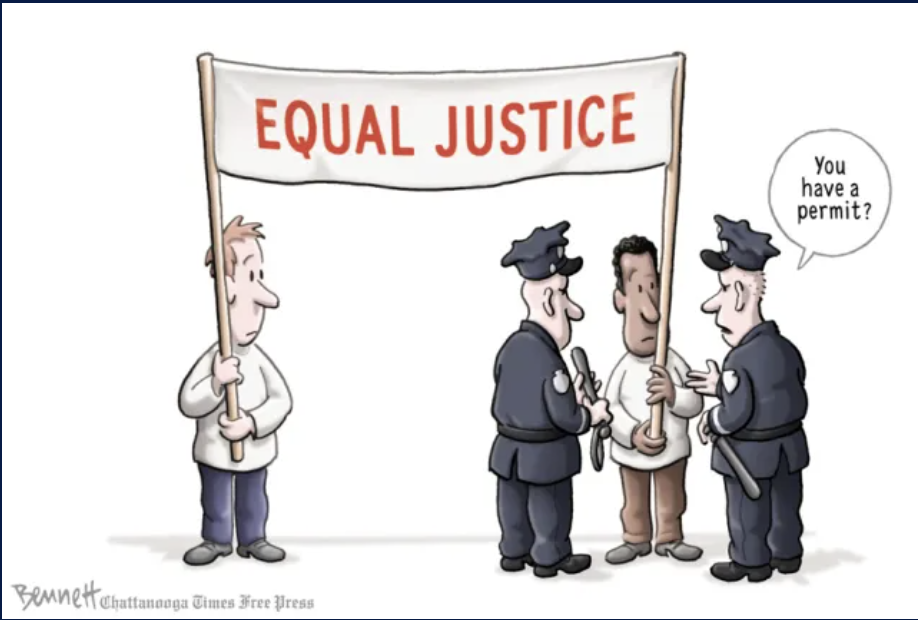
Q10. The Source you must use for answering this Q: The image (cartoon image) in the dark blue vignette (blue box) in Week 1 module (inside the module). See the Week 1 module. Here is the image:
Step by Step Solution
There are 3 Steps involved in it

Get step-by-step solutions from verified subject matter experts