Question: I need help with activity 1, 2 and 3. The first two pages are notes. Thank you. Average rate of change vs Instantaneous rate of
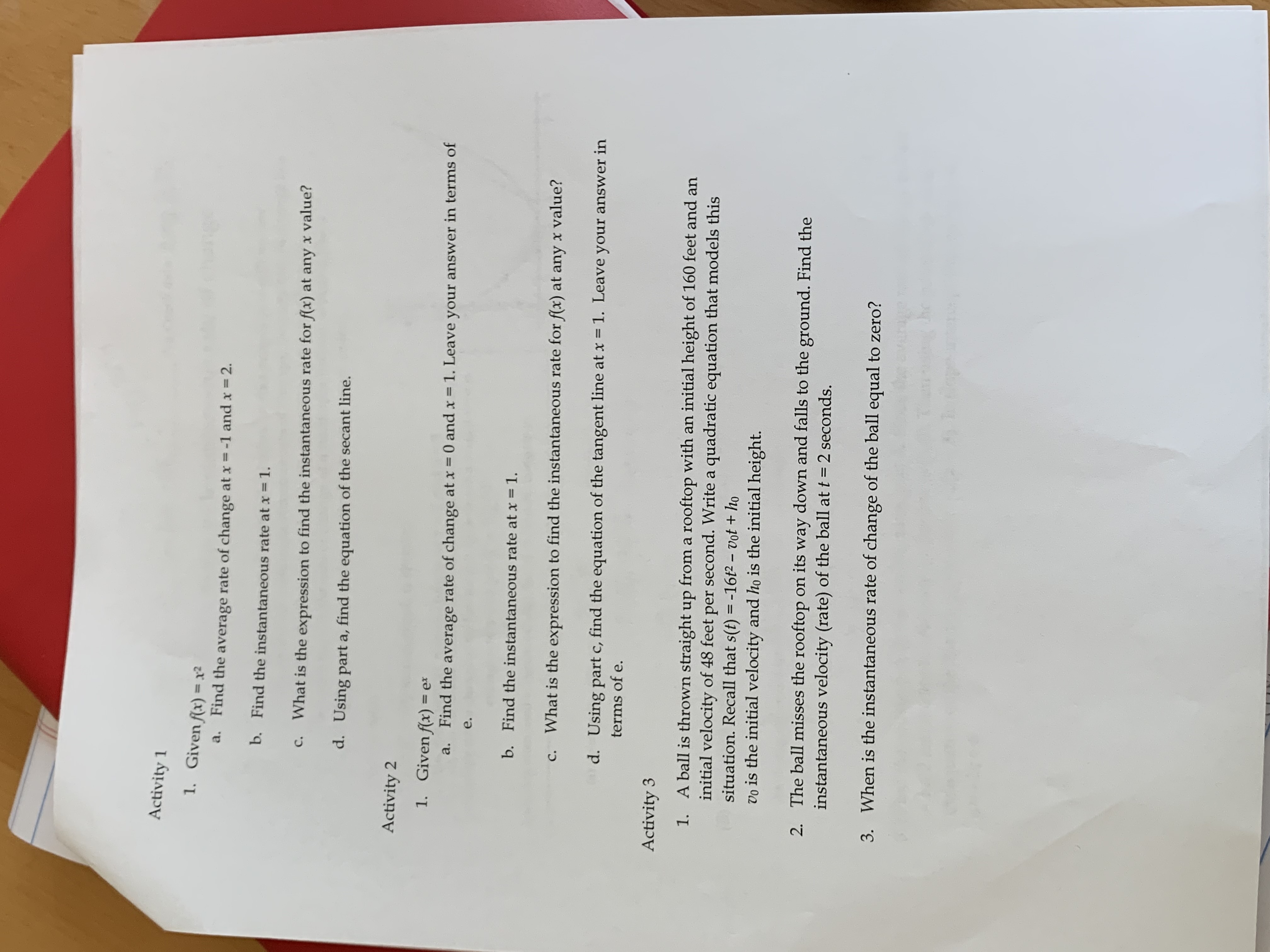
I need help with activity 1, 2 and 3. The first two pages are notes. Thank you.
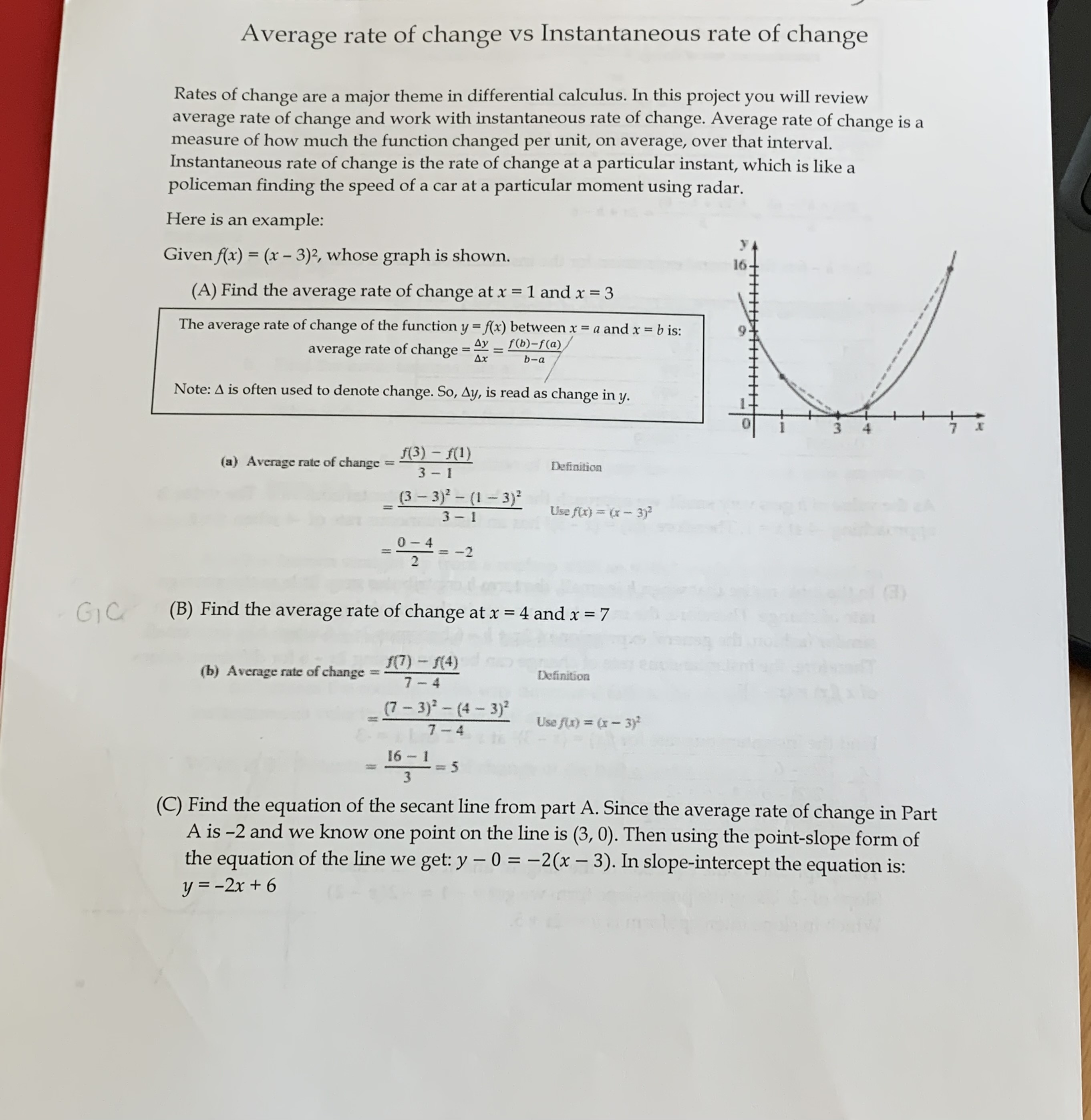
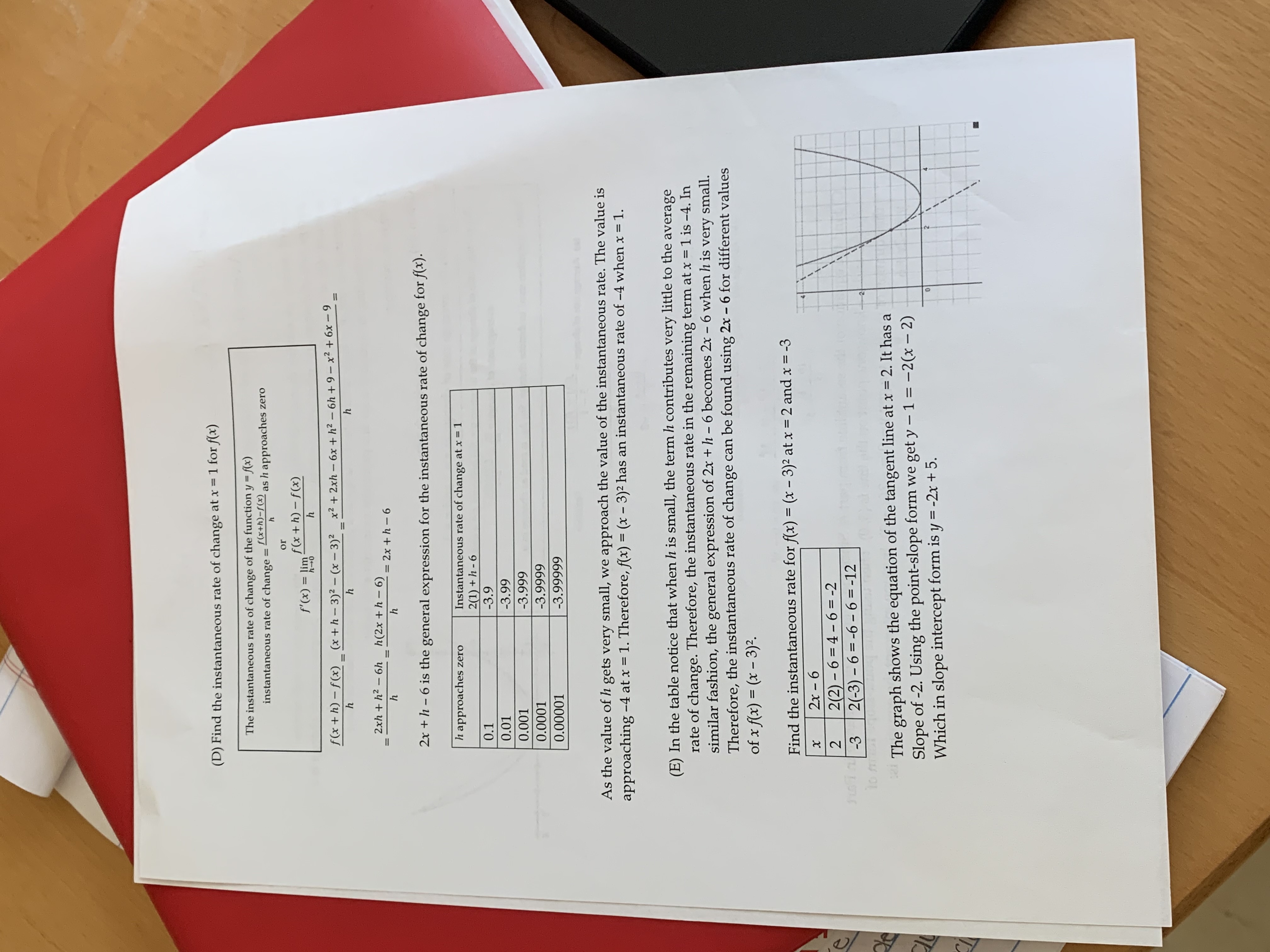
Average rate of change vs Instantaneous rate of change Rates of change are a major theme in differential calculus. In this project you will review average rate of change and work with instantaneous rate of change. Average rate of change is a measure of how much the function changed per unit, on average, over that interval. Instantaneous rate of change is the rate of change at a particular instant, which is like a policeman finding the speed of a car at a particular moment using radar. Here is an example: Given f(x) = (x - 3)2, whose graph is shown. (A) Find the average rate of change at x = 1 and x = 3 The average rate of change of the function y = f(x) between x = a and x = b is: average rate of change = Ay = [(b)-f(a) b-a Note: A is often used to denote change. So, Ay, is read as change in y. (a) Average rate of change = f(3) - f(1) 3 - 1 Definition (3-3)2 - (1 -3)2 3- 1 Use f(x) = (x- 3)2 0 - 4 =-2 GIC (B) Find the average rate of change at x = 4 and x = 7 (b) Average rate of change = 1(7) - 1(4) 7 - 4 Definition (7- 3)2- (4- 3)2 7 - 4 Use fux ) = (x - 3) 16 - 1 (C) Find the equation of the secant line from part A. Since the average rate of change in Part A is -2 and we know one point on the line is (3, 0). Then using the point-slope form of the equation of the line we get: y - 0 = -2(x - 3). In slope-intercept the equation is: y = - 2x + 6(D) Find the instantaneous rate of change at x = 1 for f(x) The instantaneous rate of change of the function y = f(x) instantaneous rate of change = [(th)-1 as h approaches zero or f'(x) = lim- im f(xth ) - f(x ) f ( x + h) - f(x)_(x+ h - 3)2 - (x - 3)2 x2 +2xh - 6x + h2 -6h+9-x2+6x-9_ h 2xh+ h2 - 6h_h(2x+h -6)=2x+h-6 2x + h - 6 is the general expression for the instantaneous rate of change for f(x). h approaches zero Instantaneous rate of change at x = 1 2(1) + h - 6 0.1 -3.9 0.01 -3.99 0.001 -3.999 0.0001 -3.9999 0.00001 -3.99999 As the value of h gets very small, we approach the value of the instantaneous rate. The value is approaching -4 at x = 1. Therefore, f(x) = (x - 3)2 has an instantaneous rate of -4 when x = 1. (E) In the table notice that when h is small, the term h contributes very little to the average rate of change. Therefore, the instantaneous rate in the remaining term at x = 1 is -4. In similar fashion, the general expression of 2x + h - 6 becomes 2x - 6 when h is very small. Therefore, the instantaneous rate of change can be found using 2x - 6 for different values of x f(x) = (x-3)2. Find the instantaneous rate for f(x) = (x - 3)2 at x = 2 and x = -3 x 2x - 6 2 2(2) - 6=4-6=-2 - 3 2(-3)-6=-6-6=-12 The graph shows the equation of the tangent line at x = 2. It has a Slope of -2. Using the point-slope form we get y - 1 = -2(x - 2) Which in slope intercept form is y = -2x + 5.Activity 1 1. Given A(x) = x2 a. Find the average rate of change at x = -1 and x = 2. b. Find the instantaneous rate at x = 1. c. What is the expression to find the instantaneous rate for f(x) at any x value? d. Using part a, find the equation of the secant line. Activity 2 1. Given f(x) = ex a. Find the average rate of change at x = 0 and x = 1. Leave your answer in terms of b. Find the instantaneous rate at x = 1. c. What is the expression to find the instantaneous rate for f(x) at any x value? d. Using part c, find the equation of the tangent line at x = 1. Leave your answer in terms of e. Activity 3 1. A ball is thrown straight up from a rooftop with an initial height of 160 feet and an initial velocity of 48 feet per second. Write a quadratic equation that models this situation. Recall that s(t) = -1612 - dot + ho vo is the initial velocity and ho is the initial height. 2. The ball misses the rooftop on its way down and falls to the ground. Find the instantaneous velocity (rate) of the ball at t = 2 seconds. 3. When is the instantaneous rate of change of the ball equal to zero
Step by Step Solution
There are 3 Steps involved in it
1 Expert Approved Answer
Step: 1 Unlock
Question Has Been Solved by an Expert!
Get step-by-step solutions from verified subject matter experts
Step: 2 Unlock
Step: 3 Unlock
Students Have Also Explored These Related Mathematics Questions!









 Study Help