







Question: I need help with all please. Please help ASAP! Thank you so much! The following algorithm takes an unsorted list of positive integers, along with
 I need help with all please. Please help ASAP! Thank you so much!
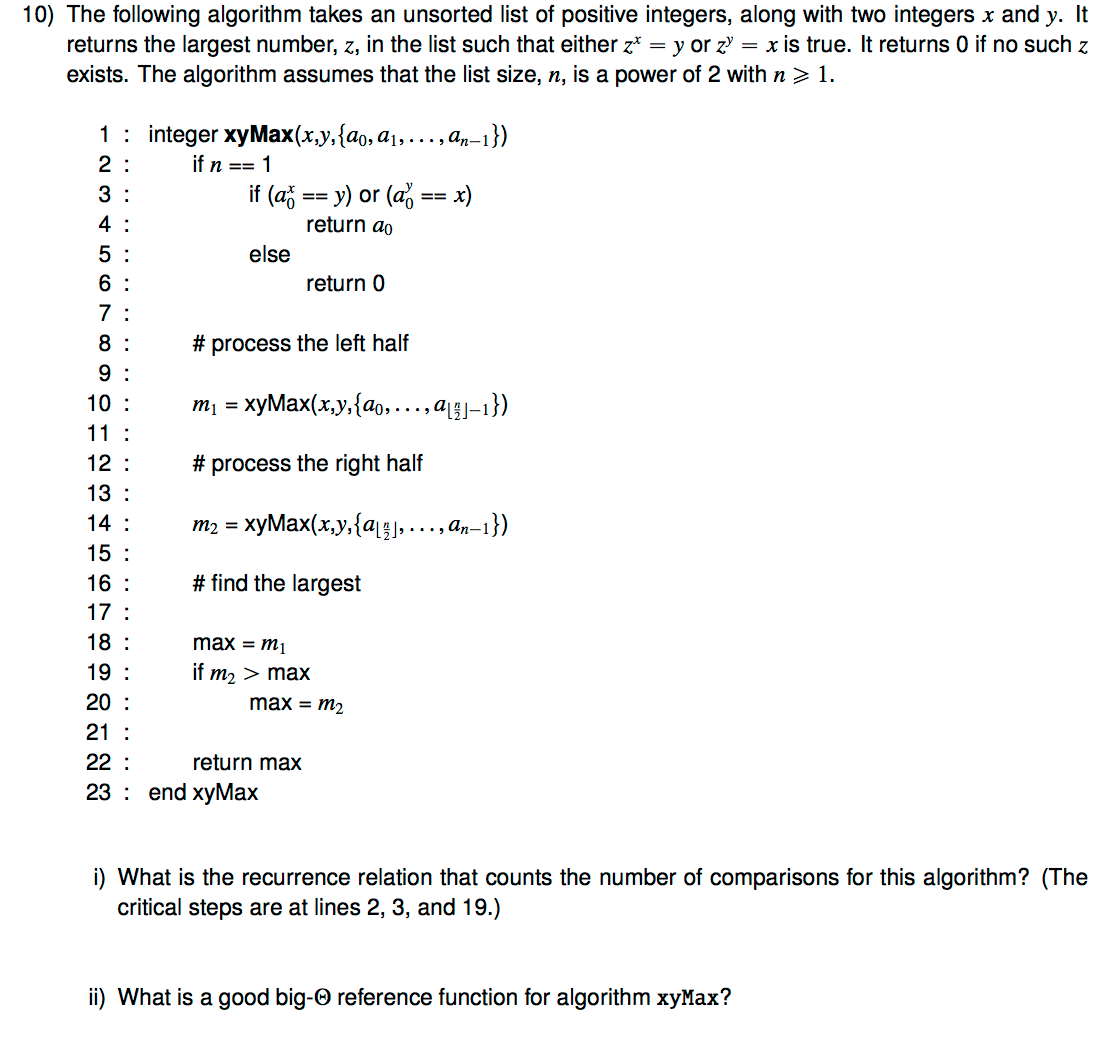
The following algorithm takes an unsorted list of positive integers, along with two integers x and y. It returns the largest number, z, in the list such that either z^x = y or z^y = x is true. It returns 0 if no such z exists. The algorithm assumes that the list size, n, is a power of 2 with n ge 1. integerxyMax(x,y,{a_0,a_1,...,a-n-1}) if n == 1 if (a_0^x == y) or (a_0^y == x) return a_0 else return 0 # process the left half m_1 = xyMax(x,y,{a_0,...a_[n/2]-1}) # process the right half m_2 = xyMax(x,y,{a[n/2],...,an-1}) # find the largest max = m_1 if m_2 > max max = m_2 return max end xyMax What is the recurrence relation that counts the number of comparisons for this algorithm? (The critical steps are at lines 2, 3, and 19.) What is a good big-Theta reference function for algorithm xyMax
Step by Step Solution
There are 3 Steps involved in it

Get step-by-step solutions from verified subject matter experts
 Study Help