







Question: I need help with answering this question. Provide a recommendation of the company, including a discussion of the strengths and risks of the companys financial
I need help with answering this question. Provide a recommendation of the company, including a discussion of the strengths and risks of the companys financial position based on analysis, integrated concepts, and data?
Late in 2018, Felix Machine Company (FMC) management was considering expansion of the companys international business activities. FMC is a South Carolinabased manufacturer of compound machines for use in industrial equipment. FMCs worldwide market was supplied from subsidiaries in France, Brazil, and Taiwan, as well as from the United States. The company was particularly successful in Asia, mainly due to the high quality of its products, its technical expertise, and excellent after-sale service. This success led corporate management to consider the feasibility of further expansion of its business in the Asian region.
FMCs Taiwanese subsidiary assembled and distributed machines and had limited manufacturing capability so that it could undertake special adaptations required. The Taiwanese subsidiary had been urging corporate management to expand its manufacturing capacity for several years. However, an alternative scenario appeared more promising. The Indian economy, with its liberalized economic policies, was growing at annual rates much page 440higher than those of many industrialized countries. Further, India had considerably lower labor costs and certain government incentives that were not available in Taiwan. Therefore, FMCs corporate management chose to first consider India for its Asian expansion and had a 4-year investment project proposal The cash expenditure for operating expenses, excluding interest payments, would be Rs 44 million in Year 1. This amount was expected to increase at a rate of 8 percent per year. The Indian subsidiary would be expected to pay a royalty of Rs 20 million to the parent company at the end of each of the four years. In addition, in those years in which the subsidiary generated a profit, it would pay a dividend to FMC equal to 100 percent of net earnings. Through negotiation with the Indian government, the subsidiary would be exempt from Indian corporate income taxes and withholding taxes on payments made to the parent company. Royalties received from the Indian subsidiary would be fully taxable in the United States at the U.S. corporate tax rate of 21 percent. Dividends received from the Indian subsidiary would be exempt from U.S. taxation. Assuming the project proposal is accepted, FMC expects to be able to sell the Indian subsidiary at the end of the fourth year for its salvage value. FMC also expects to be able to repatriate to the parent the cash balance at the end of Year 4. The cash balance will be equal to the difference between the aggregate amount of cash from operations generated by the subsidiary and the aggregate amount of dividends paid to FMC, after paying back the local bank loan, plus salvage value. The repatriated cash balance will be taxed in the United States at 21 percent only if there is a gain after deducting the cost of the original investment.prepared by the chief financial officers staff.
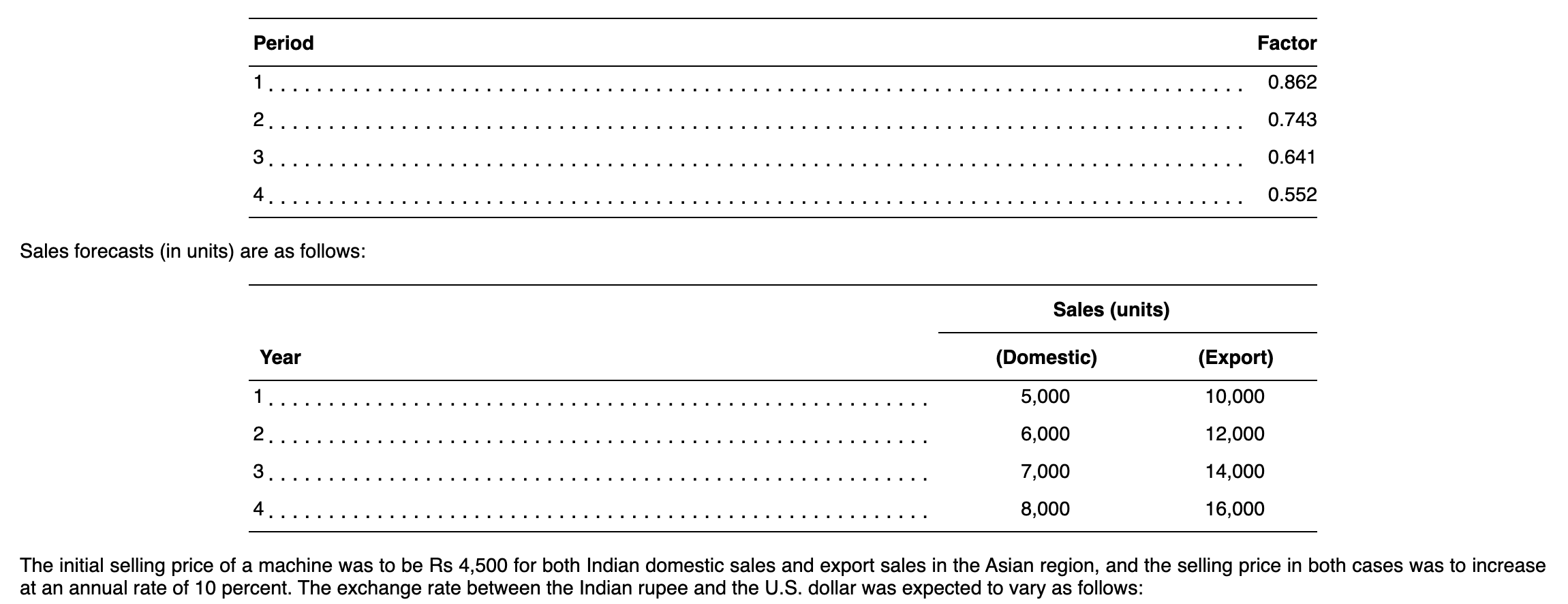
The proposal involved establishing a wholly-owned subsidiary in India that would produce machines for the Indian domestic market as well as for export to other Asian countries. The initial equity investment would be $1.5 million, equivalent to 67.5 million Indian rupees (Rs) at the exchange rate of Rs 45 to the U.S. dollar. (Assume that the Indian rupee is freely convertible, and there are no restrictions on transfers of foreign exchange out of India.) An additional Rs 27 million would be raised by borrowing from a commercial bank in India at an interest rate of 10 percent per annum. The principal amount of the bank loan would be payable in full at the end of the fourth year. The combined capital would be sufficient to purchase plant and equipment of $1.8 million and would cover other initial expenditures, including working capital. The cost of equipment installation would be $15,000, with another $5,000 for testing. No additional working capital would be required during the 4-year period. The plant was expected to have a salvage value of Rs 10 million at the end of four years. Straight-line depreciation would be applied to the original cost of the plant. The firms overall marginal after-tax cost of capital was about 12 percent. However, because of the higher risks associated with an Indian venture, FMC decided that a 16 percent discount rate would be applied in evaluating the potential project. Present value factors at 16 percent are as follows:

Results
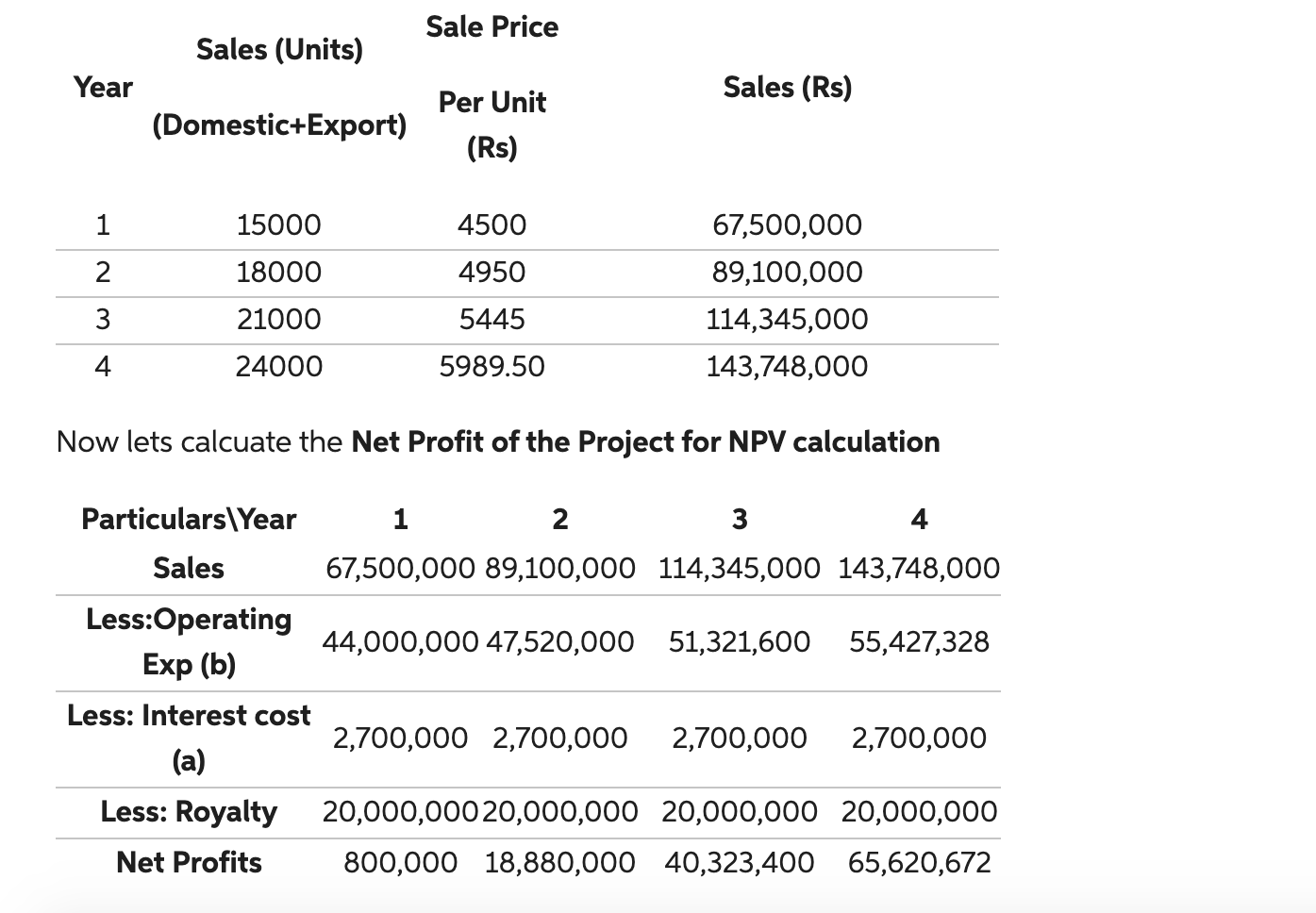
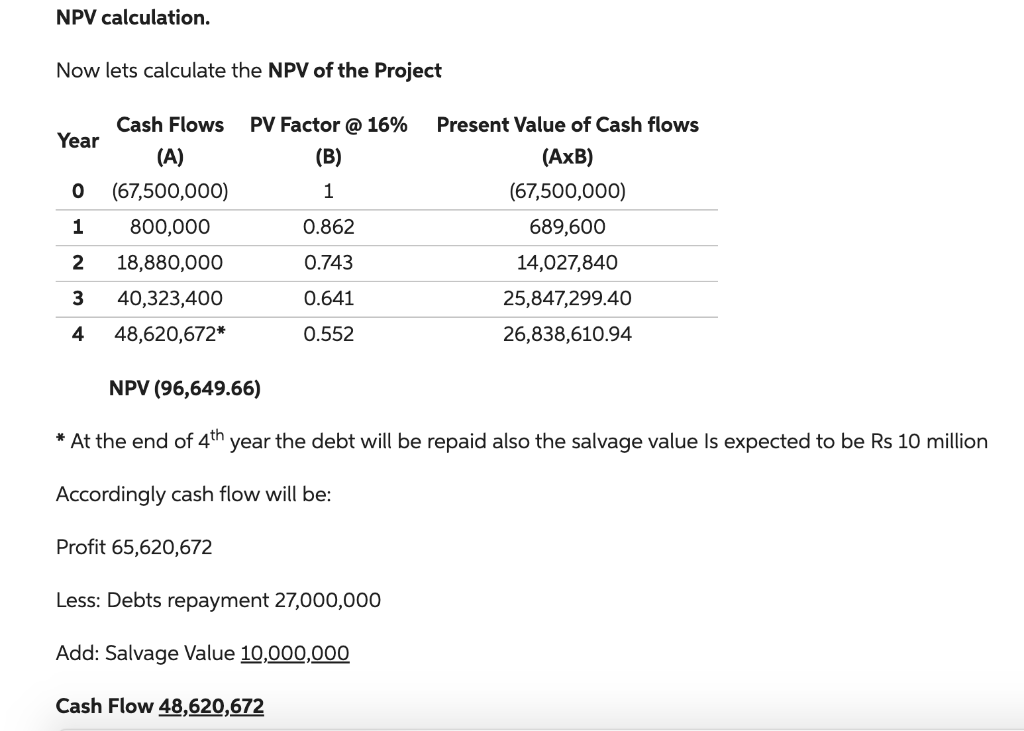
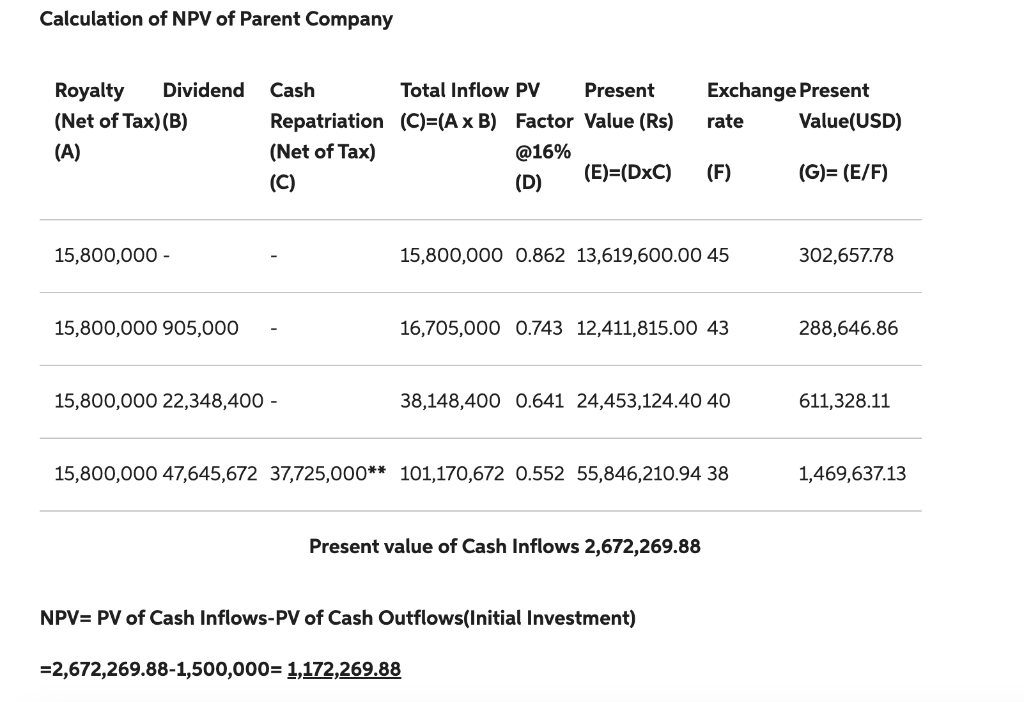
Sales forecasts (in units) are as follows: December 31 , Year 1. Rs 45 per U.S. dollar December 31, Year 2 Rs 43 per U.S. dollar December 31, Year 3 Rs 40 per U.S. dollar December 31, Year 4 Rs 38 per U.S. dollar Now lets calcuate the Net Profit of the Project for NPV calculation NPV calculation. Now lets calculate the NPV of the Project NPV (96,649.66) At the end of 4th year the debt will be repaid also the salvage value Is expected to be Rs 10 million Accordingly cash flow will be: Profit 65,620,672 Less: Debts repayment 27,000,000 Add: Salvage Value 10,000,000 Cash Flow 48,620,672 Calculation of NPV of Parent Company Present valt NPV= PV of Cash Inflows-PV of Cash Out =2,672,269.881,500,000=1,172,269.88
Step by Step Solution
There are 3 Steps involved in it

Get step-by-step solutions from verified subject matter experts
 Study Help