







Question: I need help with Case question 11.2, cumulative case question 1, please! Born in Taiwan, Lisa Su's family emigrated to the United States in 1972
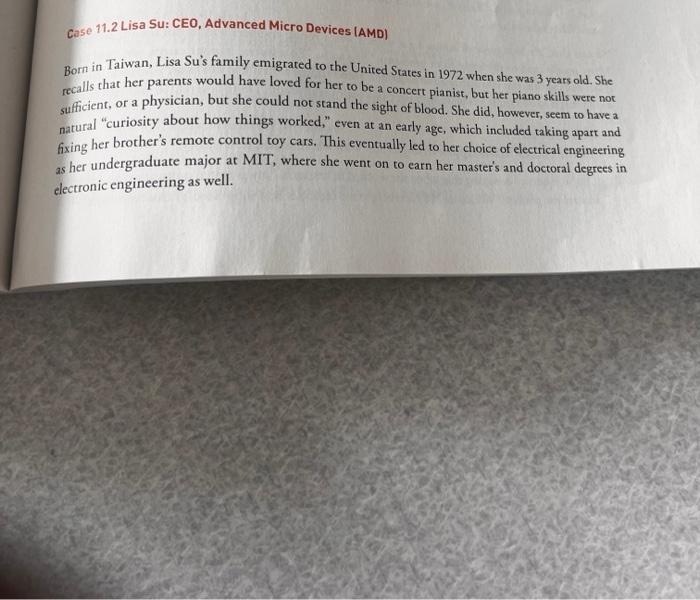
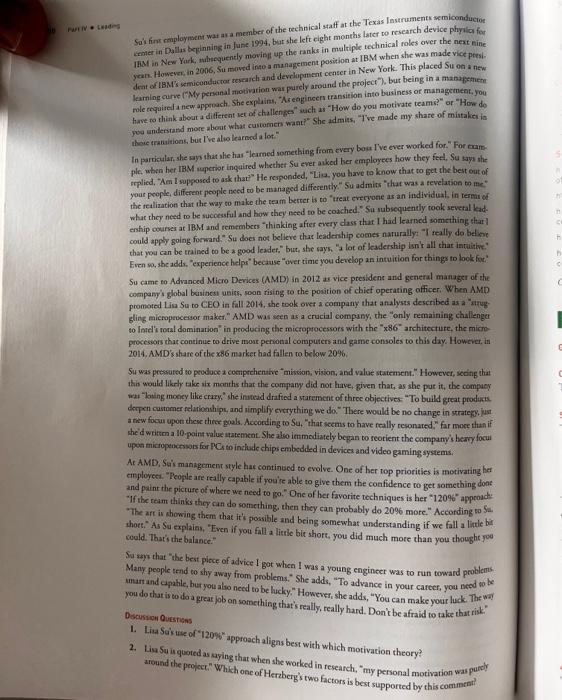
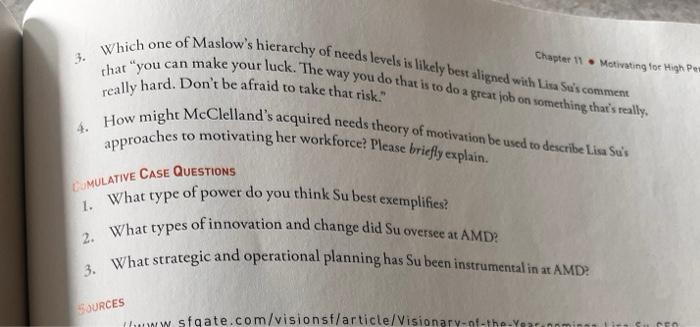
Born in Taiwan, Lisa Su's family emigrated to the United States in 1972 when she was 3 years old. She recalls that her parents would have loved for her to be a concert pianist, but her piano skills were not sufficient, or a physician, but she could not stand the sight of blood. She did, however, seem to have a natural "curiosity about how things worked," even at an early age, which included taking apart and fixing her brother's remote control toy cars. This eventually led to her choice of electrical engineering as her undergraduate major at MIT, where she went on to earn her master's and doctoral degrees in electronic engineering as well. Sol fint conploystent wat ara member of the rechnical staff at the Texas IFM in New York, shrequendly moviegl up the ranks in maltriple technical roles over the next eine yean. Howeves, in 2006, Su mourd into a management position at IBM when she was made vice persi. deat of IBMs semicondtecor tescarch and devclopment censer in New York. This placed Su on a new mole crquircla new approach. She explains, "As eagincen transition inte business or managetment, you have to think abeat 1 different uet of challenges" wach as "How do you motivate teams?" of "How do you undestasd more about what custamen wat?" She admits. "Tve made my share of mintakes in thoce iranitions, but live alwo kerned a lot:" In parricular, she ans that she has "leamed something from every bois Fve ever worked for." For cam:ple, wben her IBM iuperior inguired whether Su ever asked ler employees how they feet, Su syy she mplied, Am l supposed to ask that" He responded, "Lias, you have to know that to get the best out of your people, different people need to be managed differently." Su admits "that was a tevelation on me" the realization that the way to make the ream berter is to "treat ereryone as an individuat, in terma of whe they need to be successful and how they need to be cosched. Su subsequently took several kadeship oxurser at IBM and remembers "thiaking after every dass thar I had learned something ethat] could apply going formand." Su does not believe that leadenhip comes narurallys "T really do betione that you can be trained to be a good leader." burt, she cays, "I lot of leadership isn' all that intaitive." Even w0, she adds, "experience helps" because "over time you derelop an intuition for things to look fore," Su came to Advanced Micro Devices (AMD) in 2012 as vice president and general manuger of the company' global basiacs usies, soon rising to the position of chief operating officer. When AMD promoted Lis Su to CEO in fall 2014, she took over a company that analysts described as a "strug. gling microprocessor makes." AMD was seen as a crucial compuny, the "only remaining challenger to Indtronal domination" in producing the microprocessors with the " 86 " anchitecture, the micosproceswors that continue to drive most pernotal computers and game consoles to chis day. However, in 2014, AMDs share of the x86 marker had fallen to below 20%. Su was pressured to prodoce x comprechenathe "mition, vision, and value statement." However, secing that this would likrly take six manths that the company did not have, given that, as she put it, the compaey wat "loing moecy like crury," she inatedd drafted a starement of threc objectives" "To build great products. derpen castomer felationships, and rimplify evtrything we do. "There would be no change in statepy. jast a thew focur upon these there goals. According to Su, "that scems to have really resonared," far moes than if he'd written a io-point value itatemeat. She also immidiately began to reorient the company's heary focul upen mictopencesors for PCs to include chips embedded in devices and video gaming systems; At AMD, SGi manigement style hak continesd to evolve. One of her top priorities is motivating her enployeet. "People are really capable if you're able to glve them the confidence to get something doat and paint the pictuse of where we need to go. "One of her favorite techniques is her "120\%" appeasds. "If the ream thinks they can do something, then they can probably do 2096 more." According to 5. "The art is showing them that it' possible and being somewhat understanding if we fall a linte bir thort." As Su explains, "Even if you fall a litric bit shore, you did much mote than you thoughe you could That's the balance?" Su sys that "the best piece of advice I got when I was a young engineer was to run toward problents. Many people tend to shy away from problems," She adds, "To advance in your career, you need so ke imurtand cupatile, hut you also need to be lucky." However, she adds, "You can make your luck. The was you do that is to do a great job an something that's really, really hard. Don't be afraid to take that rik." Dscusuon Questoqs 2. Liu Su is quoted as aying that when she worked in research, "my personal motivation was purdy that "you can make your luck. The way you do that is to do a great job on something that's really. really hard. Don't be afraid to take that risk." 4. How might McClelland's acquired needs theory of motivation be used to describe Lisa Su's approaches to motivating her workforce? Please briefly explain. C Mulative Case Questions 1. What type of power do you think Su best exemplifies? 2. What types of innovation and change did Su oversee at AMD? 3. What strategic and operational planning has Su been instrumental in at AMD? 30URCES
Step by Step Solution
There are 3 Steps involved in it

Get step-by-step solutions from verified subject matter experts
 Study Help