







Question: I need help with exercise 4.7 on the picture below. Simple 3:13 PM 45% . Done MathematicsForFinance.pdf the binomial ee del. Suppose that whenever stock
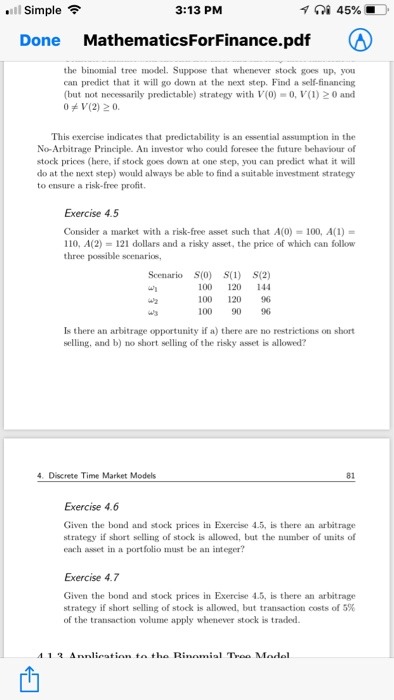
Simple 3:13 PM 45% . Done MathematicsForFinance.pdf the binomial ee del. Suppose that whenever stock goes up, you can predict that it will go down at the next step. Find a self-financing (but not necessarily predictable) strategy with V(0) 0, V(1) 2 0 and This exercise indicates that predictability is an essential assumption in the No-Arbitrage Principle. An investor who could foresee the future behaviour of stock prices (here, if stock goes down at one step, you can predict what it wil do at the next step) would always be able to find a suitable investment strategy to ensure a risk-free profit. Exercise 4.5 Consider a market with a risk-free asset such that A(0) 100, A(1) 110, A(2) 121 dollars and a risky asset, the price of which can follow three possible scenarios, Scenario S(0) S(1) S(2) 100 120 14 100 120 6 100 90 6 Is there an arbitrage opportunity if a) there are no restrictions on short selling, and b) no short selling of the risky asset is allowed? 4. Discrete Time Market Models 81 Exercise 4.6 Given the bond and stock prices in Exercise 4.5, is there an arbitrage strategy if short selling of stock is allowed, but the number of units of each asset in a portfolio must be an integer? Exercise 4.7 Given the bond and stock prices in Exercise 4.5, is there an arbitrage strategy if short selling of stock is allowed, but transaction costs of 5% of the transaction volume apply whenever stock is traded
Step by Step Solution
There are 3 Steps involved in it

Get step-by-step solutions from verified subject matter experts
 Study Help