







Question: I need help with figuring this out. Python Programming Assignment In this comprehensive programming assignment, you will combine the various components of the Python programming
I need help with figuring this out.
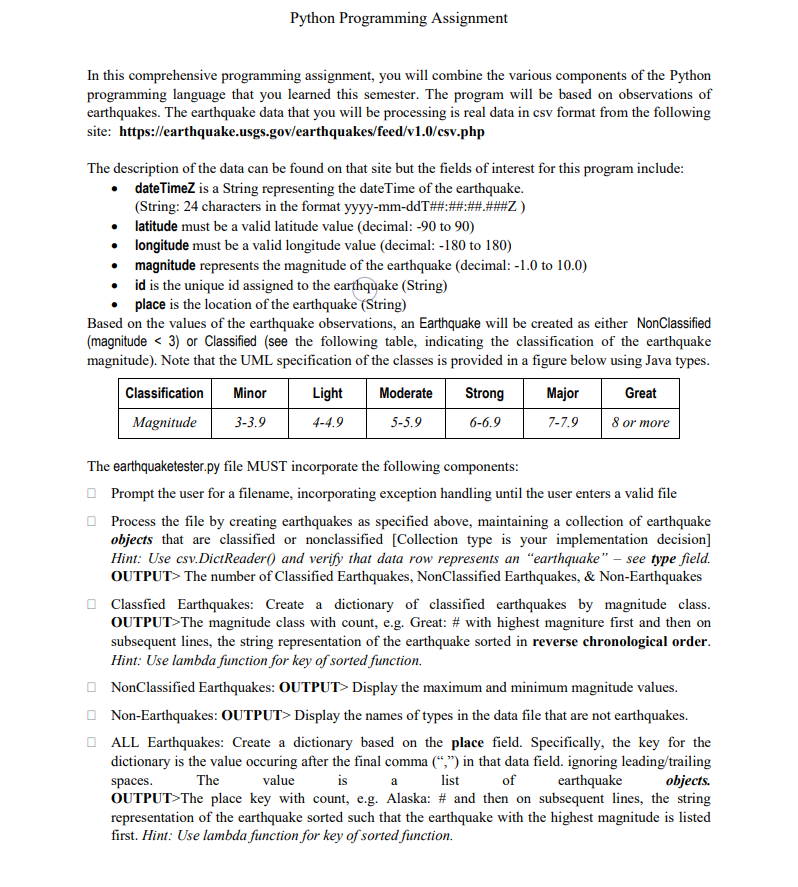
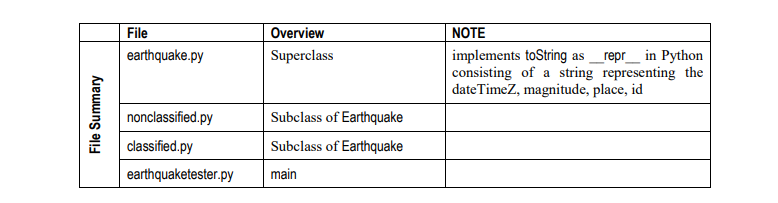
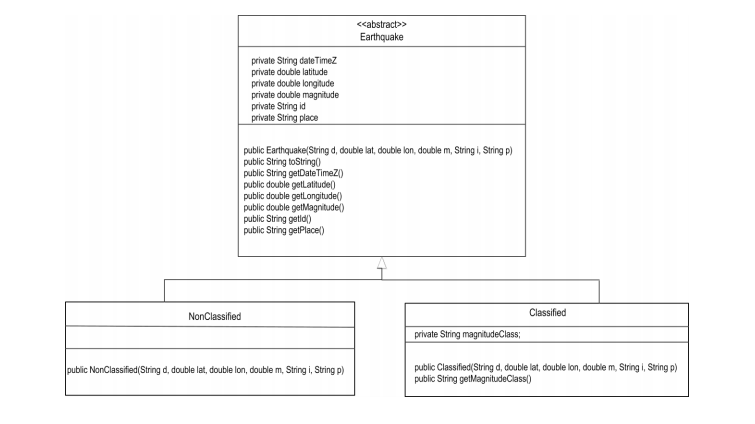
Python Programming Assignment In this comprehensive programming assignment, you will combine the various components of the Python programming language that you learned this earthquakes. The earthquake data that you will be processing is real data in csv format from the following site: https://earthquake.usgs.gov/earthquakes/feed/v1.0/csv.php semester. The program will be based on observations of The description of the data can be found on that site but the fields of interest for this program include dateTimeZ is a String representing the dateTime of the earthquake (String: 24 characters in the format yyyy latitude must be a valid latitude value (decimal: -90 to 90) longitude must be a valid longitude value (decimal: -180 to 180) magnitude represents the magnitude of the earthquake (decimal: 1.0 to 10.0) . . id is the unique id assigned to the earthquake (String) place is the location of the earthquake (String) . Based on the values of the earthquake observations, an Earthquake will be created as either NonClassified (magnitude The number of Classified Earthquakes, NonClassified Earthquakes, & Non-Earthquakes Classfied Earthquakes: Create a dictionary of classified earthquakes by magnitude class OUTPUT-The magnitude class with count, e.g. Great: # with highest magniture first and then on subsequent lines, the string representation of the earthquake sorted in reverse chronological order Hint: Use lambda function for key of sorted fiumction NonClassified Earthquakes: OUTPUT> Display the maximum and minimum magnitude values. Non-Earthquakes: OUTPUT> Display the names of types in the data file that are not earthquakes. ALL Earthquakes: Create a dictionary based on the place field. Specifically, the key for the dictionary is the value occuring after the final comma ("") in that data field. ignoring leading/trailing spaces OUTPUT-The place key with count, eg. Alaska: # and then on subsequent lines, the string representation of the earthquake sorted such that the earthquake with the highest magnitude is listed first. Hint: Use lambda function for key of sorted function. The valuesalist earthquakeobjects. Python Programming Assignment In this comprehensive programming assignment, you will combine the various components of the Python programming language that you learned this earthquakes. The earthquake data that you will be processing is real data in csv format from the following site: https://earthquake.usgs.gov/earthquakes/feed/v1.0/csv.php semester. The program will be based on observations of The description of the data can be found on that site but the fields of interest for this program include dateTimeZ is a String representing the dateTime of the earthquake (String: 24 characters in the format yyyy latitude must be a valid latitude value (decimal: -90 to 90) longitude must be a valid longitude value (decimal: -180 to 180) magnitude represents the magnitude of the earthquake (decimal: 1.0 to 10.0) . . id is the unique id assigned to the earthquake (String) place is the location of the earthquake (String) . Based on the values of the earthquake observations, an Earthquake will be created as either NonClassified (magnitude The number of Classified Earthquakes, NonClassified Earthquakes, & Non-Earthquakes Classfied Earthquakes: Create a dictionary of classified earthquakes by magnitude class OUTPUT-The magnitude class with count, e.g. Great: # with highest magniture first and then on subsequent lines, the string representation of the earthquake sorted in reverse chronological order Hint: Use lambda function for key of sorted fiumction NonClassified Earthquakes: OUTPUT> Display the maximum and minimum magnitude values. Non-Earthquakes: OUTPUT> Display the names of types in the data file that are not earthquakes. ALL Earthquakes: Create a dictionary based on the place field. Specifically, the key for the dictionary is the value occuring after the final comma ("") in that data field. ignoring leading/trailing spaces OUTPUT-The place key with count, eg. Alaska: # and then on subsequent lines, the string representation of the earthquake sorted such that the earthquake with the highest magnitude is listed first. Hint: Use lambda function for key of sorted function. The valuesalist earthquakeobjects
Step by Step Solution
There are 3 Steps involved in it

Get step-by-step solutions from verified subject matter experts
 Study Help