







Question: I need help with my essay, How does exercise improve mental health? The intro I've only one is: Everyday, people feel depression, whether it's at
I need help with my essay, "How does exercise improve mental health?" The intro I've only one is:
Everyday, people feel depression, whether it's at work or home. According to the World Health Organization, depression hits 121 million people worldwide, and only 25% people receive treatment. Those with lack of treatment will cause the rise of death by depression to 850 million per year, making it the third largest cause of death in young adults. The main causes of depression include, political conflict, divorce, loss of loved ones, etc. Alcohol drinking, drug misuse, accidents, and death are the symptoms that depression can happen and the list goes on. The only treatment to cure depression is by doing mental health exercise.
The two article that I'm working on is:
Exercise therapy improves mental and physical health in schizophrenia: a randomised controlled trial
https://web-p-ebscohost-com.evcezproxy.evc.edu/ehost/pdfviewer/pdfviewer?vid=0&sid=b6fa5646-8725-41ce-a632-8dbd1238803c%40redis
Exercise can seriously improve your mental health: Fact or fiction?
https://web-p-ebscohost-com.evcezproxy.evc.edu/ehost/pdfviewer/pdfviewer?vid=0&sid=0d649d27-1c41-4df7-9bd3-720fda90ded4%40redis
The rubric that I'm having trouble with is part (My teacher said that it can be more than one paragraph for each article):
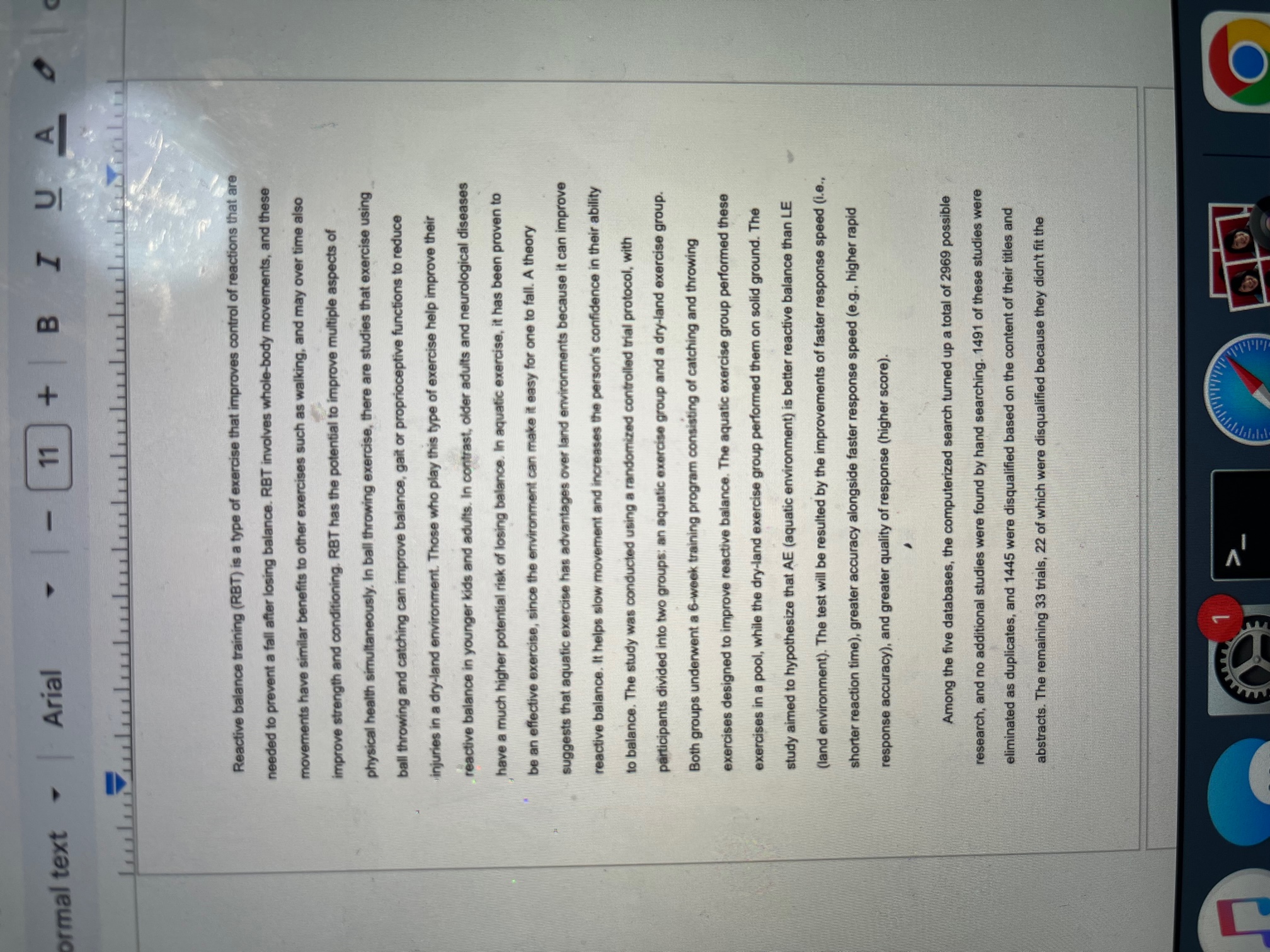
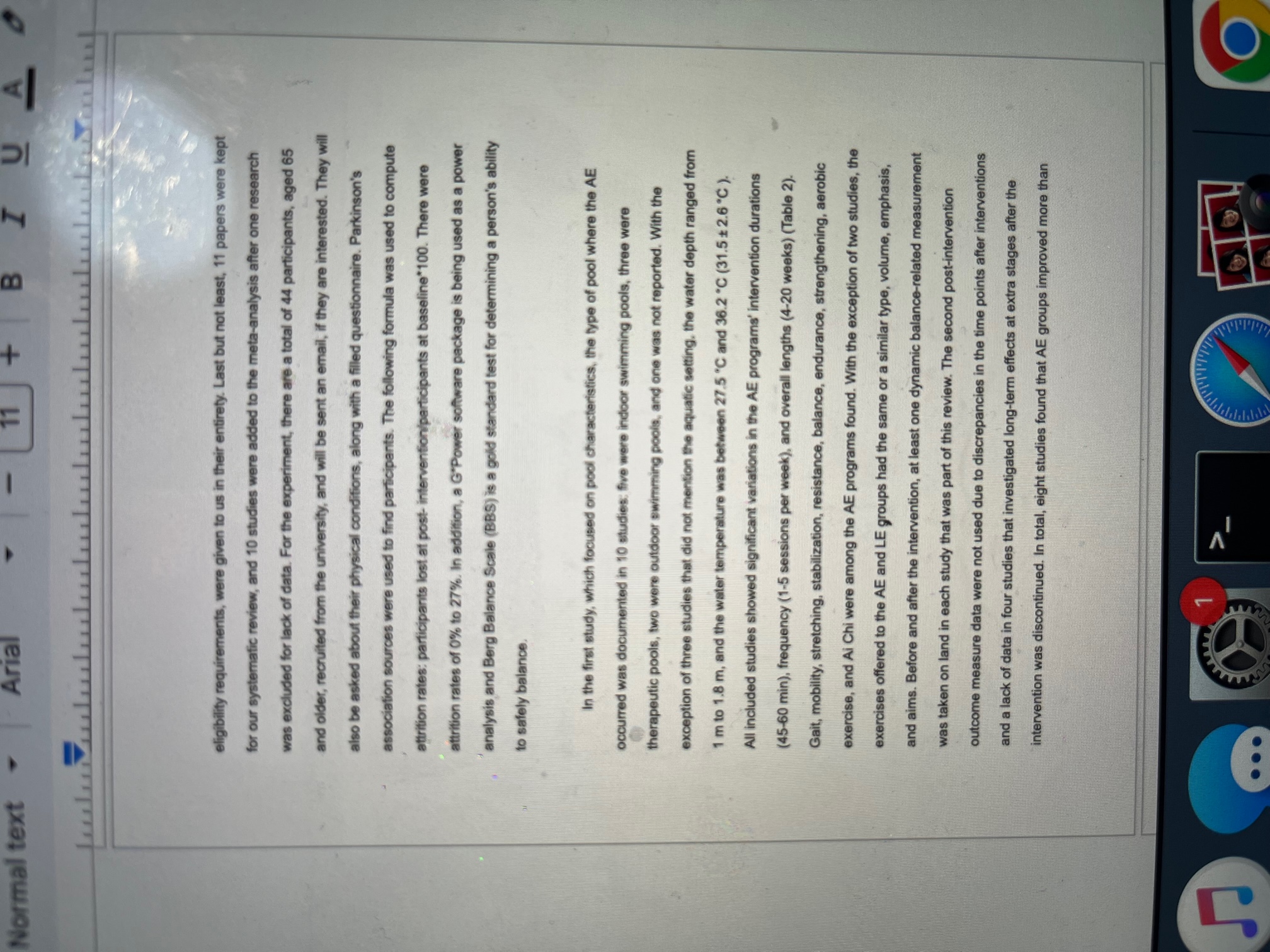

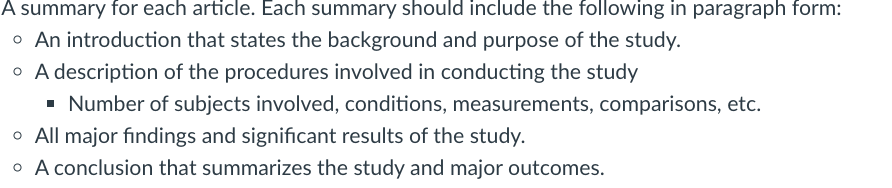
ormal text . Arial 11 + BIUA Reactive balance training (RBT) is a type of exercise that improves control of reactions that are needed to prevent a fall after losing balance. RBT involves whole-body movements, and these movements have similar benefits to other exercises such as walking, and may over time also improve strength and conditioning. RBT has the potential to improve multiple aspects of physical health simultaneously. In ball throwing exercise, there are studies that exercise using ball throwing and catching can improve balance, gait or proprioceptive functions to reduce injuries in a dry-land environment. Those who play this type of exercise help improve their reactive balance in younger kids and adults. In contrast, older adults and neurological diseases have a much higher potential risk of losing balance. In aquatic exercise, it has been proven to be an effective exercise, since the environment can make it easy for one to fall. A theory suggests that aquatic exercise has advantages over land environments because it can improve reactive balance. It helps slow movement and increases the person's confidence in their ability to balance, The study was conducted using a randomized controlled trial protocol, with participants divided into two groups; an aquatic exercise group and a dry-land exercise group. Both groups underwent a 6-week training program consisting of catching and throwing exercises designed to improve reactive balance. The aquatic exercise group performed these exercises in a pool, while the dry-land exercise group performed them on solid ground. The study aimed to hypothesize that AE (aquatic environment) is better reactive balance than LE (land environment). The test will be resulted by the improvements of faster response speed (i.e., shorter reaction time), greater accuracy alongside faster response speed (e.g., higher rapid response accuracy), and greater quality of response (higher score). Among the five databases, the computerized search turned up a total of 2969 possible research, and no additional studies were found by hand searching. 1491 of these studies were eliminated as duplicates, and 1445 were disqualified based on the content of their titles and abstracts. The remaining 33 trials, 22 of which were disqualified because they didn't fit the >Normal text Arial 11 B I U eligibility requirements, were given to us in their entirety. Last but not least, 11 papers were kept for our systematic review, and 10 studies were added to the meta-analysis after one research was excluded for lack of data. For the experiment, there are a total of 44 participants, aged 65 and older, recruited from the university, and will be sent an email, if they are interested. They will also be asked about their physical conditions, along with a filled questionnaire. Parkinson's association sources were used to find participants. The following formula was used to compute attrition rates: participants lost at post- interven cipants at baseline*100. There were attrition rates of 0% to 27%. In addition, a G"Power software package is being used as a power analysis and Berg Balance Scale (BBS) is a gold standard test for determining a person's ability to safely balance. In the first study, which focused on pool characteristics, the type of pool where the AE occurred was documented in 10 studies: five were indoor swimming pools, three were therapeutic pools, two were outdoor swimming pools, and one was not reported. With the exception of three studies that did not mention the aquatic setting, the water depth ranged from 1 m to 1.8 m, and the water temperature was between 27.5 "C and 36.2 "C (31.5 +2.6 "C ). All included studies showed significant variations in the AE programs' intervention durations (45-60 min), frequency (1-5 sessions per week), and overall lengths (4-20 weeks) (Table 2). Gait, mobility, stretching, stabilization, resistance, balance, endurance, strengthening, aerobic exercise, and Ai Chi were among the AE programs found. With the exception of two studies, the exercises offered to the AE and LE groups had the same or a similar type, volume, emphasis, and aims. Before and after the intervention, at least one dynamic balance-related measurement was taken on land in each study that was part of this review. The second post-intervention outcome measure data were not used due to discrepancies in the time points after interventions and a lack of data in four studies that investigated long-term effects at extra stages after the intervention was discontinued. In total, eight studies found that AE groups improved more than >mal text Arial intervention was discontinued. In total, eight studies found that AE groups improved more thats LE groups in at least one dynamic balance outcome measurement, while two studies found no statistically significant differences between AE and LE groups, and one study found that LE groups improved more than AE groups in one outcome measurement. According to the meta-analysis, older adults in the AE groups showed comparable improvements to those in the LE groups in terms of dynamic steady-state balance (SMD = 0.24; 95% CI,.81 to.34), proactive balance (SMD = 0.21; 95% CI,.59 to. 17), and balance test batteries (SMD = 0.24; 95% CI,.50 to.03). In conclusion, AE and LE have equivalent effects on dynamic balance in older persons 65 years of age or older. Hence, AE may be efficiently used as a safer alternative to LE, but the results should be carefully interpreted due to the small number of studies and possibility of bias. More studies with longer-term outcome measurements are required, taking into account clinical applications, to clarify effective AE procedures on balance and falls. What I learn from this is that those in aquatic environments have a better reactive balance control than those in a land environment for older adults, who are always exposed to the risk of falls. In addition, AE will be used as an effective, alternative balance training to improve their daily life. This study can assist future applications by knowing what exercise is best for aging individuals who want to improve in balance and prevent falls. The conflict of interest in this experiment is that although AE is better than LE for old people, there are few individuals who still want to play on the land environment to improve their reactive balance. This is so that they can at least try to practice their reactive balance control, so that in the future, they don't have to worry much about potential risk of fall. . . OA summary for each article. Each summary should include the following in paragraph form: o An introduction that states the background and purpose of the study. o A description of the procedures involved in conducting the study Number of subjects involved, conditions, measurements, comparisons, etc. All major findings and significant results of the study. o A conclusion that summarizes the study and major outcomes
Step by Step Solution
There are 3 Steps involved in it

Get step-by-step solutions from verified subject matter experts
 Study Help