







Question: i need help with my MATLAB code. I coded the solution for this one-dimensional heat equation using the Crank-Nicholson method for another problem. How would
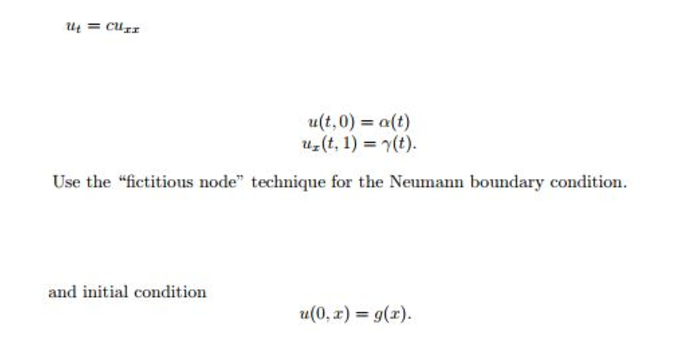
i need help with my MATLAB code. I coded the solution for this one-dimensional heat equation using the Crank-Nicholson method for another problem. How would I adjust my code to solve the one-dimensional heat equation using the fictittious node (implicit method) method? I included my code below question. Hopefully it helps. The boundary conditions are below the heat equation and there is also an initial condition to include.
clear;
n = 4; %sub intervals in the x dimension dt = 0.1; %delta t tsteps = 5; cst = 0.5;
dx = 1; %delta x uL = @(t) t; %left boundary uR = @(t) t+1; %right boundary u0 = @(x) x.^2; %initial condition
gamma = cst*dt/(2*(dx^2)); %change beta to reflect average
A = zeros(n-1,n-1); x = linspace(0,1,n+1); %start, finish, number of points t = linspace(0,tsteps*dt,tsteps+1);
u(1, 1:n+1) = u0(x);
% create a tridiagonal matrix for A % This is not affected by time, only location for j = 1:n-1 A(j,j) = 1+2.*gamma; A(j,j+1) = -gamma; A(j+1,j) = -gamma; end a = diag(A); b = diag(A,1); c = diag(A,-1);
% Delete extra row and column A(n,:) = []; A(:,n) = [];
% This bad boy fills in all of our intial values % includes boundary conditions % We need to populate the middle using the matrices for m = 1:tsteps u(m+1,1) = uL(t(m+1)); % Gives us all left hand values u(m+1,n+1) = uR(t(m+1)); % Gives us all right hand values for d =2:n R(m,d-1) = gamma.*u(m,d-1)+(1-2.*gamma).*u(m,d)+gamma.*u(m,d+1)
end fuck(m) = gamma.*uL(t(m+1)); tits(m) = gamma.*uR(t(m+1)); R1(m) = R(m,1) + fuck(m); RM(m) = R(m,3) + tits(m); k = [R1(m),R(m,2),RM(m)]'; unew=tridfun(a,b,c,k)';
u(m+1,2:4) = unew(1,:)' end
contourf (x,t,u); colorbar; xlabel('space'); ylabel('time');
u(t,0)(t) ux(t, 1) = (t). Use the "fictitious node technique for the Neumann boundary condition and initial condition a(0, z) = g(z). u(t,0)(t) ux(t, 1) = (t). Use the "fictitious node technique for the Neumann boundary condition and initial condition a(0, z) = g(z)
Step by Step Solution
There are 3 Steps involved in it

Get step-by-step solutions from verified subject matter experts
 Study Help