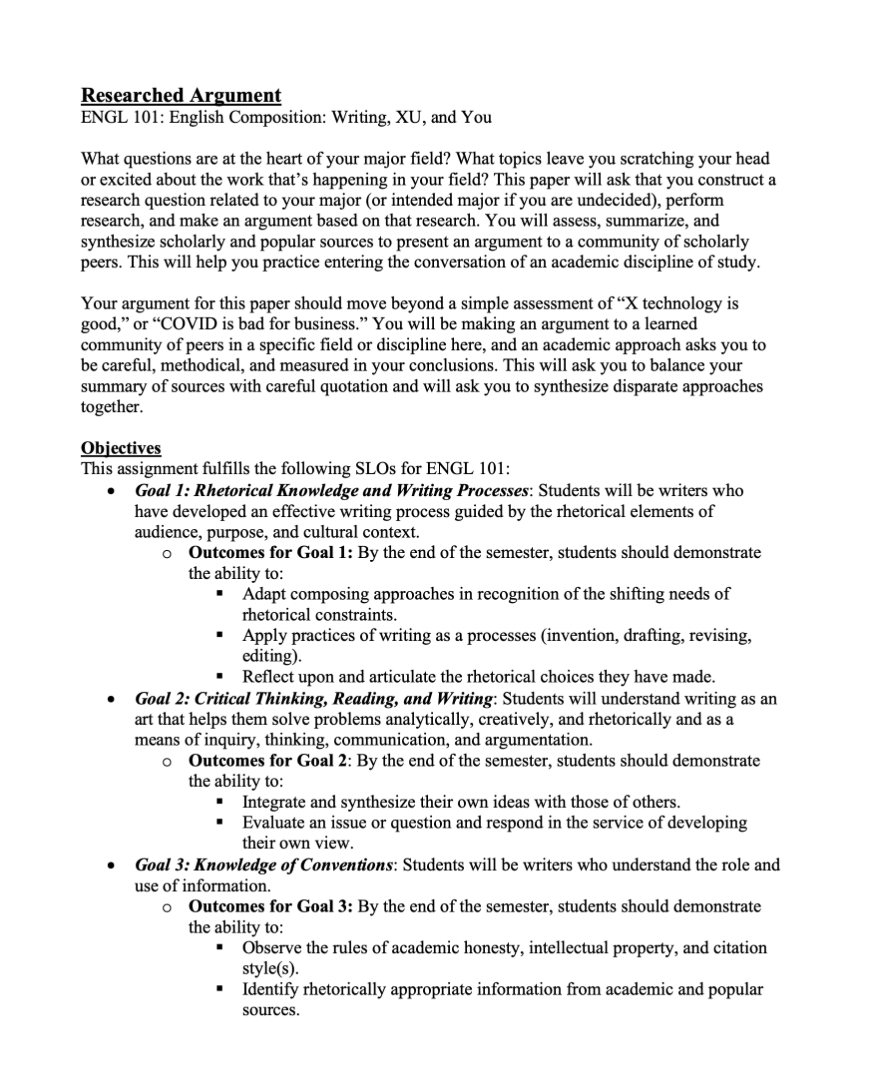
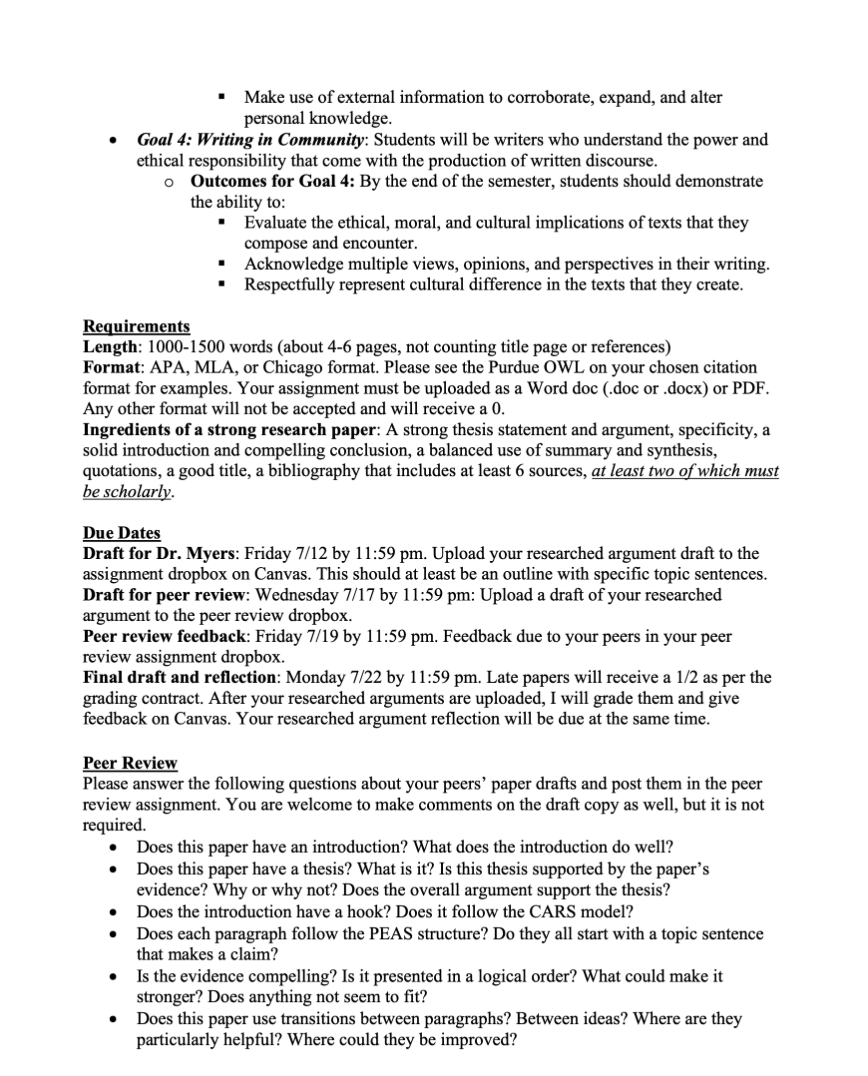
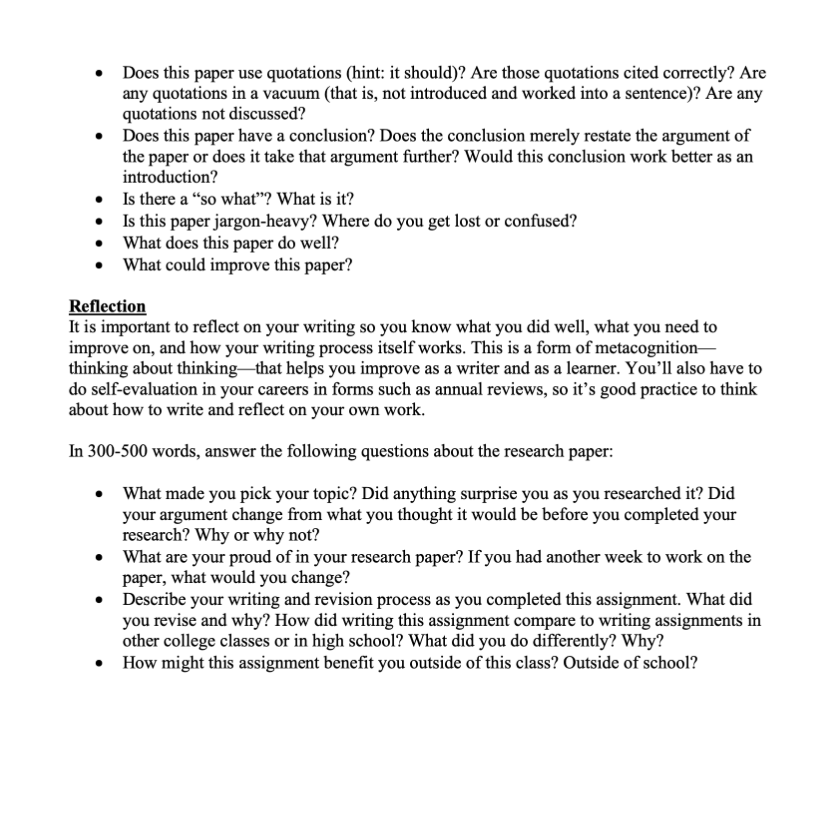
Researched Argument ENGL 101: English Composition: Writing, XU, and You What questions are at the heart of your major field? What topics leave you scratching your head or excited about the work that's happening in your field? This paper will ask that you construct a research question related to your major (or intended major if you are undecided), perform research, and make an argument based on that research. You will assess, summarize, and synthesize scholarly and popular sources to present an argument to a community of scholarly peers. This will help you practice entering the conversation of an academic discipline of study. Your argument for this paper should move beyond a simple assessment of \"X technology is good,\" or \"COVID is bad for business.\" You will be making an argument to a learned community of peers in a specific field or discipline here, and an academic approach asks you to be careful, methodical, and measured in your conclusions. This will ask you to balance your summary of sources with careful quotation and will ask you to synthesize disparate approaches together. Objectives This assignment fulfills the following SLOs for ENGL 101: * Goal I: Rhetorical Knowledge and Writing Processes: Students will be writers who have developed an effective writing process guided by the rhetorical elements of audience, purpose, and cultural context. o Outcomes for Goal 1: By the end of the semester, students should demonstrate the ability to: Adapt composing approaches in recognition of the shifting needs of rhetorical constraints. = Apply practices of writing as a processes (invention, drafting, revising, editing). Reflect upon and articulate the rhetorical choices they have made. * Goal 2: Critical Thinking, Reading, and Writing: Students will understand writing as an art that helps them solve problems analytically, creatively, and rhetorically and as a means of inquiry, thinking, communication, and argumentation. o Outcomes for Goal 2: By the end of the semester, students should demonstrate the ability to: = Integrate and synthesize their own ideas with those of others. = Evaluate an issue or question and respond in the service of developing their own view. * Goal 3: Knowledge of Conventions: Students will be writers who understand the role and use of information. o Outcomes for Goal 3: By the end of the semester, students should demonstrate the ability to: = Observe the rules of academic honesty, intellectual property, and citation style(s). * [dentify rhetorically appropriate information from academic and popular sources. = Make use of external information to corroborate, expand, and alter personal knowledge. s Goal 4: Writing in Community: Students will be writers who understand the power and ethical responsibility that come with the production of written discourse. o Outcomes for Goal 4: By the end of the semester, students should demonstrate the ability to: * Evaluate the ethical, moral, and cultural implications of texts that they compose and encounter. = Acknowledge multiple views, opinions, and perspectives in their writing. * Respectfully represent cultural difference in the texts that they create. Requirements Length: 1000-1500 words (about 4-6 pages, not counting title page or references) Format: APA, MLA, or Chicago format. Please see the Purdue OWL on your chosen citation format for examples. Your assignment must be uploaded as a Word doc (.doc or .docx) or PDF. Any other format will not be accepted and will receive a 0. Ingredients of a strong research paper: A strong thesis statement and argument, specificity, a solid introduction and compelling conclusion, a balanced use of summary and synthesis, quotations, a good title, a bibliography that includes at least 6 sources, at least two of which must be scholarly. Due Dates Draft for Dr. Myers: Friday 7/12 by 11:59 pm. Upload your researched argument draft to the assignment dropbox on Canvas. This should at least be an outline with specific topic sentences. Draft for peer review: Wednesday 7/17 by 11:59 pm: Upload a draft of your researched argument to the peer review dropbox. Peer review feedback: Friday 7/19 by 11:59 pm. Feedback due to your peers in your peer review assignment dropbox. Final draft and reflection: Monday 7/22 by 11:59 pm. Late papers will receive a 1/2 as per the grading contract. After your researched arguments are uploaded, I will grade them and give feedback on Canvas. Your researched argument reflection will be due at the same time. Peer Review Please answer the following questions about your peers' paper drafts and post them in the peer review assignment. You are welcome to make comments on the draft copy as well, but it is not required. e Does this paper have an introduction? What does the introduction do well? e Does this paper have a thesis? What is it? Is this thesis supported by the paper's evidence? Why or why not? Does the overall argument support the thesis? e Does the introduction have a hook? Does it follow the CARS model? Does each paragraph follow the PEAS structure? Do they all start with a topic sentence that makes a claim? e s the evidence compelling? Is it presented in a logical order? What could make it stronger? Does anything not seem to fit? Does this paper use transitions between paragraphs? Between ideas? Where are they particularly helpful? Where could they be improved? Does this paper use quotations (hint: it should)? Are those quotations cited correctly? Are any quotations in a vacuum (that is, not introduced and worked into a sentence)? Are any quotations not discussed? Does this paper have a conclusion? Does the conclusion merely restate the argument of the paper or does it take that argument further? Would this conclusion work better as an introduction? Is there a \"so what\"? What is it? Is this paper jargon-heavy? Where do you get lost or confused? What does this paper do well? What could improve this paper? Reflection It is important to reflect on your writing so you know what you did well, what you need to improve on, and how your writing process itself works. This is a form of metacognition thinking about thinkingthat helps you improve as a writer and as a learner. You'll also have to do self-evaluation in your careers in forms such as annual reviews, so it's good practice to think about how to write and reflect on your own work. In 300-500 words, answer the following questions about the research paper: What made you pick your topic? Did anything surprise you as you researched it? Did your argument change from what you thought it would be before you completed your research? Why or why not? What are your proud of in your research paper? If you had another week to work on the paper, what would you change? Describe your writing and revision process as you completed this assignment. What did you revise and why? How did writing this assignment compare to writing assignments in other college classes or in high school? What did you do differently? Why? How might this assignment benefit you outside of this class? Outside of school
Step by Step Solution
There are 3 Steps involved in it
1 Expert Approved Answer
Step: 1 Unlock
Question Has Been Solved by an Expert!
Get step-by-step solutions from verified subject matter experts
Step: 2 Unlock
Step: 3 Unlock
Students Have Also Explored These Related Business Writing Questions!









 Study Help