



Question: I need help with parts C, D, and E 108 PART II Planning EXTENDED PROBLEM (3-34) DENISON SPECIALTY HOSPITAL-PART 1 To complete the requirements in
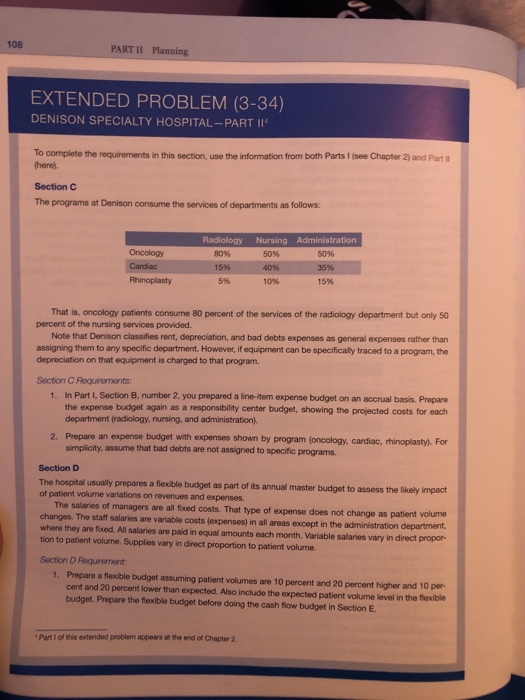
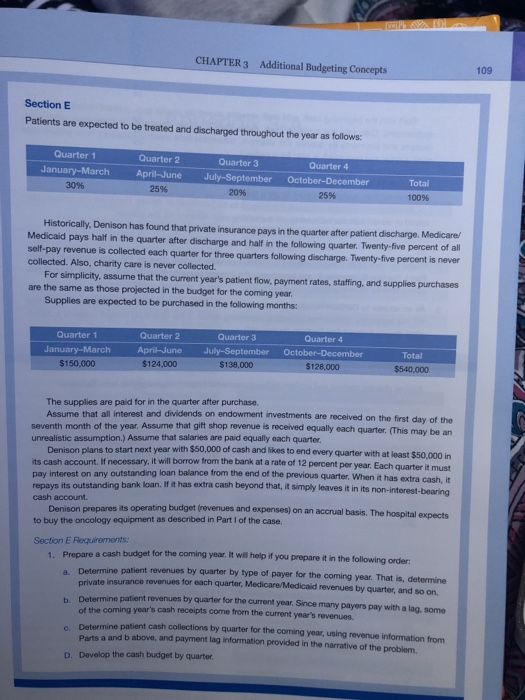
108 PART II Planning EXTENDED PROBLEM (3-34) DENISON SPECIALTY HOSPITAL-PART 1 To complete the requirements in this section, use the information from both Parts I (see Chapter 2) and Parti there) Section C The programs at Denison consume the services of departments as follows: Oncology Cardiac Rhinoplasty Radiology 80% 15% 5%6 Nursing Administration 50% 50% 4096 35% 10% 15% That is, oncology patients consume 80 percent of the services of the radiology department but only 50 percent of the nursing services provided. Note that Denison classifies rent, depreciation, and bad debts expenses as general expenses rather than assigning them to any specific department. However, if equipment can be specifically traced to a program, the depreciation on that equipment is charged to that program. Section Requirements: 1. In Part 1, Section B, number 2. you prepared a line-item expense budget on an accrual basis. Prepare the expense budget again as a responsibility center budget, showing the projected costs for each department (radiology, nursing, and administration). 2. Prepare an expense budget with expenses shown by program (oncology, cardiac, rhinoplasty). For simplicity, assume that bad debts are not assigned to specific programs. Section D The hospital usually prepares a flexible budget as part of its annual master budget to assess the likely impact of patient volume variations on revenues and expenses. The salaries of managers are all faed costs. That type of expense does not change as patient volume changes. The staff salaries are variable costs (expenses) in all areas except in the administration department, where they are fixed. All salaries are paid in equal amounts each month. Variable salaries vary in direct propor- tion to patient volume Supplies vary in direct proportion to patient volume. Section Requirement: 1. Prepare a flexible budget assuming patient volumes are 10 percent and 20 percent higher and 10 per- cent and 20 percent lower than expected. Also include the expected patient volume level in the flexible budget. Prepare the flexible budget before doing the cash flow budget in Section E. Part of this extended problem appears at the end of Chapter 2. CHAPTER 3 Additional Budgeting Concepts 109 Section E Patients are expected to be treated and discharged throughout the year as follows: Quarter 1 January-March 30% Quarter 2 April-June 25% Quarter 3 July-September 20% Quarter 4 October-December 25% Total 100% Historically, Denison has found that private insurance pays in the quarter after patient discharge. Medicare/ Medicaid pays half in the quarter after discharge and half in the following quarter. Twenty-five percent of all self-pay revenue is collected each quarter for three quarters following discharge. Twenty-five percent is never collected. Also, charity care is never collected. For simplicity, assume that the current year's patient flow, payment rates, staffing, and supplies purchases are the same as those projected in the budget for the coming year. Supplies are expected to be purchased in the following months: Quarter 1 January-March $150,000 Quarter 2 April-June $124.000 Quarter 3 July-September $138,000 Quarter 4 October-December $128.000 Total $540,000 The supplies are paid for in the quarter after purchase. Assume that all interest and dividends on endowment investments are received on the first day of the seventh month of the year. Assume that gift shop revenue is received equally each quarter. (This may be an unrealistic assumption.) Assume that salaries are paid equally each quarter. Denison plans to start next year with $50,000 of cash and likes to end every quarter with at least $50,000 in its cash account. If necessary, it will borrow from the bank at a rate of 12 percent per year. Each quarter it must pay interest on any outstanding loan balance from the end of the previous quarter. When it has extra cash, it repays its outstanding bank loan. If it has extra cash beyond that, it simply leaves it in its non-interest-bearing cash account Denison prepares its operating budget (revenues and expenses) on an accrual basis. The hospital expects to buy the oncology equipment as described in Part 1 of the case. Section E Requirements: 1. Prepare a cash budget for the coming year. will help if you prepare it in the following order: Determine patient revenues by quarter by type of payer for the coming year. That is determine private insurance revenues for each quarter Medicare/Medicaid revenues by quarter, and so on. b. Determine patient revenues by quarter for the current year. Since many payers pay with a lag, some of the coming year's cash receipts come from the current year's revenues. c. Determine patient cash collections by quarter for the coming year, using revenue information from Parts a and b above, and payment lag information provided in the narrative of the problem. D. Develop the cash budget by quarter. 108 PART II Planning EXTENDED PROBLEM (3-34) DENISON SPECIALTY HOSPITAL-PART 1 To complete the requirements in this section, use the information from both Parts I (see Chapter 2) and Parti there) Section C The programs at Denison consume the services of departments as follows: Oncology Cardiac Rhinoplasty Radiology 80% 15% 5%6 Nursing Administration 50% 50% 4096 35% 10% 15% That is, oncology patients consume 80 percent of the services of the radiology department but only 50 percent of the nursing services provided. Note that Denison classifies rent, depreciation, and bad debts expenses as general expenses rather than assigning them to any specific department. However, if equipment can be specifically traced to a program, the depreciation on that equipment is charged to that program. Section Requirements: 1. In Part 1, Section B, number 2. you prepared a line-item expense budget on an accrual basis. Prepare the expense budget again as a responsibility center budget, showing the projected costs for each department (radiology, nursing, and administration). 2. Prepare an expense budget with expenses shown by program (oncology, cardiac, rhinoplasty). For simplicity, assume that bad debts are not assigned to specific programs. Section D The hospital usually prepares a flexible budget as part of its annual master budget to assess the likely impact of patient volume variations on revenues and expenses. The salaries of managers are all faed costs. That type of expense does not change as patient volume changes. The staff salaries are variable costs (expenses) in all areas except in the administration department, where they are fixed. All salaries are paid in equal amounts each month. Variable salaries vary in direct propor- tion to patient volume Supplies vary in direct proportion to patient volume. Section Requirement: 1. Prepare a flexible budget assuming patient volumes are 10 percent and 20 percent higher and 10 per- cent and 20 percent lower than expected. Also include the expected patient volume level in the flexible budget. Prepare the flexible budget before doing the cash flow budget in Section E. Part of this extended problem appears at the end of Chapter 2. CHAPTER 3 Additional Budgeting Concepts 109 Section E Patients are expected to be treated and discharged throughout the year as follows: Quarter 1 January-March 30% Quarter 2 April-June 25% Quarter 3 July-September 20% Quarter 4 October-December 25% Total 100% Historically, Denison has found that private insurance pays in the quarter after patient discharge. Medicare/ Medicaid pays half in the quarter after discharge and half in the following quarter. Twenty-five percent of all self-pay revenue is collected each quarter for three quarters following discharge. Twenty-five percent is never collected. Also, charity care is never collected. For simplicity, assume that the current year's patient flow, payment rates, staffing, and supplies purchases are the same as those projected in the budget for the coming year. Supplies are expected to be purchased in the following months: Quarter 1 January-March $150,000 Quarter 2 April-June $124.000 Quarter 3 July-September $138,000 Quarter 4 October-December $128.000 Total $540,000 The supplies are paid for in the quarter after purchase. Assume that all interest and dividends on endowment investments are received on the first day of the seventh month of the year. Assume that gift shop revenue is received equally each quarter. (This may be an unrealistic assumption.) Assume that salaries are paid equally each quarter. Denison plans to start next year with $50,000 of cash and likes to end every quarter with at least $50,000 in its cash account. If necessary, it will borrow from the bank at a rate of 12 percent per year. Each quarter it must pay interest on any outstanding loan balance from the end of the previous quarter. When it has extra cash, it repays its outstanding bank loan. If it has extra cash beyond that, it simply leaves it in its non-interest-bearing cash account Denison prepares its operating budget (revenues and expenses) on an accrual basis. The hospital expects to buy the oncology equipment as described in Part 1 of the case. Section E Requirements: 1. Prepare a cash budget for the coming year. will help if you prepare it in the following order: Determine patient revenues by quarter by type of payer for the coming year. That is determine private insurance revenues for each quarter Medicare/Medicaid revenues by quarter, and so on. b. Determine patient revenues by quarter for the current year. Since many payers pay with a lag, some of the coming year's cash receipts come from the current year's revenues. c. Determine patient cash collections by quarter for the coming year, using revenue information from Parts a and b above, and payment lag information provided in the narrative of the problem. D. Develop the cash budget by quarter
Step by Step Solution
There are 3 Steps involved in it

Get step-by-step solutions from verified subject matter experts