







Question: I need help with problem 3. Problem 1 and 2 given for context. 1. Consider the following share repurchase proposal: BL will use $209 million
I need help with problem 3. Problem 1 and 2 given for context.
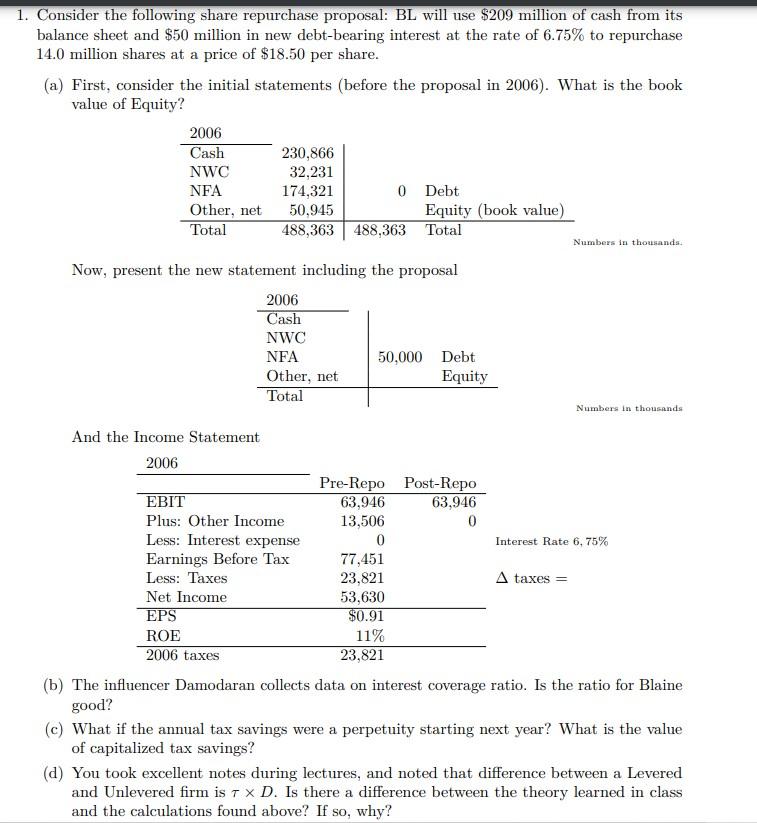
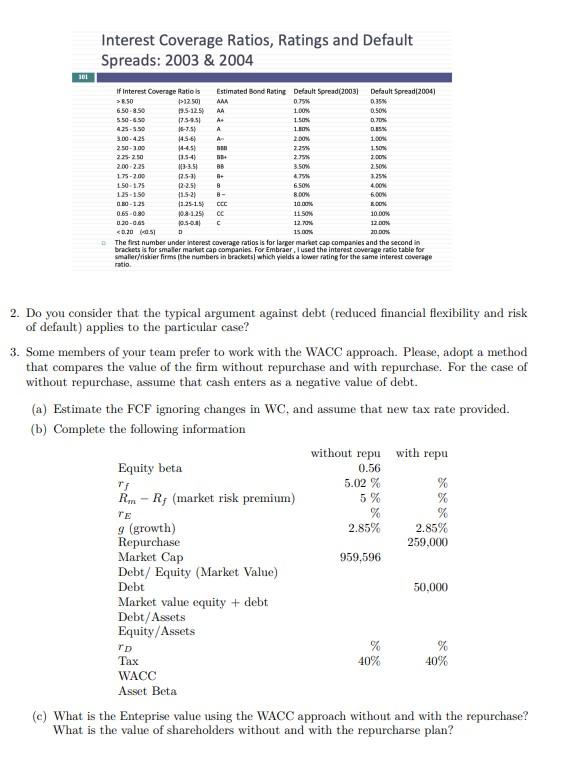
1. Consider the following share repurchase proposal: BL will use $209 million of cash from its balance sheet and $50 million in new debt-bearing interest at the rate of 6.75% to repurchase 14.0 million shares at a price of $18.50 per share. (a) First, consider the initial statements (before the proposal in 2006). What is the book value of Equity? Now, present the new statement including the proposal rs in thousands. Numbers in thousands And the Income Statement (b) The influencer Damodaran collects data on interest coverage ratio. Is the ratio for Blaine good? (c) What if the annual tax savings were a perpetuity starting next year? What is the value of capitalized tax savings? (d) You took excellent notes during lectures, and noted that difference between a Levered and Unlevered firm is D. Is there a difference between the theory learned in class and the calculations found above? If so, why? Interest Coverage Ratios, Ratings and Default Spreads: 2003 \& 2004 2. Do you consider that the typical argument against debt (reduced financial flexibility and risk of default) applies to the particular case? 3. Some members of your team prefer to work with the WACC approach. Please, adopt a method that compares the value of the firm without repurchase and with repurchase. For the case of without repurchase, assume that cash enters as a negative value of debt. (a) Estimate the FCF ignoring changes in WC, and assume that new tax rate provided. (b) Complete the following information (c) What is the Enteprise value using the WACC approach without and with the repurchase? What is the value of shareholders without and with the repurcharse plan? 1. Consider the following share repurchase proposal: BL will use $209 million of cash from its balance sheet and $50 million in new debt-bearing interest at the rate of 6.75% to repurchase 14.0 million shares at a price of $18.50 per share. (a) First, consider the initial statements (before the proposal in 2006). What is the book value of Equity? Now, present the new statement including the proposal rs in thousands. Numbers in thousands And the Income Statement (b) The influencer Damodaran collects data on interest coverage ratio. Is the ratio for Blaine good? (c) What if the annual tax savings were a perpetuity starting next year? What is the value of capitalized tax savings? (d) You took excellent notes during lectures, and noted that difference between a Levered and Unlevered firm is D. Is there a difference between the theory learned in class and the calculations found above? If so, why? Interest Coverage Ratios, Ratings and Default Spreads: 2003 \& 2004 2. Do you consider that the typical argument against debt (reduced financial flexibility and risk of default) applies to the particular case? 3. Some members of your team prefer to work with the WACC approach. Please, adopt a method that compares the value of the firm without repurchase and with repurchase. For the case of without repurchase, assume that cash enters as a negative value of debt. (a) Estimate the FCF ignoring changes in WC, and assume that new tax rate provided. (b) Complete the following information (c) What is the Enteprise value using the WACC approach without and with the repurchase? What is the value of shareholders without and with the repurcharse plan
Step by Step Solution
There are 3 Steps involved in it

Get step-by-step solutions from verified subject matter experts
 Study Help