







Question: I need help with question 13.6! I need the steps in order to understand it better! thanks! 13.6 Hill's operations manager (see Problems 13.3 through
I need help with question 13.6! I need the steps in order to understand it better! thanks!
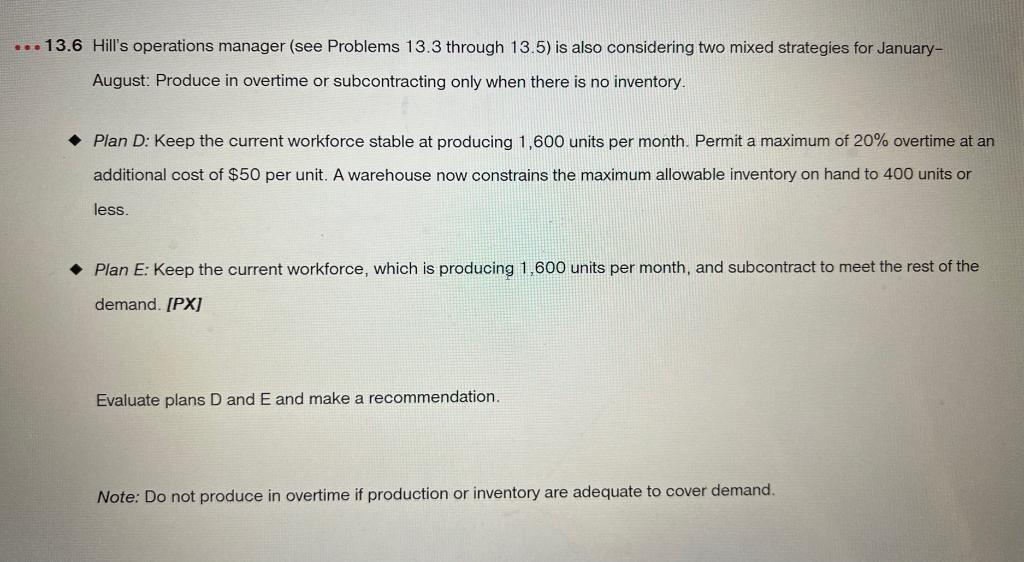
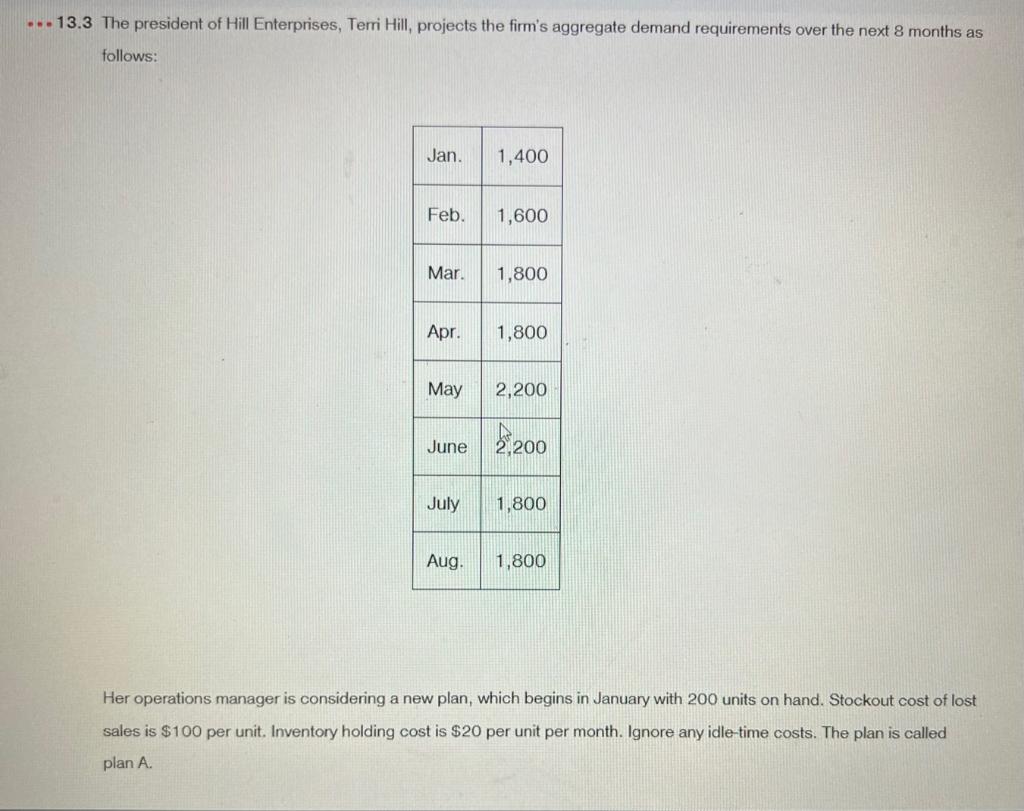
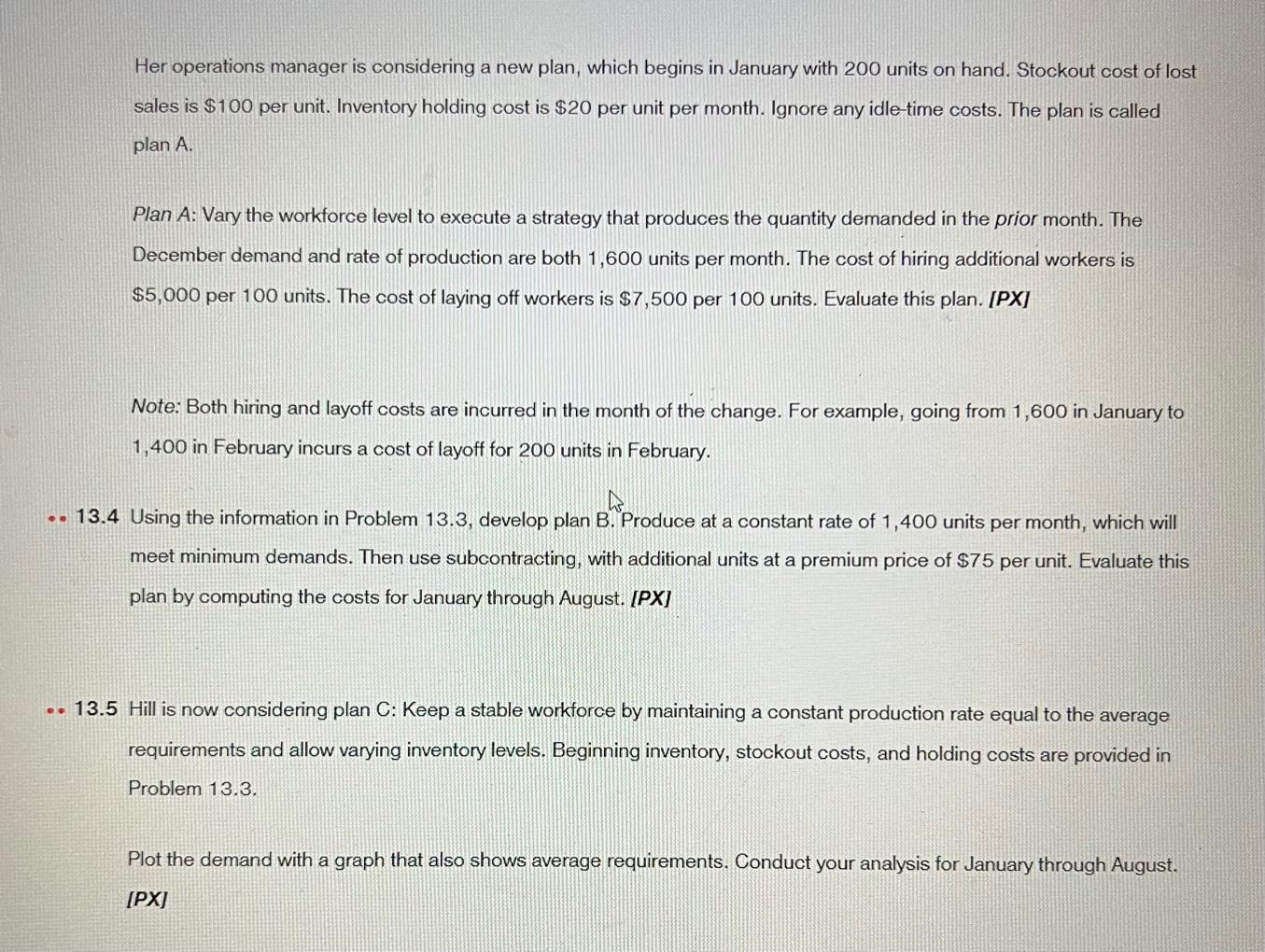
13.6 Hill's operations manager (see Problems 13.3 through 13.5) is also considering two mixed strategies for JanuaryAugust: Produce in overtime or subcontracting only when there is no inventory. Plan D: Keep the current workforce stable at producing 1,600 units per month. Permit a maximum of 20% overtime at an additional cost of $50 per unit. A warehouse now constrains the maximum allowable inventory on hand to 400 units or less. - Plan E: Keep the current workforce, which is producing 1,600 units per month, and subcontract to meet the rest of the demand. [PX] Evaluate plans D and E and make a recommendation. Note: Do not produce in overtime if production or inventory are adequate to cover demand. 13.3 The president of Hill Enterprises, Terri Hill, projects the firm's aggregate demand requirements over the next 8 months as follows: Her operations manager is considering a new plan, which begins in January with 200 units on hand. Stockout cost of lost sales is $100 per unit. Inventory holding cost is $20 per unit per month. Ignore any idle-time costs. The plan is called plan A. Her operations manager is considering a new plan, which begins in January with 200 units on hand. Stockout cost of lost sales is $100 per unit. Inventory holding cost is $20 per unit per month. Ignore any idle-time costs. The plan is called plan A. Plan A: Vary the workforce level to execute a strategy that produces the quantity demanded in the prior month. The December demand and rate of production are both 1,600 units per month. The cost of hiring additional workers is $5,000 per 100 units. The cost of laying off workers is $7,500 per 100 units. Evaluate this plan. [PX] Note: Both hiring and layoff costs are incurred in the month of the change. For example, going from 1,600 in January to 1,400 in February incurs a cost of layoff for 200 units in February. 13.4 Using the information in Problem 13.3, develop plan B. Produce at a constant rate of 1,400 units per month, which will meet minimum demands. Then use subcontracting, with additional units at a premium price of $75 per unit. Evaluate this plan by computing the costs for January through August. [PX] 13.5 Hill is now considering plan C: Keep a stable workforce by maintaining a constant production rate equal to the average requirements and allow varying inventory levels. Beginning inventory, stockout costs, and holding costs are provided in Problem 13.3. Plot the demand with a graph that also shows average requirements. Conduct your analysis for January through August. [PX]
Step by Step Solution
There are 3 Steps involved in it

Get step-by-step solutions from verified subject matter experts
 Study Help