







Question: I need help with Question 1-4 To analyze the effect of a minimum wage increase, a famous study used a quasi-experiment for two adjacent states:
I need help with Question 1-4
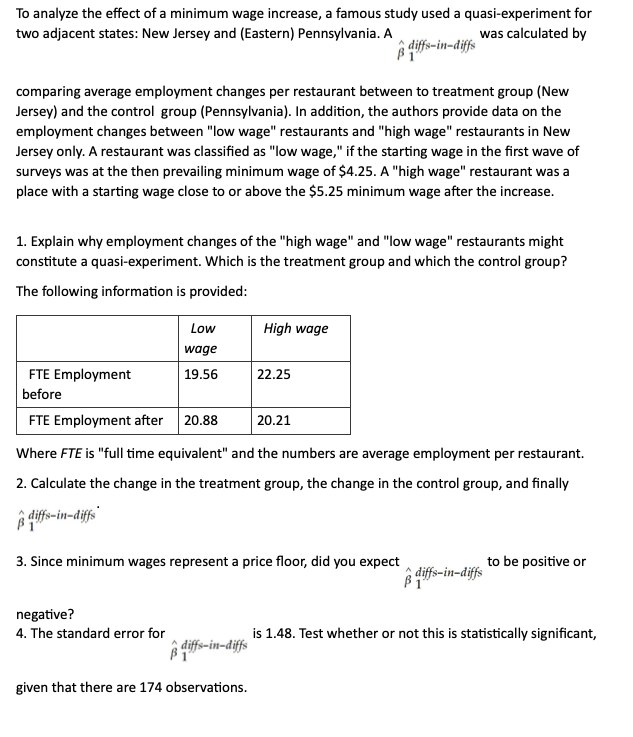
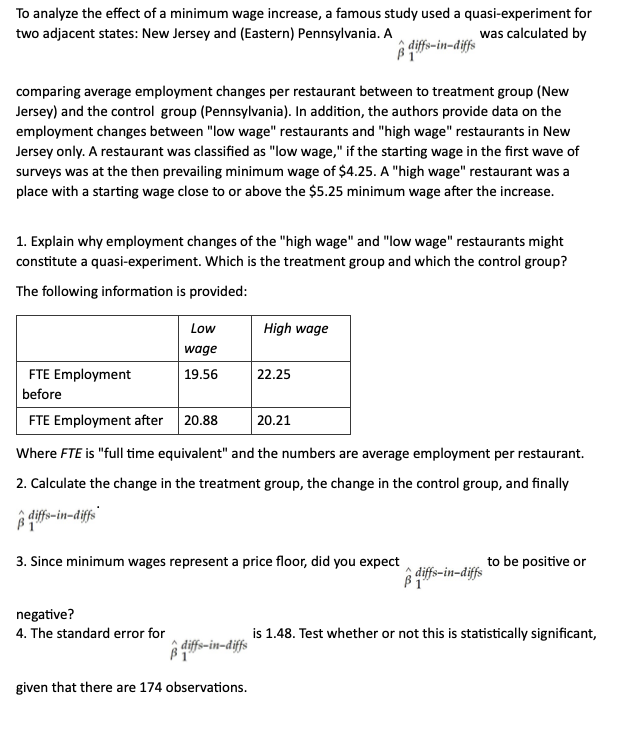
To analyze the effect of a minimum wage increase, a famous study used a quasi-experiment for two adjacent states: New Jersey and (Eastern) Pennsylvania. A A diffs-in-diffs was calculated by comparing average employment changes per restaurant between to treatment group (New Jersey) and the control group (Pennsylvania). In addition, the authors provide data on the employment changes between "low wage" restaurants and "high wage" restaurants in New Jersey only. A restaurant was classified as "low wage," if the starting wage in the first wave of surveys was at the then prevailing minimum wage of $4.25. A "high wage" restaurant was a place with a starting wage close to or above the $5.25 minimum wage after the increase. 1. Explain why employment changes of the "high wage" and "low wage" restaurants might constitute a quasi-experiment. Which is the treatment group and which the control group? The following information is provided: Low High wage wage FTE Employment 19.56 22.25 before FTE Employment after 20.88 20.21 Where FTE is "full time equivalent" and the numbers are average employment per restaurant. 2. Calculate the change in the treatment group, the change in the control group, and finally diffs-in-diffs 3. Since minimum wages represent a price floor, did you expect A diffs-in-diffs to be positive or B1 negative? 4. The standard error for ~ diffs-in-diffs is 1.48. Test whether or not this is statistically significant, given that there are 174 observations
Step by Step Solution
There are 3 Steps involved in it

Get step-by-step solutions from verified subject matter experts
 Study Help