







Question: I need help with question 2-5 please it is urgent changes in the practical procedure, since we will be outlining a method for a different
I need help with question 2-5 please it is urgent
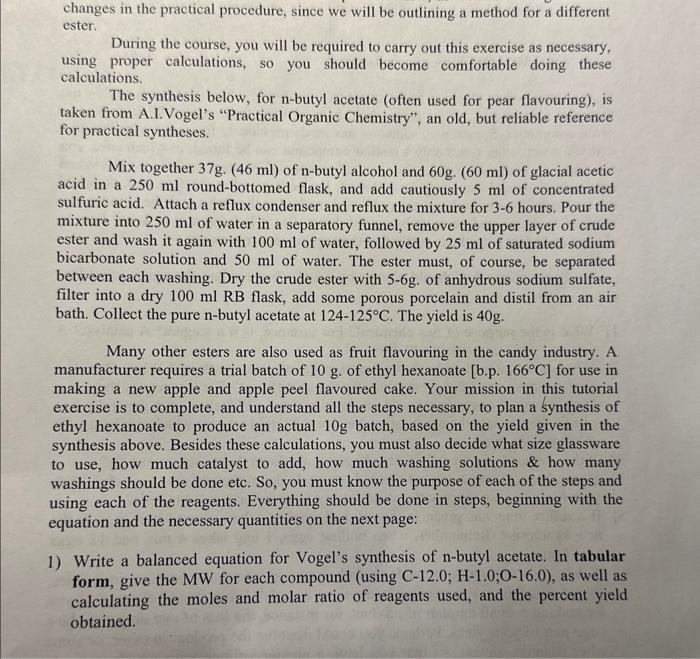
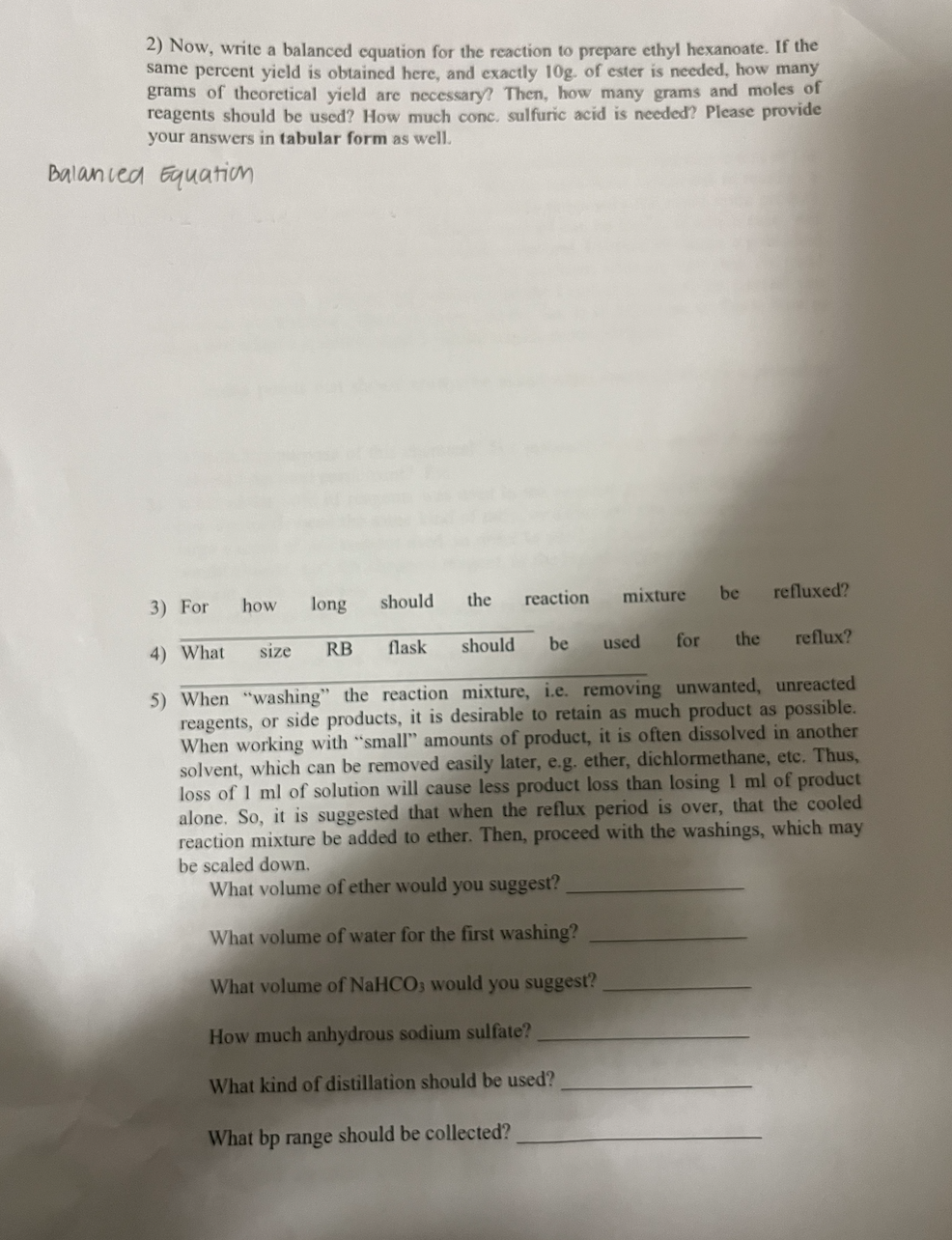
changes in the practical procedure, since we will be outlining a method for a different ester. During the course, you will be required to carry out this exercise as necessary, using proper calculations, so you should become comfortable doing these calculations. The synthesis below, for n-butyl acetate (often used for pear flavouring), is taken from A.I.Vogel's "Practical Organic Chemistry", an old, but reliable reference for practical syntheses. Mix together 37g. (46ml) of n-butyl alcohol and 60g.(60ml) of glacial acetic acid in a 250ml round-bottomed flask, and add cautiously 5ml of concentrated sulfuric acid. Attach a reflux condenser and reflux the mixture for 3-6 hours. Pour the mixture into 250ml of water in a separatory funnel, remove the upper layer of crude ester and wash it again with 100ml of water, followed by 25ml of saturated sodium bicarbonate solution and 50ml of water. The ester must, of course, be separated between each washing. Dry the crude ester with 56g. of anhydrous sodium sulfate, filter into a dry 100mlRB flask, add some porous porcelain and distil from an air bath. Collect the pure n-butyl acetate at 124125C. The yield is 40g. Many other esters are also used as fruit flavouring in the candy industry. A manufacturer requires a trial batch of 10g. of ethyl hexanoate [b.p. 166C ] for use in making a new apple and apple peel flavoured cake. Your mission in this tutorial exercise is to complete, and understand all the steps necessary, to plan a synthesis of ethyl hexanoate to produce an actual 10g batch, based on the yield given in the synthesis above. Besides these calculations, you must also decide what size glassware to use, how much catalyst to add, how much washing solutions \& how many washings should be done etc. So, you must know the purpose of each of the steps and using each of the reagents. Everything should be done in steps, beginning with the equation and the necessary quantities on the next page: 1) Write a balanced equation for Vogel's synthesis of n-butyl acetate. In tabular form, give the MW for each compound (using C12.0;H1.0;O16.0 ), as well as calculating the moles and molar ratio of reagents used, and the percent yield obtained. 2) Now, write a balanced equation for the reaction to prepare ethyl hexanoate. If the same percent yield is obtained here, and exactly 10g. of ester is needed, how many grams of theoretical yield are necessary? Then, how many grams and moles of reagents should be used? How much conc. sulfuric acid is needed? Please provide your answers in tabular form as well. ea Equation 3) For how long should the reaction mixture be refluxed? 4) What size RB flask should be used for the reflux? 5) When "washing" the reaction mixture, i.e. removing unwanted, unreacted reagents, or side products, it is desirable to retain as much product as possible. When working with "small" amounts of product, it is often dissolved in another solvent, which can be removed easily later, e.g. ether, dichlormethane, etc. Thus, loss of 1ml of solution will cause less product loss than losing 1ml of product alone. So, it is suggested that when the reflux period is over, that the cooled reaction mixture be added to ether. Then, proceed with the washings, which may be scaled down. What volume of ether would you suggest? What volume of water for the first washing? What volume of NaHCO3 would you suggest? How much anhydrous sodium sulfate? What kind of distillation should be used? What bp range should be collected
Step by Step Solution
There are 3 Steps involved in it

Get step-by-step solutions from verified subject matter experts
 Study Help