







Question: I need help with question 2a and 2b. 1. (20 points) Suppose we have a design space spanned by 30 design variables, where each design
 I need help with question 2a and 2b.
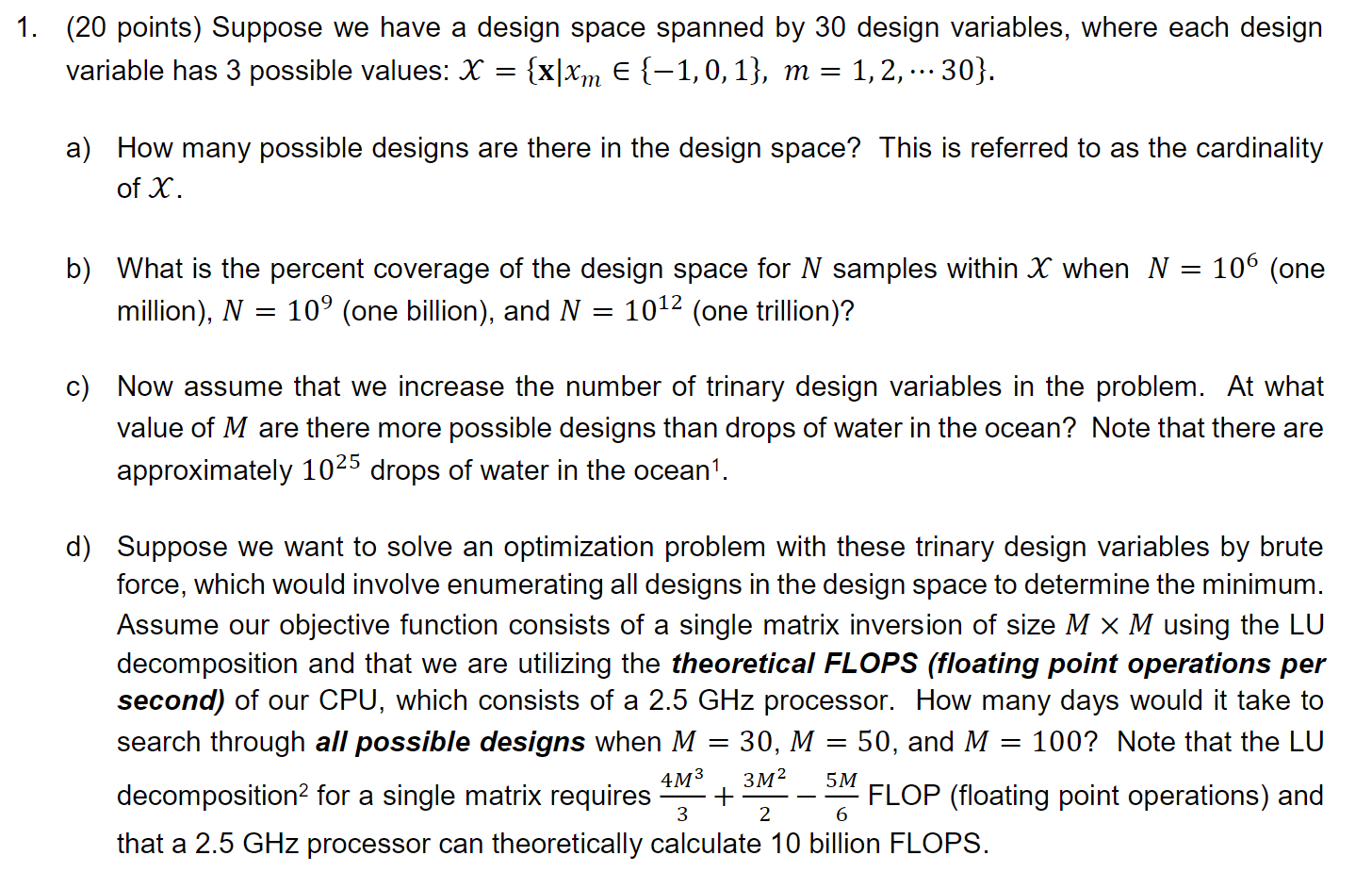
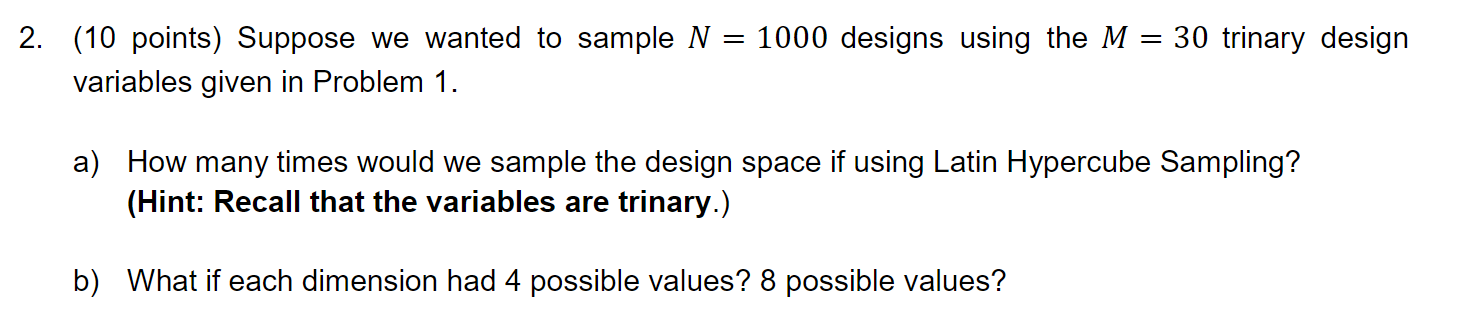
1. (20 points) Suppose we have a design space spanned by 30 design variables, where each design variable has 3 possible values: X = {x|xm E{-1,0,1}, m = 1, 2, ... 30}. a) How many possible designs are there in the design space? This is referred to as the cardinality of X. b) What is the percent coverage of the design space for N samples within x when N = 106 (one million), N 10 (one billion), and N 1012 (one trillion)? c) Now assume that we increase the number of trinary design variables in the problem. At what value of M are there more possible designs than drops of water in the ocean? Note that there are approximately 1025 drops of water in the ocean?. d) Suppose we want to solve an optimization problem with these trinary design variables by brute force, which would involve enumerating all designs in the design space to determine the minimum. Assume our objective function consists of a single matrix inversion of size M X M using the LU decomposition and that we are utilizing the theoretical FLOPS (floating point operations per second) of our CPU, which consists of a 2.5 GHz processor. How many days would it take to search through all possible designs when M 30, M = 50, and M = 100? Note that the LU 4M 3M2 decomposition2 for a single matrix requires + FLOP (floating point operations) and that a 2.5 GHz processor can theoretically calculate 10 billion FLOPS. = 5M 3 2 6 1000 designs using the M - 30 trinary design 2. (10 points) Suppose we wanted to sample N variables given in Problem 1. a) How many times would we sample the design space if using Latin Hypercube Sampling? (Hint: Recall that the variables are trinary.) b) What if each dimension had 4 possible values? 8 possible values? 1. (20 points) Suppose we have a design space spanned by 30 design variables, where each design variable has 3 possible values: X = {x|xm E{-1,0,1}, m = 1, 2, ... 30}. a) How many possible designs are there in the design space? This is referred to as the cardinality of X. b) What is the percent coverage of the design space for N samples within x when N = 106 (one million), N 10 (one billion), and N 1012 (one trillion)? c) Now assume that we increase the number of trinary design variables in the problem. At what value of M are there more possible designs than drops of water in the ocean? Note that there are approximately 1025 drops of water in the ocean?. d) Suppose we want to solve an optimization problem with these trinary design variables by brute force, which would involve enumerating all designs in the design space to determine the minimum. Assume our objective function consists of a single matrix inversion of size M X M using the LU decomposition and that we are utilizing the theoretical FLOPS (floating point operations per second) of our CPU, which consists of a 2.5 GHz processor. How many days would it take to search through all possible designs when M 30, M = 50, and M = 100? Note that the LU 4M 3M2 decomposition2 for a single matrix requires + FLOP (floating point operations) and that a 2.5 GHz processor can theoretically calculate 10 billion FLOPS. = 5M 3 2 6 1000 designs using the M - 30 trinary design 2. (10 points) Suppose we wanted to sample N variables given in Problem 1. a) How many times would we sample the design space if using Latin Hypercube Sampling? (Hint: Recall that the variables are trinary.) b) What if each dimension had 4 possible values? 8 possible values
Step by Step Solution
There are 3 Steps involved in it

Get step-by-step solutions from verified subject matter experts
 Study Help