



Question: I need help with questions 1 8 and 1 9 ( 4 % ) Stacking fault energy is fairly high in pure C u (
I need help with questions and
Stacking fault energy is fairly high in pure but stacking fault energy decreases as is added to to form the solidsolution alloy called brass. In brass with and stacking fault energy is only Circle the letter of every statement below that correctly describes the changes that occur as stacking fault energy decreases? There may be or correct answers below.
a Dislocation cross slip occurs more easily and more often.
b Average spacing between ::type partial dislocation pairs increases.
c Partial dislocation pairs have a higher probability to intersect one another during cold work.
d Twins form more easily, and the concentration of twins increases.
e The metal's workhardening rate increases.
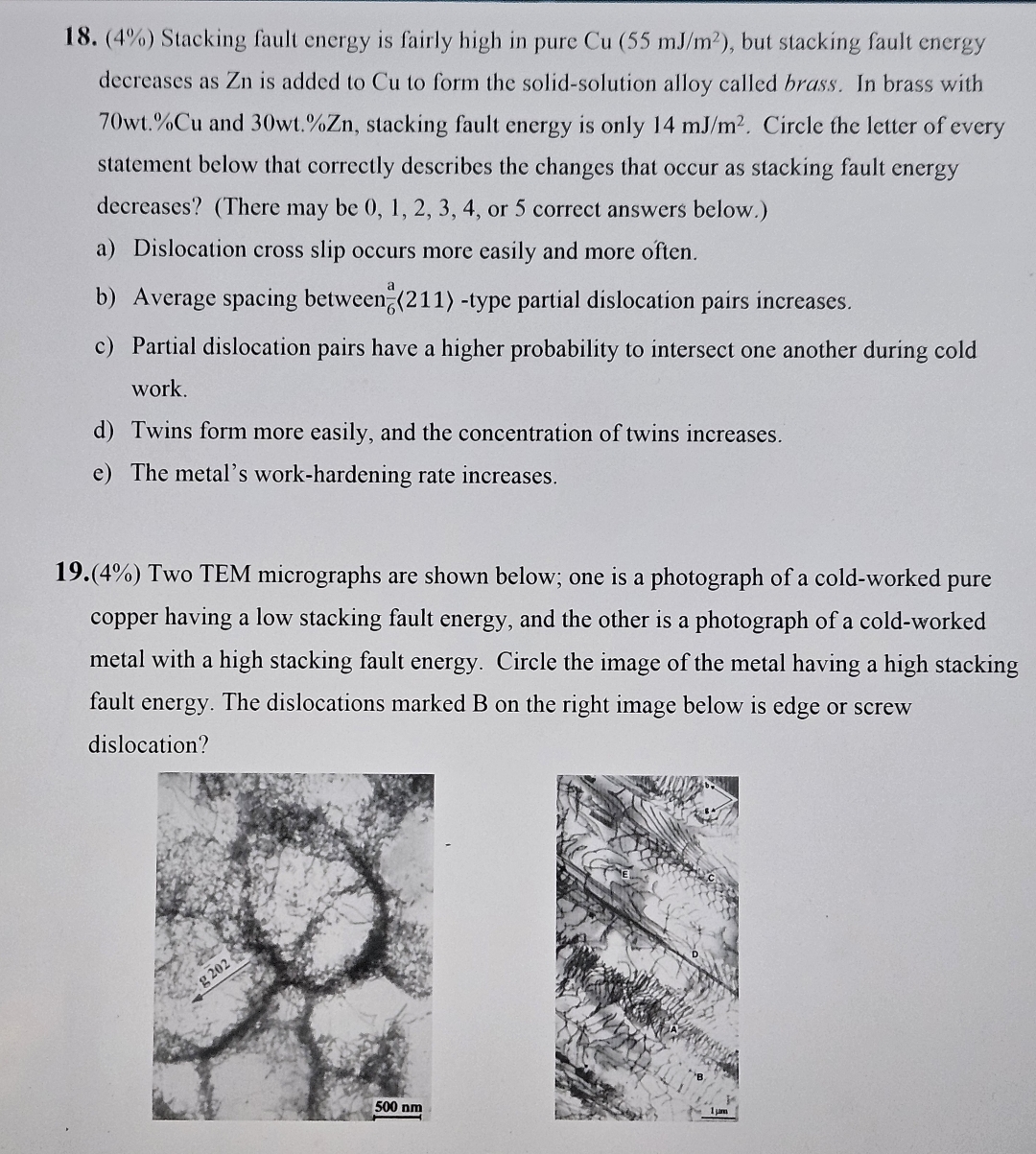
Two TEM micrographs are shown below; one is a photograph of a coldworked pure copper having a low stacking fault energy, and the other is a photograph of a coldworked metal with a high stacking fault energy. Circle the image of the metal having a high stacking fault energy. The dislocations marked B on the right image below is edge or screw dislocation?
Step by Step Solution
There are 3 Steps involved in it
1 Expert Approved Answer
Step: 1 Unlock

Question Has Been Solved by an Expert!
Get step-by-step solutions from verified subject matter experts
Step: 2 Unlock
Step: 3 Unlock