



Question: I NEED HELP WITH REQUIREMENT 2 AND 3 PLEASE. The Cocoa Bean Edibles Factory manufactures and distributes chocolate products. (Click the icon to view more
I NEED HELP WITH REQUIREMENT 2 AND 3 PLEASE.
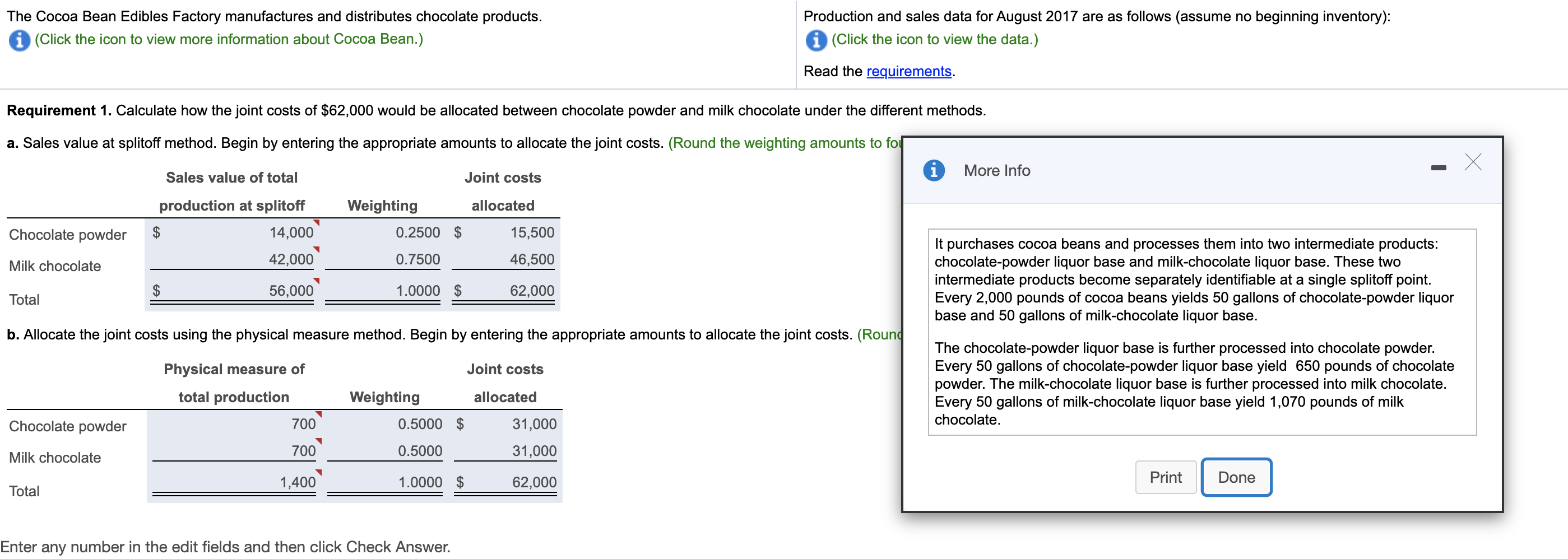
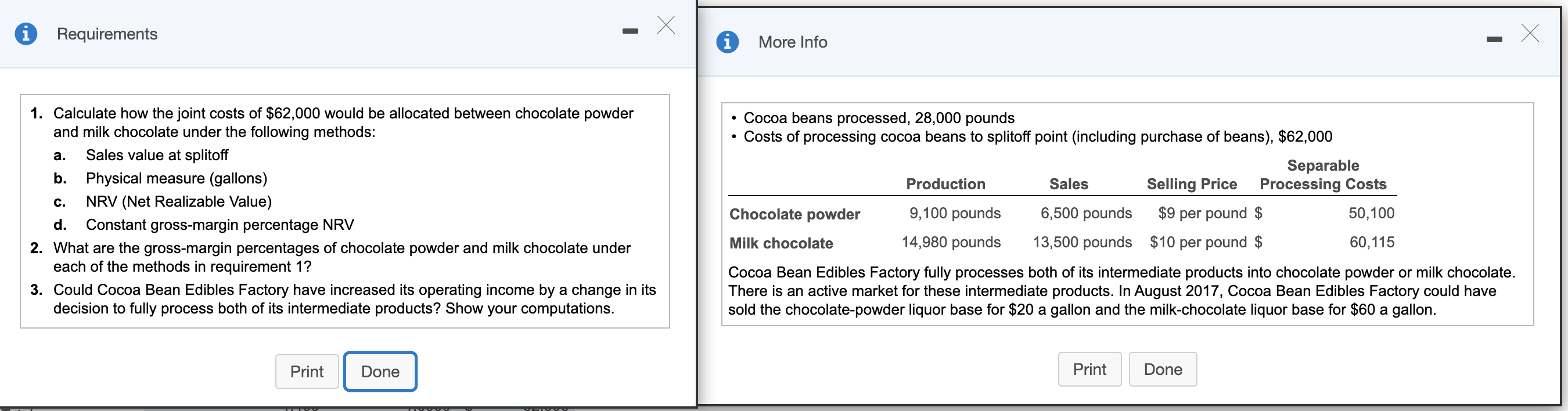
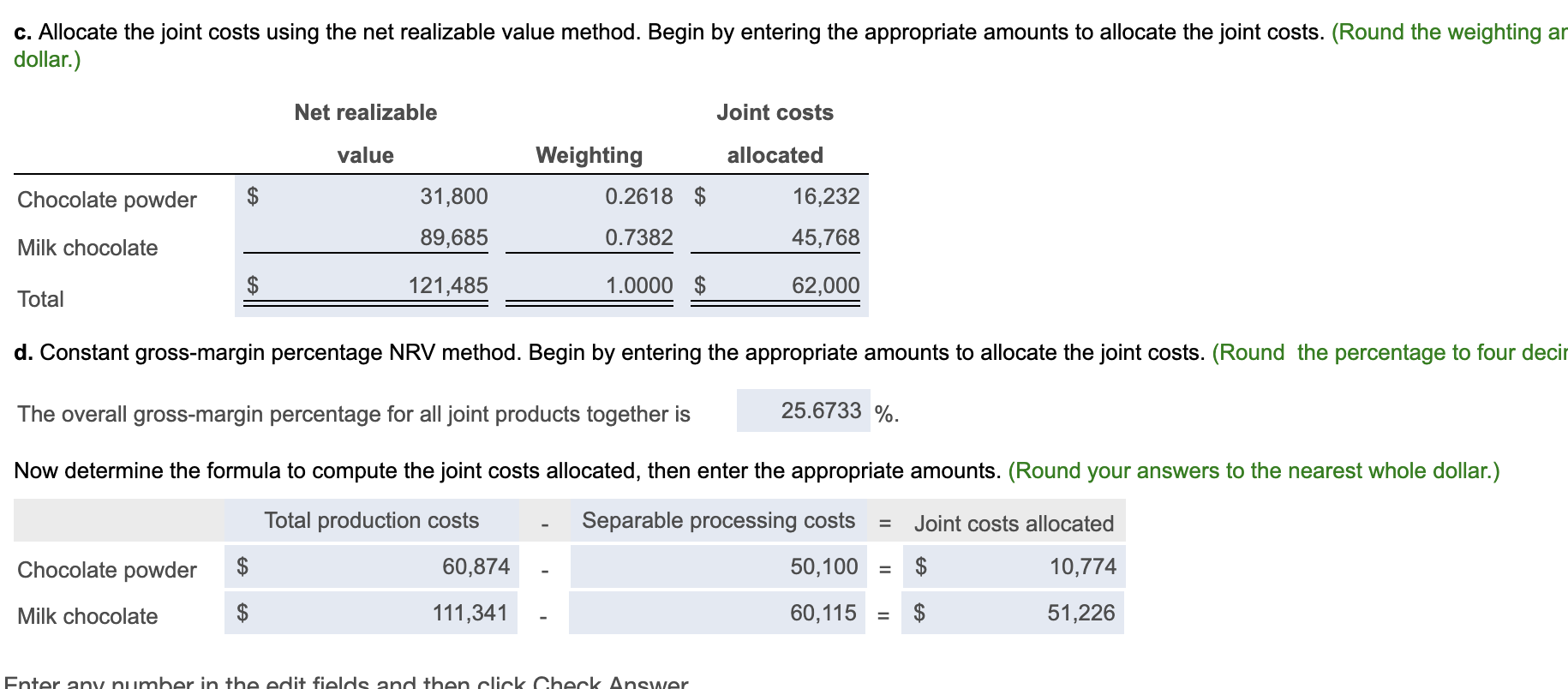
The Cocoa Bean Edibles Factory manufactures and distributes chocolate products. (Click the icon to view more information about Cocoa Bean.) Production and sales data for August 2017 are as follows (assume no beginning inventory): (Click the icon to view the data.) Read the requirements. Requirement 1. Calculate how the joint costs of $62,000 would be allocated between chocolate powder and milk chocolate under the different methods. a. Sales value at splitoff method. Begin by entering the appropriate amounts to allocate the joint costs. (Round the weighting amounts to for More Info Joint costs Weighting allocated Chocolate powder Sales value of total production at splitoff 14,000 42,000 $ 56,000 0.2500 $ 0.7500 15,500 46,500 Milk chocolate It purchases cocoa beans and processes them into two intermediate products: chocolate-powder liquor base and milk-chocolate liquor base. These two intermediate products become separately identifiable at a single splitoff point. Every 2,000 pounds of cocoa beans yields 50 gallons of chocolate powder liquor base and 50 gallons of milk-chocolate liquor base. 1.0000 $ 62,000 Total b. Allocate the joint costs using the physical measure method. Begin by entering the appropriate amounts to allocate the joint costs. (Round Physical measure of total production 700 Joint costs Weighting allocated 0.5000 $ 31,000 0.5000 31,000 The chocolate-powder liquor base is further processed into chocolate powder. Every 50 gallons of chocolate powder liquor base yield 650 pounds of chocolate powder. The milk-chocolate liquor base is further processed into milk chocolate. Every 50 gallons of milk-chocolate liquor base yield 1,070 pounds of milk chocolate. Chocolate powder Milk chocolate 7009 1,400 1.0000 $ 62,000 Print Done Total Enter any number in the edit fields and then click Check Answer. 1 Requirements More Info 1. Calculate how the joint costs of $62,000 would be allocated between chocolate powder and milk chocolate under the following methods: a. Sales value at splitoff b. Physical measure (gallons) c. NRV (Net Realizable Value) d. Constant gross-margin percentage NRV 2. What are the gross-margin percentages of chocolate powder and milk chocolate under each of the methods in requirement 1? 3. Could Cocoa Bean Edibles Factory have increased its operating income by a change in its decision to fully process both of its intermediate products? Show your computations. Cocoa beans processed, 28,000 pounds Costs of processing cocoa beans to splitoff point (including purchase of beans), $62,000 Separable Production Sales Selling Price Processing Costs Chocolate powder 9,100 pounds 6,500 pounds $9 per pound $ 50,100 Milk chocolate 14,980 pounds 13,500 pounds $10 per pound $ 60,115 Cocoa Bean Edibles Factory fully processes both of its intermediate products into chocolate powder or milk chocolate. There is an active market for these intermediate products. In August 2017, Cocoa Bean Edibles Factory could have sold the chocolate-powder liquor base for $20 a gallon and the milk-chocolate liquor base for $60 a gallon. Print Done Print Done c. Allocate the joint costs using the net realizable value method. Begin by entering the appropriate amounts to allocate the joint costs. (Round the weighting ar dollar.) Net realizable Joint costs value Weighting allocated Chocolate powder 31,800 89,685 0.2618 $ 0.7382 1.0000 $ 16,232 45,768 Milk chocolate 121,485 62,000 Total d. Constant gross-margin percentage NRV method. Begin by entering the appropriate amounts to allocate the joint costs. (Round the percentage to four decir The overall gross-margin percentage for all joint products together is 25.6733 %. Now determine the formula to compute the joint costs allocated, then enter the appropriate amounts. (Round your answers to the nearest whole dollar.) Total production costs 60,874 - - Chocolate powder Separable processing costs = Joint costs allocated 50,100 = $ 10,774 60,115 = $ 51,226 Milk chocolate 111,341 - Enter any number in the edit fields and then click Check Answer The Cocoa Bean Edibles Factory manufactures and distributes chocolate products. (Click the icon to view more information about Cocoa Bean.) Production and sales data for August 2017 are as follows (assume no beginning inventory): (Click the icon to view the data.) Read the requirements. Requirement 1. Calculate how the joint costs of $62,000 would be allocated between chocolate powder and milk chocolate under the different methods. a. Sales value at splitoff method. Begin by entering the appropriate amounts to allocate the joint costs. (Round the weighting amounts to for More Info Joint costs Weighting allocated Chocolate powder Sales value of total production at splitoff 14,000 42,000 $ 56,000 0.2500 $ 0.7500 15,500 46,500 Milk chocolate It purchases cocoa beans and processes them into two intermediate products: chocolate-powder liquor base and milk-chocolate liquor base. These two intermediate products become separately identifiable at a single splitoff point. Every 2,000 pounds of cocoa beans yields 50 gallons of chocolate powder liquor base and 50 gallons of milk-chocolate liquor base. 1.0000 $ 62,000 Total b. Allocate the joint costs using the physical measure method. Begin by entering the appropriate amounts to allocate the joint costs. (Round Physical measure of total production 700 Joint costs Weighting allocated 0.5000 $ 31,000 0.5000 31,000 The chocolate-powder liquor base is further processed into chocolate powder. Every 50 gallons of chocolate powder liquor base yield 650 pounds of chocolate powder. The milk-chocolate liquor base is further processed into milk chocolate. Every 50 gallons of milk-chocolate liquor base yield 1,070 pounds of milk chocolate. Chocolate powder Milk chocolate 7009 1,400 1.0000 $ 62,000 Print Done Total Enter any number in the edit fields and then click Check Answer. 1 Requirements More Info 1. Calculate how the joint costs of $62,000 would be allocated between chocolate powder and milk chocolate under the following methods: a. Sales value at splitoff b. Physical measure (gallons) c. NRV (Net Realizable Value) d. Constant gross-margin percentage NRV 2. What are the gross-margin percentages of chocolate powder and milk chocolate under each of the methods in requirement 1? 3. Could Cocoa Bean Edibles Factory have increased its operating income by a change in its decision to fully process both of its intermediate products? Show your computations. Cocoa beans processed, 28,000 pounds Costs of processing cocoa beans to splitoff point (including purchase of beans), $62,000 Separable Production Sales Selling Price Processing Costs Chocolate powder 9,100 pounds 6,500 pounds $9 per pound $ 50,100 Milk chocolate 14,980 pounds 13,500 pounds $10 per pound $ 60,115 Cocoa Bean Edibles Factory fully processes both of its intermediate products into chocolate powder or milk chocolate. There is an active market for these intermediate products. In August 2017, Cocoa Bean Edibles Factory could have sold the chocolate-powder liquor base for $20 a gallon and the milk-chocolate liquor base for $60 a gallon. Print Done Print Done c. Allocate the joint costs using the net realizable value method. Begin by entering the appropriate amounts to allocate the joint costs. (Round the weighting ar dollar.) Net realizable Joint costs value Weighting allocated Chocolate powder 31,800 89,685 0.2618 $ 0.7382 1.0000 $ 16,232 45,768 Milk chocolate 121,485 62,000 Total d. Constant gross-margin percentage NRV method. Begin by entering the appropriate amounts to allocate the joint costs. (Round the percentage to four decir The overall gross-margin percentage for all joint products together is 25.6733 %. Now determine the formula to compute the joint costs allocated, then enter the appropriate amounts. (Round your answers to the nearest whole dollar.) Total production costs 60,874 - - Chocolate powder Separable processing costs = Joint costs allocated 50,100 = $ 10,774 60,115 = $ 51,226 Milk chocolate 111,341 - Enter any number in the edit fields and then click Check
Step by Step Solution
There are 3 Steps involved in it

Get step-by-step solutions from verified subject matter experts