







Question: I need help with the following problem: Consider a town with N residents. The town has been selected to receive either a new swimming pool
I need help with the following problem:
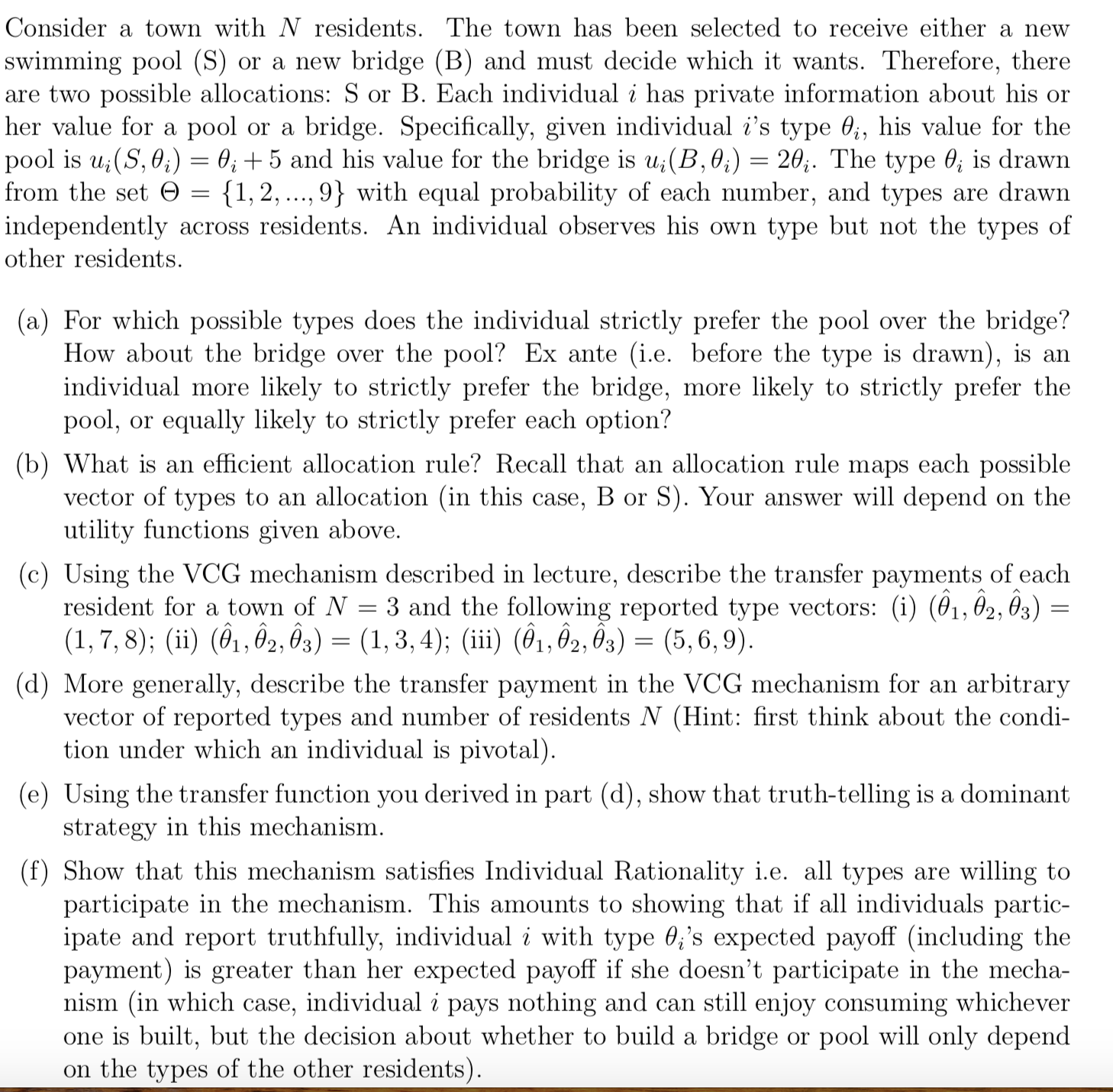
Consider a town with N residents. The town has been selected to receive either a new swimming pool (S) or a new bridge (B) and must decide which it wants. Therefore, there are two possible allocations: S or B. Each individual i has private information about his or her value for a pool or a bridge. Specically, given individual i's type 6,, his value for the pool is 11,-(8, 6,) = 6,- + 5 and his value for the bridge is 11,-(B, 6,) = 26,. The type 6,- is drawn from the set 9 = {1, 2, ..., 9} with equal probability of each number, and types are drawn independently across residents. An individual observes his own type but not the types of other residents. (a) For which possible types does the individual strictly prefer the pool over the bridge? How about the bridge over the pool? Ex ante (i.e. before the type is drawn), is an individual more likely to strictly prefer the bridge, more likely to strictly prefer the pool, or equally likely to strictly prefer each option? (b) What is an eicient allocation rule? Recall that an allocation rule maps each possible vector of types to an allocation (in this case, B or S). Your answer will depend on the utility functions given above. (0 ) Using the VCG mechanism described' 1n lecture, describe the transfer payments of each resident for a town of N 3 and the following reported type vectors: (1) (61, 62, 63): (1,7,8); (ii) (61,6263): (1, 3, 4); (iii) (61,6263): (5, 6, 9). ((1) More generally, describe the transfer payment in the VCG mechanism for an arbitrary vector of reported types and number of residents N (Hint: rst think about the condi tion under which an individual is pivotal). (e) Using the transfer function you derived in part ((1), show that truth-telling is a dominant strategy in this mechanism. (f) Show that this mechanism satises Individual Rationality i.e. all types are willing to participate in the mechanism. This amounts to showing that if all individuals partic ipate and report truthfully, individual 2' with type 6,'s expected payo (including the payment) is greater than her expected payo if she doesn't participate in the mecha- nism (in which case, individual i pays nothing and can still enjoy consuming whichever one is built, but the decision about whether to build a bridge or pool will only depend on the types of the other residents)
Step by Step Solution
There are 3 Steps involved in it

Get step-by-step solutions from verified subject matter experts
 Study Help