



Question: I need help with these economic assessments. Please help with it as ASAP, will rate ( modified from Brueckner Exercise 3 . 2 ) In
I need help with these economic assessments. Please help with it as ASAP, will rate
modified from Brueckner Exercise
In this problem, you will solve for the equilibrium population of an idealized city experiencing
ruralurban migration, following the augmented HarrisTodaro model from Chapter The in
comes earned in urban employment and in the rural area are y and yA respectively, and t is
commuting cost per mile. J is the number of available urban jobs.
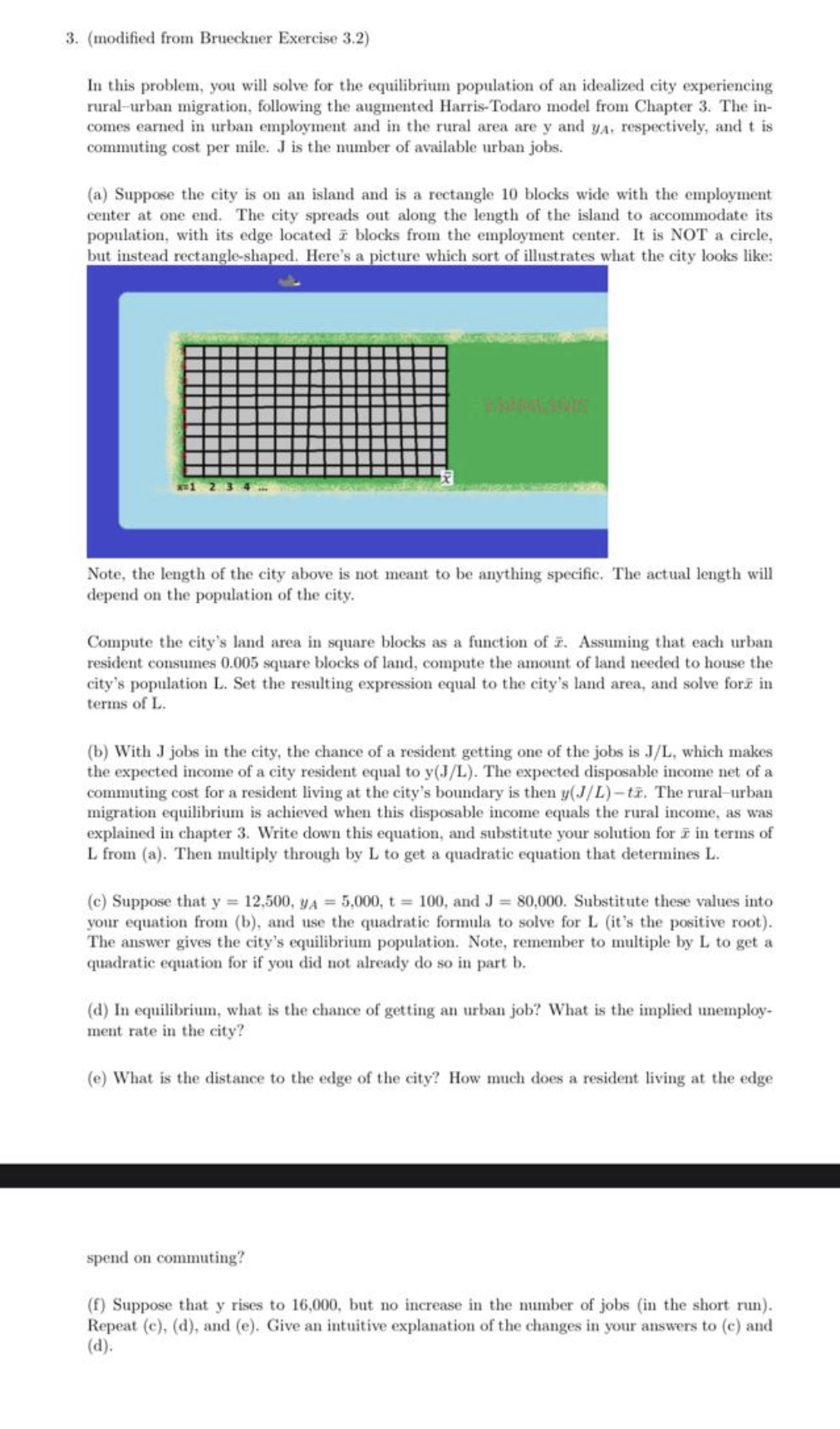
a Suppose the city is on an island and is a rectangle blocks wide with the employment
center at one end. The city spreads out along the length of the island to accommodate its
population, with its edge located barx blocks from the employment center. It is NOT a circle,
but instead rectangleshaped. Here's a picture which sort of illustrates what the city looks like:
Note, the length of the city above is not meant to be anything specific. The actual length will
depend on the population of the city.
Compute the city's land area in square blocks as a function of barx Assuming that each urban
resident consumes square blocks of land, compute the amount of land needed to house the
city's population L Set the resulting expression equal to the city's land area, and solve for barx in
terms of L
b With J jobs in the city, the chance of a resident getting one of the jobs is JL which makes
the expected income of a city resident equal to yJL The expected disposable income net of a
commuting cost for a resident living at the city's boundary is then yJLt barx The ruralurban
migration equilibrium is achieved when this disposable income equals the rural income, as was
explained in chapter Write down this equation, and substitute your solution for barx in terms of
L from a Then multiply through by L to get a quadratic equation that determines L
c Suppose that yyAt and J Substitute these values into
your equation from b and use the quadratic formula to solve for L its the positive root
The answer gives the city's equilibrium population. Note, remember to multiple by L to get a
quadratic equation for if you did not already do so in part b
d In equilibrium, what is the chance of getting an urban job? What is the implied unemploy
ment rate in the city?
e What is the distance to the edge of the city? How much does a resident living at the edge
spend on commuting?
f Suppose that y rises to but no increase in the number of jobs in the short run
Repeat cd and e Give an intuitive explanation of the changes in your answers to c and
d
Step by Step Solution
There are 3 Steps involved in it
1 Expert Approved Answer
Step: 1 Unlock

Question Has Been Solved by an Expert!
Get step-by-step solutions from verified subject matter experts
Step: 2 Unlock
Step: 3 Unlock