



Question: I need help with these multiple-choice questions, few sentence explanation is fine 19. We would expect that the level of income that would equate total
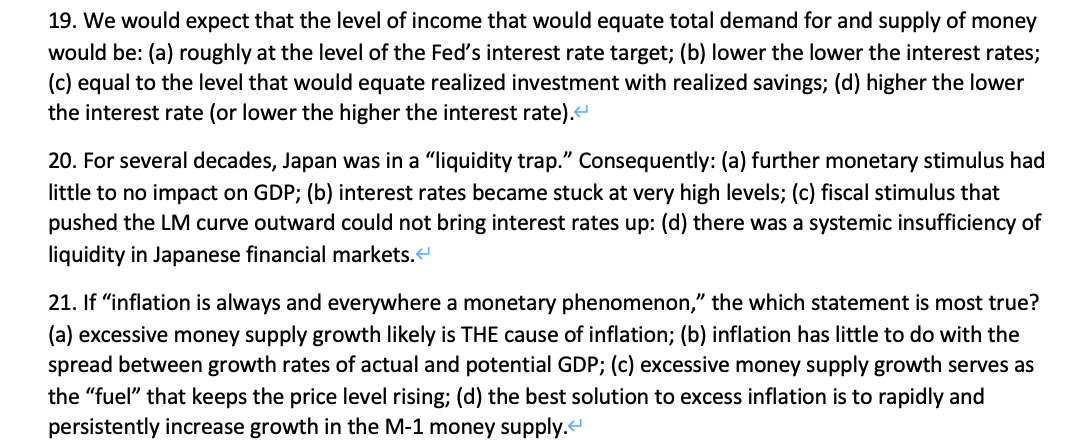 I need help with these multiple-choice questions, few sentence explanation is fine
19. We would expect that the level of income that would equate total demand for and supply of money would be: (a) roughly at the level of the Fed's interest rate target; (b) lower the lower the interest rates; (c) equal to the level that would equate realized investment with realized savings; (d) higher the lower the interest rate (or lower the higher the interest rate). 20. For several decades, Japan was in a liquidity trap. Consequently: (a) further monetary stimulus had little to no impact on GDP; (b) interest rates became stuck at very high levels; (c) fiscal stimulus that pushed the LM curve outward could not bring interest rates up: (d) there was a systemic insufficiency of liquidity in Japanese financial markets. 21. If "inflation is always and everywhere a monetary phenomenon," the which statement is most true? (a) excessive money supply growth likely is THE cause of inflation; (b) inflation has little to do with the spread between growth rates of actual and potential GDP; (c) excessive money supply growth serves as the "fuel" that keeps the price level rising; (d) the best solution to excess inflation is to rapidly and persistently increase growth in the M-1 money supply
Step by Step Solution
There are 3 Steps involved in it

Get step-by-step solutions from verified subject matter experts