Question: I need help with these questions please !!! It's Number 1 THROUGH 12, I've been trying all week and I don't understand! The subject is
I need help with these questions please !!! It's Number 1 THROUGH 12, I've been trying all week and I don't understand!
The subject is BUSINESS LAW, it doesn't show the exact subject but it is in business
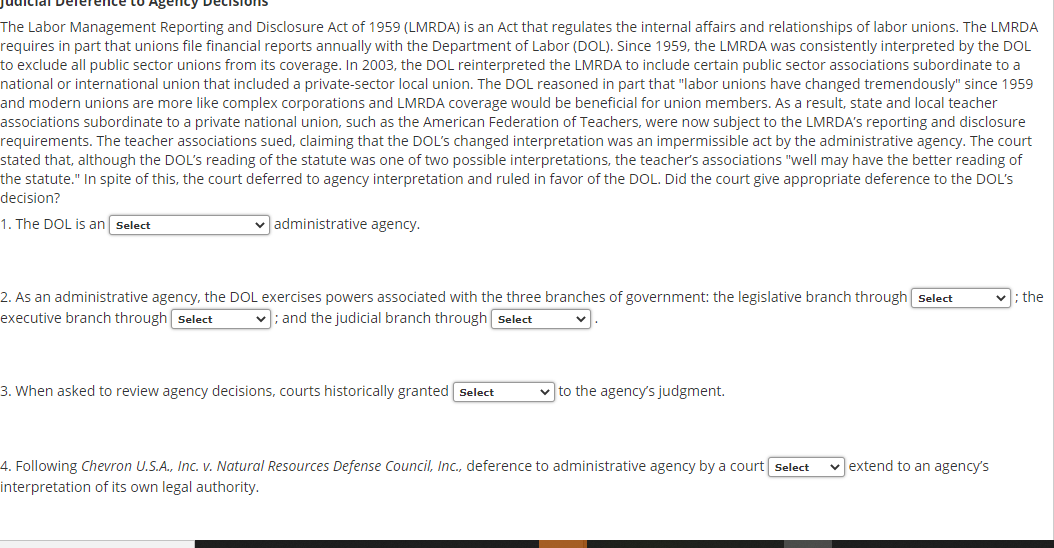
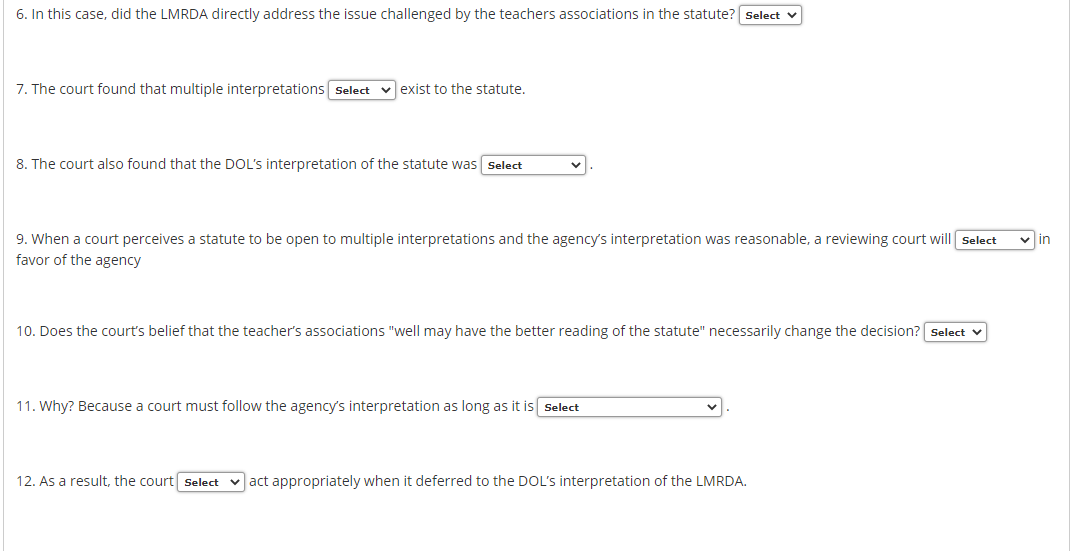
Judicial CISION Agency The Labor Management Reporting and Disclosure Act of 1959 (LMRDA) is an Act that regulates the internal affairs and relationships of labor unions. The LMRDA requires in part that unions file financial reports annually with the Department of Labor (DOL). Since 1959, the LMRDA was consistently interpreted by the DOL to exclude all public sector unions from its coverage. In 2003, the DOL reinterpreted the LMRDA to include certain public sector associations subordinate to a national or international union that included a private sector local union. The DOL reasoned in part that "labor unions have changed tremendously" since 1959 and modern unions are more like complex corporations and LMRDA coverage would be beneficial for union members. As a result, state and local teacher associations subordinate to a private national union, such as the American Federation of Teachers, were now subject to the LMRDA's reporting and disclosure requirements. The teacher associations sued, claiming that the DOL's changed interpretation was an impermissible act by the administrative agency. The court stated that, although the DOL's reading of the statute was one of two possible interpretations, the teacher's associations "well may have the better reading of the statute." In spite of this, the court deferred to agency interpretation and ruled in favor of the DOL. Did the court give appropriate deference to the DOL'S decision? 1. The DOL is an Select administrative agency. ; the 2. As an administrative agency, the DOL exercises powers associated with the three branches of government: the legislative branch through Select executive branch through Select ; and the judicial branch through Select 3. When asked to review agency decisions, courts historically granted Select to the agency's judgment. extend to an agency's 4. Following Chevron U.S.A., Inc. v. Natural Resources Defense Council, Inc., deference to administrative agency by a court Select interpretation of its own legal authority. 6. In this case, did the LMRDA directly address the issue challenged by the teachers associations in the statute? Select 7. The court found that multiple interpretations Select exist to the statute. 8. The court also found that the DOL's interpretation of the statute was select 9. When a court perceives a statute to be open to multiple interpretations and the agency's interpretation was reasonable, a reviewing court will Select favor of the agency 10. Does the court's belief that the teacher's associations "well may have the better reading of the statute" necessarily change the decision? Select 11. Why? Because a court must follow the agency's interpretation as long as it is Select 12. As a result, the court Select act appropriately when it deferred to the DOL's interpretation of the LMRDA. Judicial CISION Agency The Labor Management Reporting and Disclosure Act of 1959 (LMRDA) is an Act that regulates the internal affairs and relationships of labor unions. The LMRDA requires in part that unions file financial reports annually with the Department of Labor (DOL). Since 1959, the LMRDA was consistently interpreted by the DOL to exclude all public sector unions from its coverage. In 2003, the DOL reinterpreted the LMRDA to include certain public sector associations subordinate to a national or international union that included a private sector local union. The DOL reasoned in part that "labor unions have changed tremendously" since 1959 and modern unions are more like complex corporations and LMRDA coverage would be beneficial for union members. As a result, state and local teacher associations subordinate to a private national union, such as the American Federation of Teachers, were now subject to the LMRDA's reporting and disclosure requirements. The teacher associations sued, claiming that the DOL's changed interpretation was an impermissible act by the administrative agency. The court stated that, although the DOL's reading of the statute was one of two possible interpretations, the teacher's associations "well may have the better reading of the statute." In spite of this, the court deferred to agency interpretation and ruled in favor of the DOL. Did the court give appropriate deference to the DOL'S decision? 1. The DOL is an Select administrative agency. ; the 2. As an administrative agency, the DOL exercises powers associated with the three branches of government: the legislative branch through Select executive branch through Select ; and the judicial branch through Select 3. When asked to review agency decisions, courts historically granted Select to the agency's judgment. extend to an agency's 4. Following Chevron U.S.A., Inc. v. Natural Resources Defense Council, Inc., deference to administrative agency by a court Select interpretation of its own legal authority. 6. In this case, did the LMRDA directly address the issue challenged by the teachers associations in the statute? Select 7. The court found that multiple interpretations Select exist to the statute. 8. The court also found that the DOL's interpretation of the statute was select 9. When a court perceives a statute to be open to multiple interpretations and the agency's interpretation was reasonable, a reviewing court will Select favor of the agency 10. Does the court's belief that the teacher's associations "well may have the better reading of the statute" necessarily change the decision? Select 11. Why? Because a court must follow the agency's interpretation as long as it is Select 12. As a result, the court Select act appropriately when it deferred to the DOL's interpretation of the LMRDA









 Study Help