







Question: 2. 3. 4. 5. A shopping bag A contains 5 oranges and 4 apples, and another shopping bag B contains 2 oranges and 3
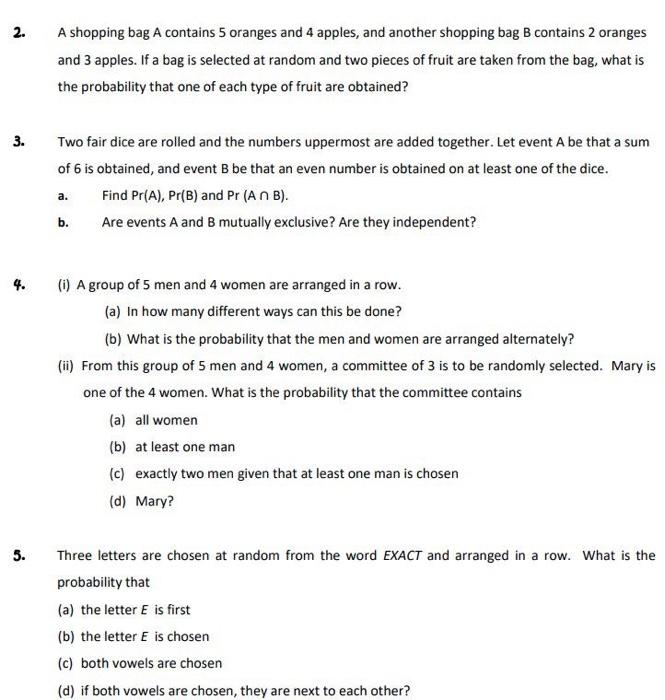
2. 3. 4. 5. A shopping bag A contains 5 oranges and 4 apples, and another shopping bag B contains 2 oranges and 3 apples. If a bag is selected at random and two pieces of fruit are taken from the bag, what is the probability that one of each type of fruit are obtained? Two fair dice are rolled and the numbers uppermost are added together. Let event A be that a sum of 6 is obtained, and event B be that an even number is obtained on at least one of the dice. Find Pr(A), Pr(B) and Pr (A n B). Are events A and B mutually exclusive? Are they independent? a. b. (i) A group of 5 men and 4 women are arranged in a row. (a) In how many different ways can this be done? (b) What is the probability that the men and women are arranged alternately? (ii) From this group of 5 men and 4 women, a committee of 3 is to be randomly selected. Mary is one of the 4 women. What is the probability that the committee contains (a) all women (b) at least one man (c) exactly two men given that at least one man is chosen (d) Mary? Three letters are chosen at random from the word EXACT and arranged in a row. What is the probability that (a) the letter E is first (b) the letter E is chosen (c) both vowels are chosen (d) if both vowels are chosen, they are next to each other?
Step by Step Solution
3.37 Rating (153 Votes )
There are 3 Steps involved in it
Answer 2 The probability of obtaining one of each type of fruit is 815 3 a PrA 19 PrB 59 PrA and B 19 b No events A and B are not mutually exclusive Yes they are independent 4 i a In how many differen... View full answer

Get step-by-step solutions from verified subject matter experts
 Study Help