



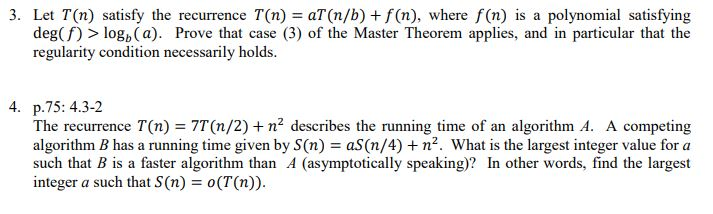
Question: I need help with these two questions 3. Let T(n) satisfy the recurrence T(n) =aT(n/b)+f(n), where f(n) is a polynomial satisfying deg(f) > logb(a). Prove
I need help with these two questions
3. Let T(n) satisfy the recurrence T(n) =aT(n/b)+f(n), where f(n) is a polynomial satisfying deg(f) > logb(a). Prove that case (3) of the Master Theorem applies, and in particular that the regularity condition necessarily holds 4. p.75: 4.3-2 The recurrence T(n) 7T(n/2)+n2 describes the running time of an algorithm A. A competing algorithm B has a running time given by S(n) aS (n/4) n2. What is the largest integer value for a such that B is a faster algorithm than A (asymptotically speaking)? In other words, find the largest integer a such that S(n) -o(T(n)) 3. Let T(n) satisfy the recurrence T(n) =aT(n/b)+f(n), where f(n) is a polynomial satisfying deg(f) > logb(a). Prove that case (3) of the Master Theorem applies, and in particular that the regularity condition necessarily holds 4. p.75: 4.3-2 The recurrence T(n) 7T(n/2)+n2 describes the running time of an algorithm A. A competing algorithm B has a running time given by S(n) aS (n/4) n2. What is the largest integer value for a such that B is a faster algorithm than A (asymptotically speaking)? In other words, find the largest integer a such that S(n) -o(T(n))
Step by Step Solution
There are 3 Steps involved in it

Get step-by-step solutions from verified subject matter experts