







Question: I need help with this code problem! The following code is requierd; % Design an echo filter that produces the original signal plus two echoes.
% Design an echo filter that produces the original signal plus two echoes.
% The first echo is attenuated by 20% and occurs at 1 Second.
% The second echo is attenuated by 30% and occurs at 1.5 Seconds.
% System Works at Fs=8192.
close all
clear all
load( 'splat' )
N=length(y); % y is the default name of the uploaded signal
a1=0.8; % 20% attenuation
a2=0.7; % 30% attenuation
td1=1; % time delay 1 in seconds
td2=1.5; % time delay 2 in seconds
Ts=1/Fs; % sampling period
n1= floor(td1/Ts); % time delay 1 in samples
n2= floor (td2/Ts); % time delay 1 in samples
h(1)=1; % unit-sample response coefficients
h(n1)=a1;
h(n2)=a2;
yecho=conv(h,y); % filter output
sound(y, Fs) % Hear the original signal
n=0:length(y)-1;
plot(n*Ts,y);
xlabel( 'seconds' , 'fontsize' ,14)
title( 'Input Signal' , 'fontsize' ,14)
sound(yecho) % Hear the output signal with echoes
figure
n=0:length(yecho)-1;
plot(n*Ts,yecho) % time axis is in seconds
xlabel( 'seconds' , 'fontsize' ,14)
title( 'Output Signal' , 'fontsize' ,14)
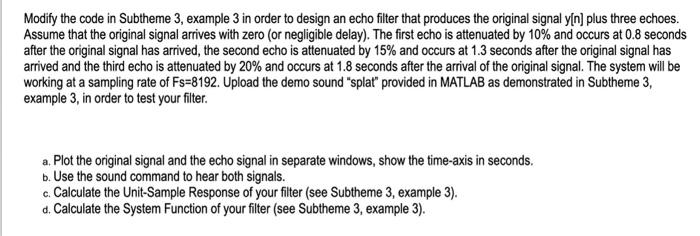
Modify the code in Subtheme 3 , example 3 in order to design an echo filter that produces the original signal y[n] plus three echoes. Assume that the original signal arrives with zero (or negligible delay). The first echo is attenuated by 10% and occurs at 0.8 seconds after the original signal has arrived, the second echo is attenuated by 15% and occurs at 1.3 seconds after the original signal has arrived and the third echo is attenuated by 20% and occurs at 1.8 seconds after the arrival of the original signal. The system will be working at a sampling rate of Fs=8192. Upload the demo sound "splat" provided in MATLAB as demonstrated in Subtheme 3 , example 3 , in order to test your filter. a. Plot the original signal and the echo signal in separate windows, show the time-axis in seconds. b. Use the sound command to hear both signals. c. Calculate the Unit-Sample Response of your filter (see Subtheme 3, example 3). d. Calculate the System Function of your filter (see Subtheme 3, example 3)
Step by Step Solution
There are 3 Steps involved in it

Get step-by-step solutions from verified subject matter experts
 Study Help