







Question: I need help with this in NetLogo Your assignment is to make a Netlogo program a physics model called alternatively Ising model or Spin-glass. Heres
I need help with this in NetLogo
Your assignment is to make a Netlogo program a physics model called alternatively Ising model or Spin-glass. Heres a description of the model, using a socio-political scenario:
People start with random political affiliations (Democrat or Republican), and the people are spatially positioned in a grid. Each person has 8 neighbors (including diagonal directions like NW and SE). If a person has more Democratic neighbors than Republican neighbors, then the person buckles under the peer pressure, and becomes Democrat. If a person has more Republican neighbors, they become Republican. If a person has 4 of each kind of neighbor, they stay whatever they were before.
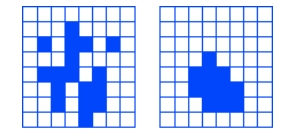 Design a Netlogo simulation for this set of rules. Given this rule set, if you start with the pattern at Time 1, then it should look like the pattern shown in Time 2 after applying the rules once:
All of the Democrats are shown by white squares, and all the republicans are shown by black squares. Hint 1: You dont need to use turtles at all for this simulation; youll only need to worry about patches. Hint 2: Here is a set up routine you can use to randomly create political affiliations: Patches-own [party] to setup ca ask patches [ifelse (random 100)
Hint 4: Youll definitely want to use the sum command, and youll probably need at least one if or ifelse statement. The whole program will be about 4 lines long.
Question 1: Show your whole Netlogo program
Question 2: Given random configurations with 50% Democrat density, what happens over time? Describe why, as a first pass, this is a reasonable model of how Democrats and Republicans are distributed across the country.
Question 3: Now, allow your patches to assert their individuality. Add some random noise to your simulation - so that even if all of ones neighbors are Democrats, one still could be Republican. So, instead of the statement: [let sumz (sum [party] of neighbors) if sumz
Question 4: With randomness set to 2, what happens over time if the initial density of democrats is 56%? Repeat the simulation several times. This behavior is reasonable for some situations, but it doesnt seem like a good behavior for simulating political parties. WHY NOT? You dont have to actually program a new model, but describe how you would change the model to give more realistic behavior.
Step by Step Solution
There are 3 Steps involved in it

Get step-by-step solutions from verified subject matter experts
 Study Help