Question: I need help with this problem Antenna Systems was founded in 1967 to take advantage of the growing market for television antenna facilities to service
I need help with this problem
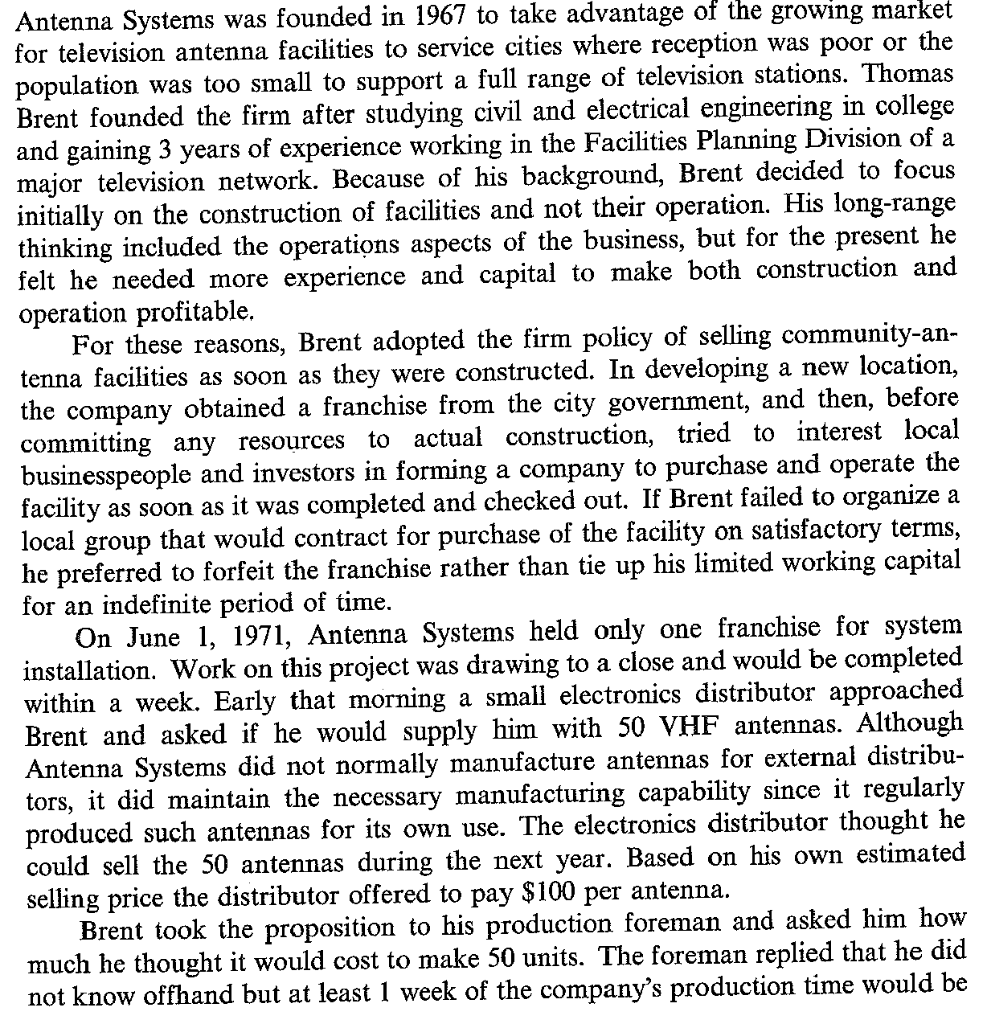
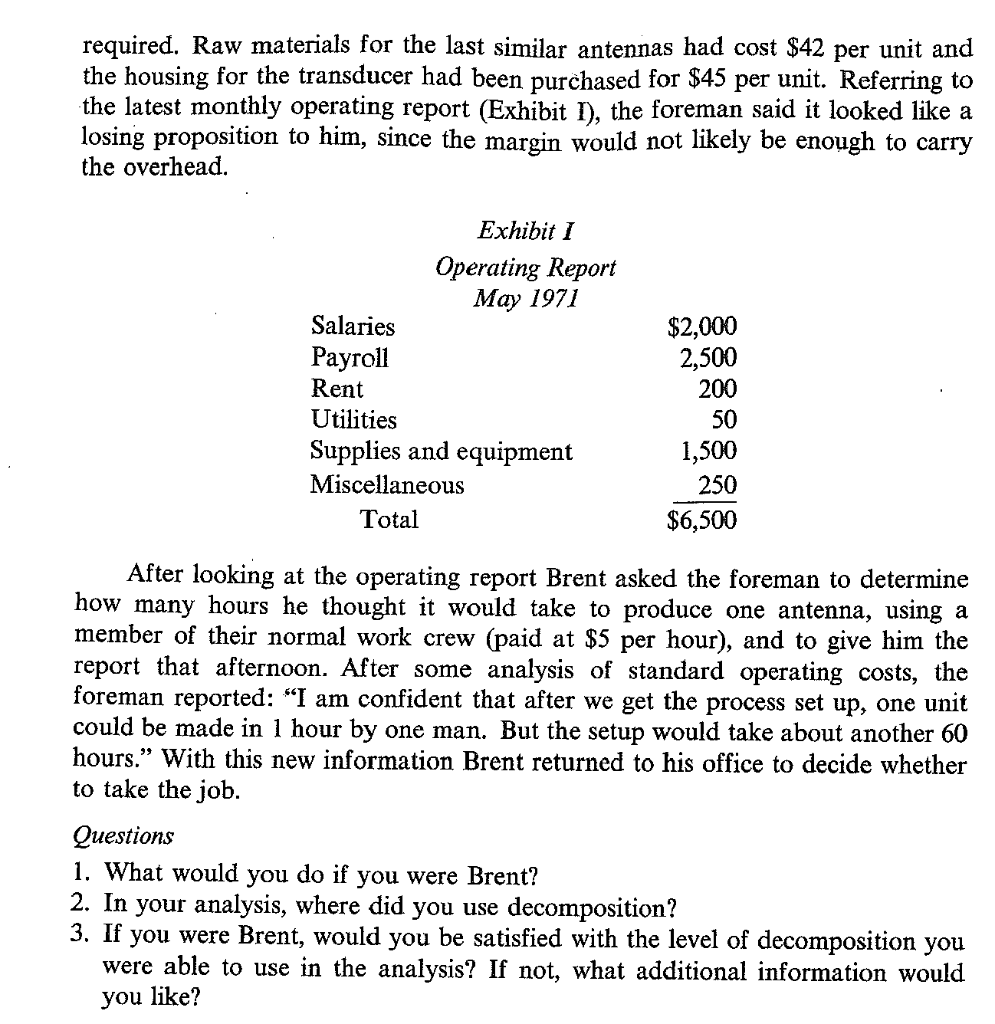
Antenna Systems was founded in 1967 to take advantage of the growing market for television antenna facilities to service cities where reception was poor or the population was too small to support a full range of television stations. Thomas Brent founded the firm after studying civil and electrical engineering in college and gaining 3 years of experience working in the Facilities Planning Division of a major television network. Because of his background, Brent decided to focus initially on the construction of facilities and not their operation. His long-range thinking included the operations aspects of the business, but for the present he felt he needed more experience and capital to make both construction and operation profitable. For these reasons, Brent adopted the firm policy of selling community-an- tenna facilities as soon as they were constructed. In developing a new location, the company obtained a franchise from the city government, and then, before committing any resources to actual construction, tried to interest local businesspeople and investors in forming a company to purchase and operate the facility as soon as it was completed and checked out. If Brent failed to organize a local group that would contract for purchase of the facility on satisfactory terms, he preferred to forfeit the franchise rather than tie up his limited working capital for an indefinite period of time. On June 1, 1971, Antenna Systems held only one franchise for system installation. Work on this project was drawing to a close and would be completed within a week. Early that morning a small electronics distributor approached Brent and asked if he would supply him with 50 VHF antennas. Although Antenna Systems did not normally manufacture antennas for external distribu- tors, it did maintain the necessary manufacturing capability since it regularly produced such antennas for its own use. The electronics distributor thought he could sell the 50 antennas during the next year. Based on his own estimated selling price the distributor offered to pay $100 per antenna. Brent took the proposition to his production foreman and asked him how much he thought it would cost to make 50 units. The foreman replied that he did not know offhand but at least 1 week of the company's production time would be required. Raw materials for the last similar antennas had cost $42 per unit and the housing for the transducer had been purchased for $45 per unit. Referring to the latest monthly operating report (Exhibit I), the foreman said it looked like a losing proposition to him, since the margin would not likely be enough to carry the overhead. Exhibit I Operating Report May 1971 Salaries Payroll Rent Utilities Supplies and equipment Miscellaneous Total $2,000 2,500 200 50 1,500 250 $6,500 After looking at the operating report Brent asked the foreman to determine how many hours he thought it would take to produce one antenna, using a member of their normal work crew (paid at $5 per hour), and to give him the report that afternoon. After some analysis of standard operating costs, the foreman reported: I am confident that after we get the process set up, one unit could be made in 1 hour by one man. But the setup would take about another 60 hours." With this new information Brent returned to his office to decide whether to take the job. Questions 1. What would you do if you were Brent? 2. In your analysis, where did you use decomposition? 3. If you were Brent, would you be satisfied with the level of decomposition you were able to use in the analysis? If not, what additional information would you like? Antenna Systems was founded in 1967 to take advantage of the growing market for television antenna facilities to service cities where reception was poor or the population was too small to support a full range of television stations. Thomas Brent founded the firm after studying civil and electrical engineering in college and gaining 3 years of experience working in the Facilities Planning Division of a major television network. Because of his background, Brent decided to focus initially on the construction of facilities and not their operation. His long-range thinking included the operations aspects of the business, but for the present he felt he needed more experience and capital to make both construction and operation profitable. For these reasons, Brent adopted the firm policy of selling community-an- tenna facilities as soon as they were constructed. In developing a new location, the company obtained a franchise from the city government, and then, before committing any resources to actual construction, tried to interest local businesspeople and investors in forming a company to purchase and operate the facility as soon as it was completed and checked out. If Brent failed to organize a local group that would contract for purchase of the facility on satisfactory terms, he preferred to forfeit the franchise rather than tie up his limited working capital for an indefinite period of time. On June 1, 1971, Antenna Systems held only one franchise for system installation. Work on this project was drawing to a close and would be completed within a week. Early that morning a small electronics distributor approached Brent and asked if he would supply him with 50 VHF antennas. Although Antenna Systems did not normally manufacture antennas for external distribu- tors, it did maintain the necessary manufacturing capability since it regularly produced such antennas for its own use. The electronics distributor thought he could sell the 50 antennas during the next year. Based on his own estimated selling price the distributor offered to pay $100 per antenna. Brent took the proposition to his production foreman and asked him how much he thought it would cost to make 50 units. The foreman replied that he did not know offhand but at least 1 week of the company's production time would be required. Raw materials for the last similar antennas had cost $42 per unit and the housing for the transducer had been purchased for $45 per unit. Referring to the latest monthly operating report (Exhibit I), the foreman said it looked like a losing proposition to him, since the margin would not likely be enough to carry the overhead. Exhibit I Operating Report May 1971 Salaries Payroll Rent Utilities Supplies and equipment Miscellaneous Total $2,000 2,500 200 50 1,500 250 $6,500 After looking at the operating report Brent asked the foreman to determine how many hours he thought it would take to produce one antenna, using a member of their normal work crew (paid at $5 per hour), and to give him the report that afternoon. After some analysis of standard operating costs, the foreman reported: I am confident that after we get the process set up, one unit could be made in 1 hour by one man. But the setup would take about another 60 hours." With this new information Brent returned to his office to decide whether to take the job. Questions 1. What would you do if you were Brent? 2. In your analysis, where did you use decomposition? 3. If you were Brent, would you be satisfied with the level of decomposition you were able to use in the analysis? If not, what additional information would you like









 Study Help