





Question: i need help with this problem ill post the whole question down below. First photo is showing what needs to be answered Second phote is
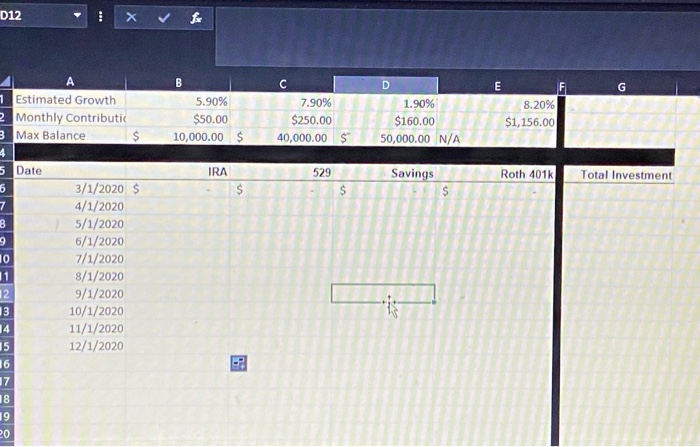
i need help with this problem ill post the whole question down below.
First photo is showing what needs to be answered
Second phote is what the correct answer is supposed to look like.
 i need help with this problem ill post the whole question
down below. First photo is showing what needs to be answered Second
In the Investment worksheet, you will be calculating the monthly balance of a persons investments over a 30 year period. So, you will enter the formulas for each investment vehicle in the first row (row 7). You then will autofill those down for 359 more cells. These 360 total cells represent every month of this persons investments over 30 years. Follow each of the steps below
Manually enter a formula that will calculate the balance of the IRA investment in B7. To do this, take the previous balance, add the contribution, then add the earned interest for the month (which is the balance times the interest rate divided by 12). One additional aspect is that you have decided to have a maximum amount for your investments. For this investment, it is the amount in B3 ($10,000). You should adjust your formula to account for this by having an IF function that stops adding the monthly contribution once the current balance exceeds the maximum amount. It should still add the interest though. Once this is done, autofill the formula downwards (down column B) until you have reached 360 total balance listings.
The formula for the next two investments will have the same core (previous balance plus contribution plus interest). A significant difference though is that there are now four possible calculations instead of two. You still have the maximum balance situation but you also will be adding the payment from the previous investment once that balance has reached its own maximum. The 2x2 set of possibilities would be as follows
o Situation 1: balance is not maxed out & no extra payment from the previous investment
o Situation 2: balance is maxed out & no extra payment from the previous investment
o Situation 3: balance is not maxed out & an extra payment from the previous investment
o Situation 4: balance is maxed out & an extra payment from the previous investment
So, you would have four IF statements that address each of these situations and has an appropriate formula for each (not having or having a contribution depending on the balance being maxed out AND not having or having an extra contribution if the previous investment(s) have been maxed out)
The final investment (the 401k) does not have a max amount so it only has two possible situations: extra contributions or not. You should only check the second to last investment (the savings) and if it has been maxed out, you should add ALL of the contributions from all three prior investments.
With all the formulas entered and autofilled, you need to then autofill the date (column A) down for the entire 360 month rows. Each row should represent a month so each date should be one month advanced from the previous cell. Then, enter a SUM function in cell G6 and autofill that down to where the investment contributions end.
The final total at the end (2/1/2050) should be $2,351,041.86

012 X for 8.20% 1 Estimated Growth 2 Monthly Contributi 3 Max Balance 5.90% $50.00 10,000.00 7.90% $250.00 40,000.00 1.90% $160.00 50,000.00 N/A $1,156.00 $ $ $ 5 Date Savings Roth 401k Total Investment 3/1/2020 $ 4/1/2020 5/1/2020 6/1/2020 7/1/2020 8/1/2020 9/1/2020 10/1/2020 11/1/2020 12/1/2020 Estimated Growth Monthly Contributi S SL 156.00 a 10000 M $160.00 400000 5000000 NA Roth 2016 Total Investment 11/2005 4/1/2020 S 5/1/2020 6/1/2003 7/1/2020 $ 1/1/2020 9/1/2020 S 10/1/2020 $ 11/1/2020 $ 12/1/2020 $ 1/1/20215 2/1/2021 S 1/1/2021 S 4/1/2021 S 5/1/20215 6/1/2021 S 7/1/20215 3/1/2021 $ 9/1/20215 10/1/2021 $ 11/1/20215 12/1/2021 $ $0.00 $ 100.25 $ 150.74 201.48 252.47 $ 308.71 $ 355215 106.95 $ 458.95 $ 51121 563.72 $ 616.49 $ 152 $ 722.82 $ 77437 $ 810.19 $ 8:34.27 $ 918.62 $ 911 $ 1048125 1101275 250.00 $ 501.65 $ 744.95 $ 1,009.92 $ 1.966 57 5 1,524.91 $ 1,71445 2.046 20 S 2.110.175 2,575.18 2,142.33 $ 1,111.045 1.101.5) 5 3,650.705 1.127.145 4.200.20 4.401375 4,760.885 5,042.22 5,125.41 $ 810.47 $ 1600S 130 $ 48065 64152 S 802 54S 9631 1.125 135 1.287 125 1.849 15 1,611 45 $ 1,77400 1,936.815 2,099 S 2,263 20 $ 2,426.78 2 550 53 5 2.754.735 2.010.00 $ 3,083.71 $ 3.248 59 $ 3.413. 7 5 1156 00 2,319.90 3401.75 4.67161 5.1995 7.058 SE 8.259.79 9.4722 10.612 05 11,922.09 12.199.49 1440S 42 15.659.85 16,922.85 10.104.50 19.47.81 20,75191 22,061.80 21,368 55 24.63424 26.000 1.616.00 224704 487820 6 524.53 181.11 94800 11.525.27 12.212.99 14.11.23 16 620.06 16 319.55 20 089.76 21810.78 23.562.67 25 325.50 27.099.14 28.884.28 30.680.38 12.487.71 34.306.36 16 116.39 pmt situation not maxed out and no extra pay yes situation maxed out and no extra paymenino situation not maxed out and extra paymer yes situation maxed out and extra payment no pmt no no yes Yes

Step by Step Solution

There are 3 Steps involved in it

1 Expert Approved Answer
Step: 1 Unlock blur-text-image
Question Has Been Solved by an Expert!

Get step-by-step solutions from verified subject matter experts

Step: 2 Unlock
Step: 3 Unlock

Students Have Also Explored These Related Finance Questions!