







Question: I need help with this problem: Radon is a colorless and odorless radioactive gas that can accumulate in residential homes. High levels of exposure can
I need help with this problem:
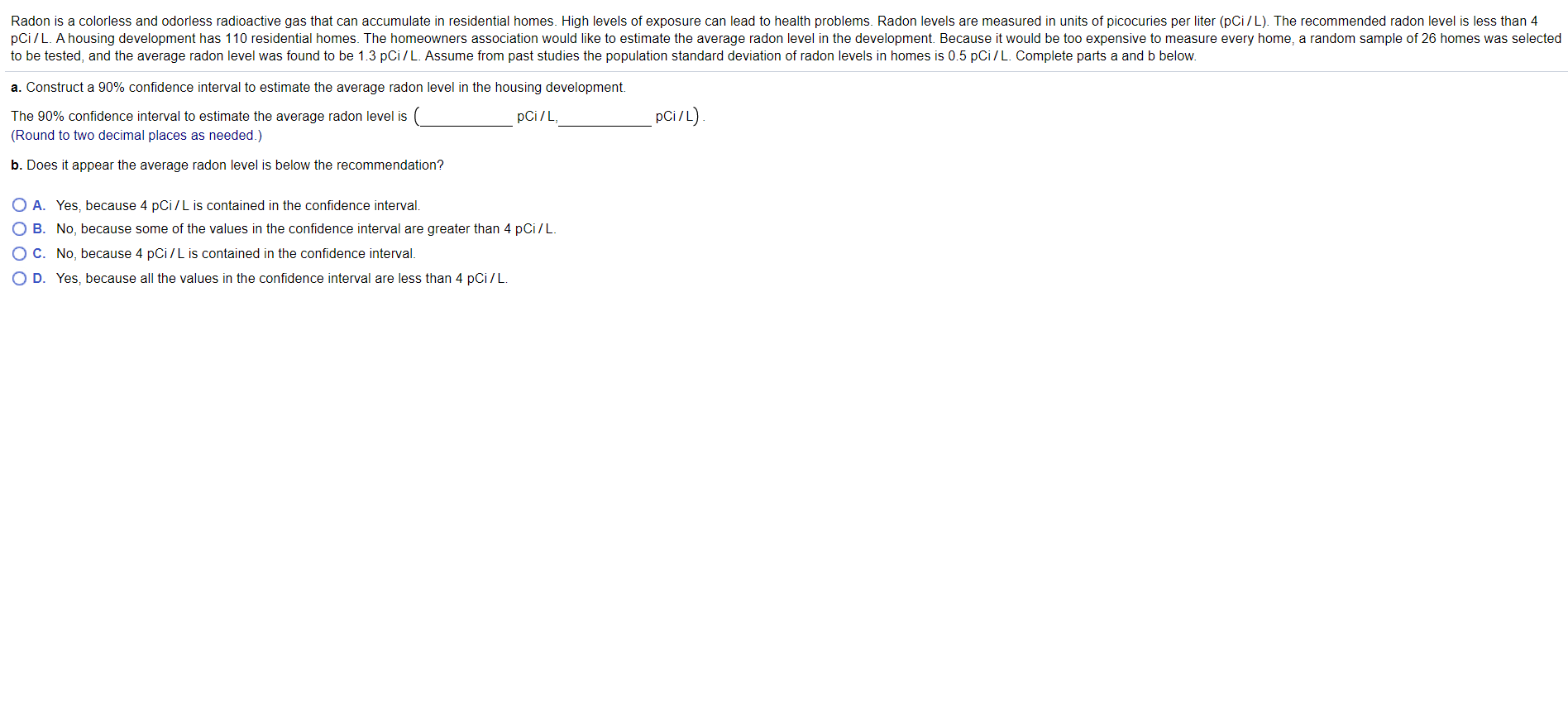
Radon is a colorless and odorless radioactive gas that can accumulate in residential homes. High levels of exposure can lead to health problems. Radon levels are measured in units of picocuries per liter (pCi / L). The recommended radon level is less than 4 pCi / L. A housing development has 110 residential homes. The homeowners association would like to estimate the average radon level in the development. Because it would be too expensive to measure every home, a random sample of 26 homes was selected to be tested, and the average radon level was found to be 1.3 pCi / L. Assume from past studies the population standard deviation of radon levels in homes is 0.5 pCi / L. Complete parts a and b below. a. Construct a 90% confidence interval to estimate the average radon level in the housing development. The 90% confidence interval to estimate the average radon level is ( pCi/L, PCi /L) (Round to two decimal places as needed.) b. Does it appear the average radon level is below the recommendation? O A. Yes, because 4 pCi / L is contained in the confidence interval. O B. No, because some of the values in the confidence interval are greater than 4 pCi / L O C. No, because 4 pCi / L is contained in the confidence interval. O D. Yes, because all the values in the confidence interval are less than 4 pCi / L
Step by Step Solution
There are 3 Steps involved in it

Get step-by-step solutions from verified subject matter experts
 Study Help