Question: I need help with this problem very urgent!! I will give the best rating please help me solve the following c++ problems. The questions are
I need help with this problem very urgent!! I will give the best rating please help me solve the following c++ problems. The questions are highlighted. Please help and explain!!
I need you to use the code that is already provided and build on tip of it the classes that is asked, which is highlighted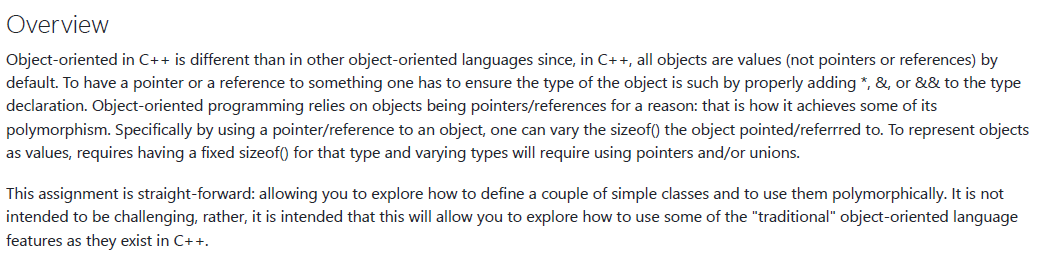
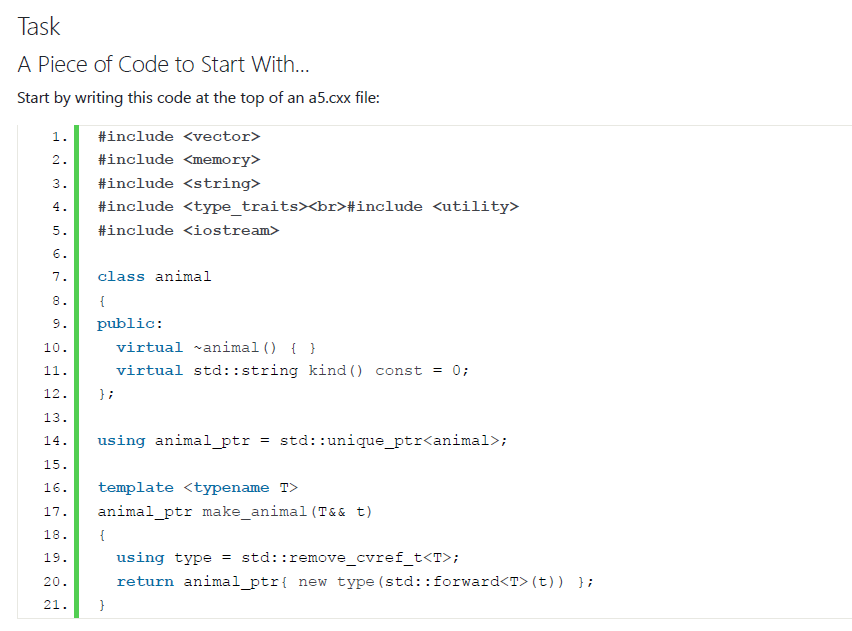
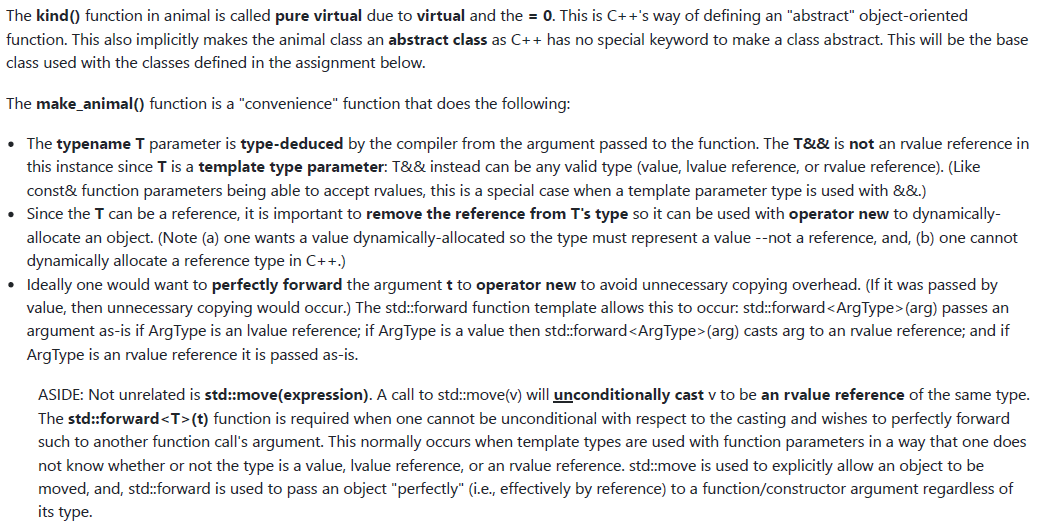
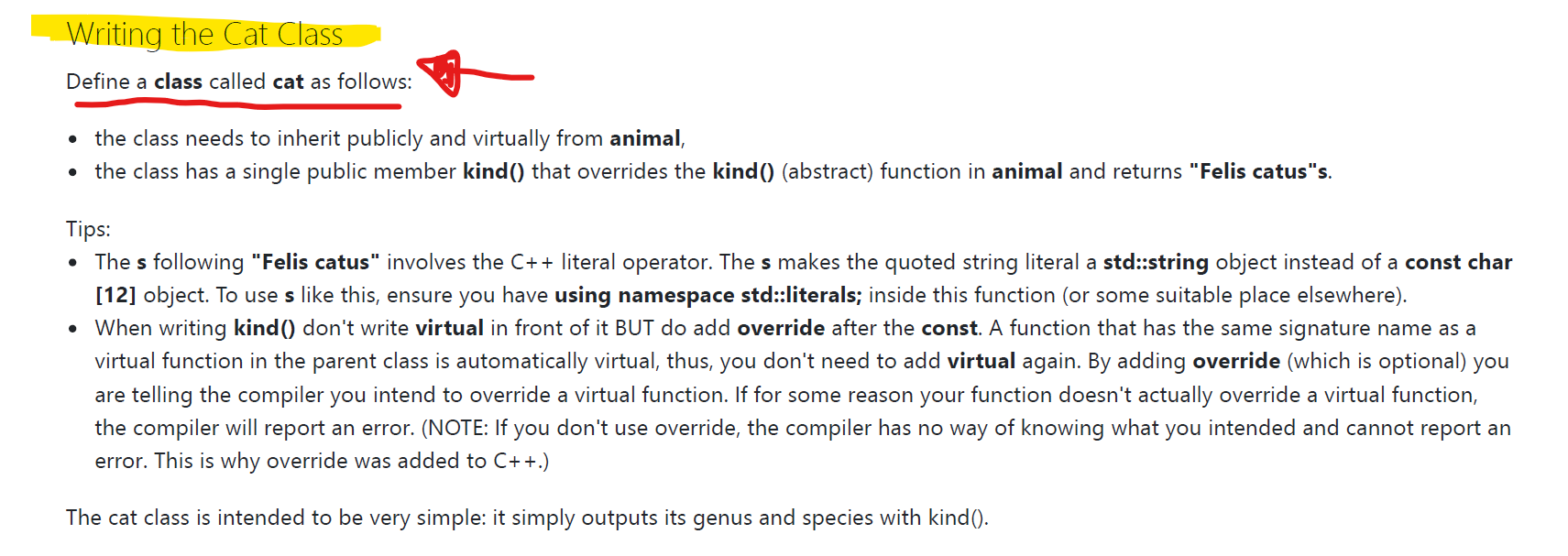
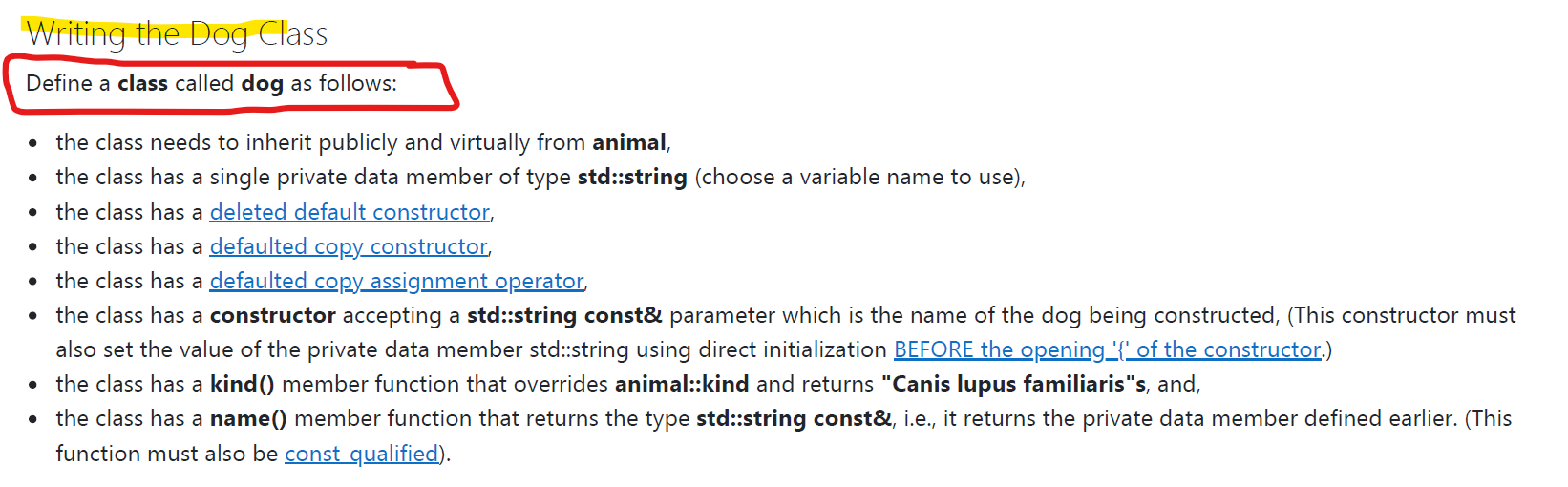
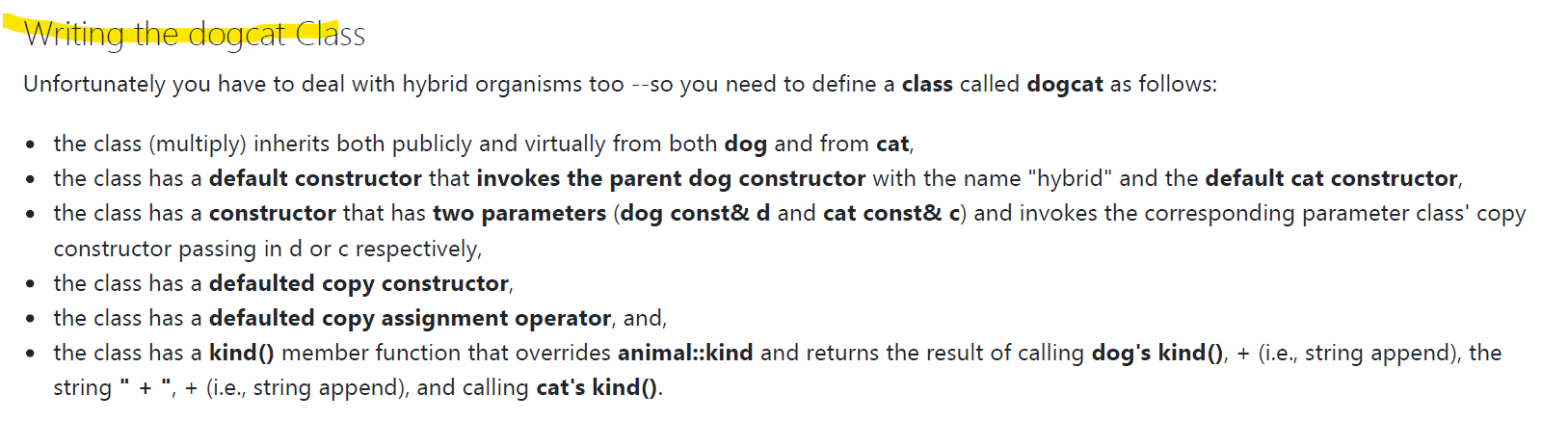
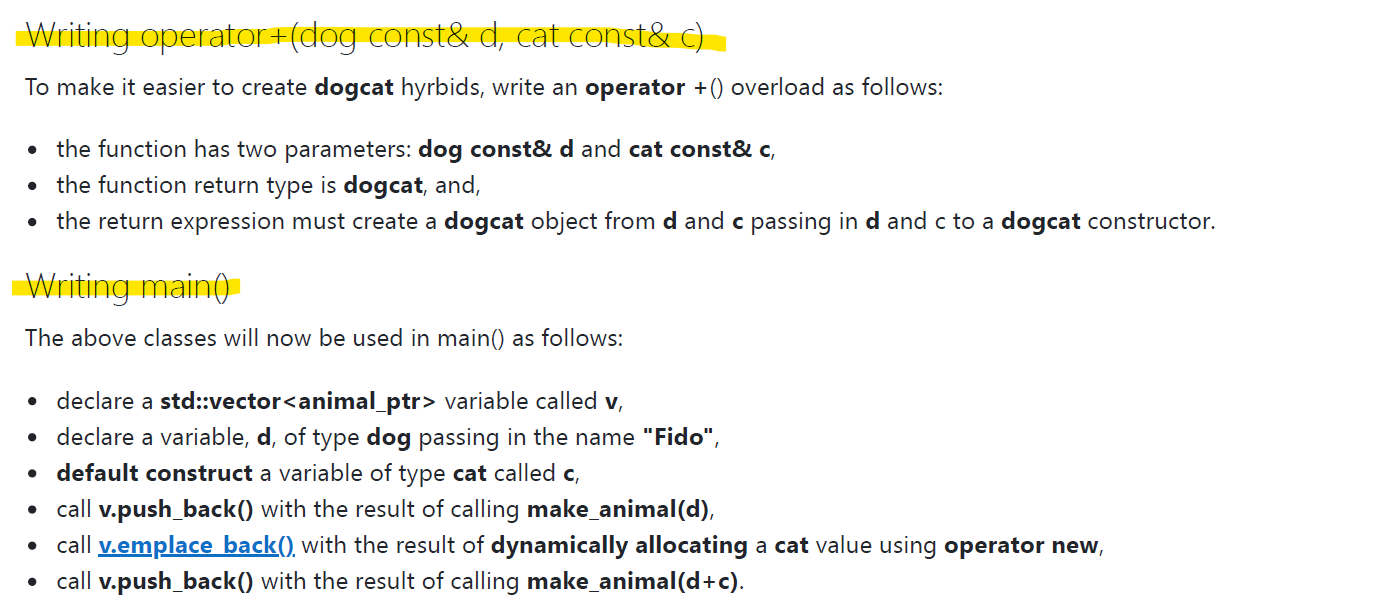

Overview Object-oriented in C++ is different than in other object-oriented languages since, in C++, all objects are values (not pointers or references) by default. To have a pointer or a reference to something one has to ensure the type of the object is such by properly adding *, &, or && to the type declaration. Object-oriented programming relies on objects being pointers/references for a reason that is how it achieves some of its polymorphism. Specifically by using a pointer/reference to an object, one can vary the sizeof() the object pointed/referred to. To represent objects as values, requires having a fixed sizeof() for that type and varying types will require using pointers and/or unions. This assignment is straight-forward: allowing you to explore how to define a couple of simple classes and to use them polymorphically. It is not intended to be challenging, rather, it is intended that this will allow you to explore how to use some of the "traditional" object-oriented language features as they exist in C++. Task A Piece of Code to Start With... Start by writing this code at the top of an a5.cxx file: 1. 2. 3. #include #include #include #include #include 5. 6. 7. 8. 9. class animal { public: virtual -animal() { } virtual std::string kind() const = 0; }; 10. 11. 12. 13. 14. using animal_ptr = std:: unique_ptr; 15. 16. 17. 18. template animal_ptr make_animal (T&& t) { using type std::remove_cvref_t; return animal_ptr{ new type (std:: forward(t)) }; } 19. 20. 21. The kind() function in animal is called pure virtual due to virtual and the = 0. This is C++'s way of defining an "abstract" object-oriented function. This also implicitly makes the animal class an abstract class as C++ has no special keyword to make a class abstract. This will be the base class used with the classes defined in the assignment below. The make_animal() function is a "convenience" function that does the following: The typename T parameter is type-deduced by the compiler from the argument passed to the function. The T&& is not an rvalue reference in this instance since T is a template type parameter: T&& instead can be any valid type (value, Ivalue reference, or rvalue reference). (Like const& function parameters being able to accept rvalues, this is a special case when a template parameter type is used with &&.) Since the T can be a reference, it is important to remove the reference from T's type so it can be used with operator new to dynamically- allocate an object. (Note (a) one wants a value dynamically-allocated so the type must represent a value --not a reference, and, (b) one cannot dynamically allocate a reference type in C++.) Ideally one would want to perfectly forward the argument t to operator new to avoid unnecessary copying overhead. (If it was passed by value, then unnecessary copying would occur.) The std::forward function template allows this to occur: std:forward (arg) passes an argument as-is if ArgType is an Ivalue reference; if ArgType is a value then std::forward(arg) casts arg to an rvalue reference; and if ArgType is an rvalue reference it is passed as-is. . ASIDE: Not unrelated is std::move(expression). A call to std::move(V) will unconditionally cast v to be an rvalue reference of the same type. The std::forward(t) function is required when one cannot be unconditional with respect to the casting and wishes to perfectly forward such to another function call's argument. This normally occurs when template types are used with function parameters in a way that one does not know whether or not the type is a value, Ivalue reference, or an rvalue reference. std::move is used to explicitly allow an object to be moved, and, std::forward is used to pass an object "perfectly" (i.e., effectively by reference) to a function/constructor argument regardless of its type. Writing the Cat Class Define a class called cat as follows: the class needs to inherit publicly and virtually from animal, the class has a single public member kind() that overrides the kind() (abstract) function in animal and returns "Felis catus"s. . Tips: The s following "Felis catus" involves the C++ literal operator. The s makes the quoted string literal a std::string object instead of a const char [12] object. To use s like this, ensure you have using namespace std::literals; inside this function (or some suitable place elsewhere). When writing kind() don't write virtual in front of it BUT do add override after the const. A function that has the same signature name as a virtual function in the parent class is automatically virtual, thus, you don't need to add virtual again. By adding override (which is optional) you are telling the compiler you intend to override a virtual function. If for some reason your function doesn't actually override a virtual function, the compiler will report an error. (NOTE: If you don't use override, the compiler has no way of knowing what you intended and cannot report an error. This is why override was added to C++.) The cat class is intended to be very simple: it simply outputs its genus and species with kind(). Writing the Dog Class Define a class called dog as follows: . the class needs to inherit publicly and virtually from animal, the class has a single private data member of type std::string (choose a variable name to use), the class has a deleted default constructor, the class has a defaulted copy constructor, the class has a defaulted copy assignment operator, the class has a constructor accepting a std::string const& parameter which is the name of the dog being constructed, (This constructor must also set the value of the private data member std::string using direct initialization BEFORE the opening_{' of the constructor.) the class has a kind() member function that overrides animal::kind and returns "Canis lupus familiaris's, and, the class has a name() member function that returns the type std::string const&, i.e., it returns the private data member defined earlier. (This function must also be const-qualified). Writing the Dog Class Define a class called dog as follows: . the class needs to inherit publicly and virtually from animal, the class has a single private data member of type std::string (choose a variable name to use), the class has a deleted default constructor, the class has a defaulted copy constructor, the class has a defaulted copy assignment operator, the class has a constructor accepting a std::string const& parameter which is the name of the dog being constructed, (This constructor must also set the value of the private data member std::string using direct initialization BEFORE the opening_{' of the constructor.) the class has a kind() member function that overrides animal::kind and returns "Canis lupus familiaris's, and, the class has a name() member function that returns the type std::string const&, i.e., it returns the private data member defined earlier. (This function must also be const-qualified). Writing the dogcat Class Unfortunately you have to deal with hybrid organisms too --so you need to define a class called dogcat as follows: the class (multiply) inherits both publicly and virtually from both dog and from cat, the class has a default constructor that invokes the parent dog constructor with the name "hybrid" and the default cat constructor, the class has a constructor that has two parameters (dog const& d and cat const& c) and invokes the corresponding parameter class' copy constructor passing in d or c respectively, the class has a defaulted copy constructor, the class has a defaulted copy assignment operator, and, the class has a kind() member function that overrides animal::kind and returns the result of calling dog's kind(), + (i.e., string append), the string" + ", + (i.e., string append), and calling cat's kind(). . Writing operator+(dog const& d, cat const& c) To make it easier to create dogcat hyrbids, write an operator +() overload as follows: the function has two parameters: dog const& d and cat const&c, the function return type is dogcat, and, the return expression must create a dogcat object from d and c passing in d and c to a dogcat constructor. Writing main() The above classes will now be used in main() as follows: declare a std::vector variable called v, declare a variable, d, of type dog passing in the name "Fido", default construct a variable of type cat called c, call v.push_back() with the result of calling make_animal(d), call v.emplace back(). with the result of dynamically allocating a cat value using operator new, call v.push_back() with the result of calling make_animal(d+c). out put 1. = 2. Canis lupus familiaris, name Fido Felis catus Canis lupus familiaris + Felis catus, name 3. = Fido Overview Object-oriented in C++ is different than in other object-oriented languages since, in C++, all objects are values (not pointers or references) by default. To have a pointer or a reference to something one has to ensure the type of the object is such by properly adding *, &, or && to the type declaration. Object-oriented programming relies on objects being pointers/references for a reason that is how it achieves some of its polymorphism. Specifically by using a pointer/reference to an object, one can vary the sizeof() the object pointed/referred to. To represent objects as values, requires having a fixed sizeof() for that type and varying types will require using pointers and/or unions. This assignment is straight-forward: allowing you to explore how to define a couple of simple classes and to use them polymorphically. It is not intended to be challenging, rather, it is intended that this will allow you to explore how to use some of the "traditional" object-oriented language features as they exist in C++. Task A Piece of Code to Start With... Start by writing this code at the top of an a5.cxx file: 1. 2. 3. #include #include #include #include #include 5. 6. 7. 8. 9. class animal { public: virtual -animal() { } virtual std::string kind() const = 0; }; 10. 11. 12. 13. 14. using animal_ptr = std:: unique_ptr; 15. 16. 17. 18. template animal_ptr make_animal (T&& t) { using type std::remove_cvref_t; return animal_ptr{ new type (std:: forward(t)) }; } 19. 20. 21. The kind() function in animal is called pure virtual due to virtual and the = 0. This is C++'s way of defining an "abstract" object-oriented function. This also implicitly makes the animal class an abstract class as C++ has no special keyword to make a class abstract. This will be the base class used with the classes defined in the assignment below. The make_animal() function is a "convenience" function that does the following: The typename T parameter is type-deduced by the compiler from the argument passed to the function. The T&& is not an rvalue reference in this instance since T is a template type parameter: T&& instead can be any valid type (value, Ivalue reference, or rvalue reference). (Like const& function parameters being able to accept rvalues, this is a special case when a template parameter type is used with &&.) Since the T can be a reference, it is important to remove the reference from T's type so it can be used with operator new to dynamically- allocate an object. (Note (a) one wants a value dynamically-allocated so the type must represent a value --not a reference, and, (b) one cannot dynamically allocate a reference type in C++.) Ideally one would want to perfectly forward the argument t to operator new to avoid unnecessary copying overhead. (If it was passed by value, then unnecessary copying would occur.) The std::forward function template allows this to occur: std:forward (arg) passes an argument as-is if ArgType is an Ivalue reference; if ArgType is a value then std::forward(arg) casts arg to an rvalue reference; and if ArgType is an rvalue reference it is passed as-is. . ASIDE: Not unrelated is std::move(expression). A call to std::move(V) will unconditionally cast v to be an rvalue reference of the same type. The std::forward(t) function is required when one cannot be unconditional with respect to the casting and wishes to perfectly forward such to another function call's argument. This normally occurs when template types are used with function parameters in a way that one does not know whether or not the type is a value, Ivalue reference, or an rvalue reference. std::move is used to explicitly allow an object to be moved, and, std::forward is used to pass an object "perfectly" (i.e., effectively by reference) to a function/constructor argument regardless of its type. Writing the Cat Class Define a class called cat as follows: the class needs to inherit publicly and virtually from animal, the class has a single public member kind() that overrides the kind() (abstract) function in animal and returns "Felis catus"s. . Tips: The s following "Felis catus" involves the C++ literal operator. The s makes the quoted string literal a std::string object instead of a const char [12] object. To use s like this, ensure you have using namespace std::literals; inside this function (or some suitable place elsewhere). When writing kind() don't write virtual in front of it BUT do add override after the const. A function that has the same signature name as a virtual function in the parent class is automatically virtual, thus, you don't need to add virtual again. By adding override (which is optional) you are telling the compiler you intend to override a virtual function. If for some reason your function doesn't actually override a virtual function, the compiler will report an error. (NOTE: If you don't use override, the compiler has no way of knowing what you intended and cannot report an error. This is why override was added to C++.) The cat class is intended to be very simple: it simply outputs its genus and species with kind(). Writing the Dog Class Define a class called dog as follows: . the class needs to inherit publicly and virtually from animal, the class has a single private data member of type std::string (choose a variable name to use), the class has a deleted default constructor, the class has a defaulted copy constructor, the class has a defaulted copy assignment operator, the class has a constructor accepting a std::string const& parameter which is the name of the dog being constructed, (This constructor must also set the value of the private data member std::string using direct initialization BEFORE the opening_{' of the constructor.) the class has a kind() member function that overrides animal::kind and returns "Canis lupus familiaris's, and, the class has a name() member function that returns the type std::string const&, i.e., it returns the private data member defined earlier. (This function must also be const-qualified). Writing the Dog Class Define a class called dog as follows: . the class needs to inherit publicly and virtually from animal, the class has a single private data member of type std::string (choose a variable name to use), the class has a deleted default constructor, the class has a defaulted copy constructor, the class has a defaulted copy assignment operator, the class has a constructor accepting a std::string const& parameter which is the name of the dog being constructed, (This constructor must also set the value of the private data member std::string using direct initialization BEFORE the opening_{' of the constructor.) the class has a kind() member function that overrides animal::kind and returns "Canis lupus familiaris's, and, the class has a name() member function that returns the type std::string const&, i.e., it returns the private data member defined earlier. (This function must also be const-qualified). Writing the dogcat Class Unfortunately you have to deal with hybrid organisms too --so you need to define a class called dogcat as follows: the class (multiply) inherits both publicly and virtually from both dog and from cat, the class has a default constructor that invokes the parent dog constructor with the name "hybrid" and the default cat constructor, the class has a constructor that has two parameters (dog const& d and cat const& c) and invokes the corresponding parameter class' copy constructor passing in d or c respectively, the class has a defaulted copy constructor, the class has a defaulted copy assignment operator, and, the class has a kind() member function that overrides animal::kind and returns the result of calling dog's kind(), + (i.e., string append), the string" + ", + (i.e., string append), and calling cat's kind(). . Writing operator+(dog const& d, cat const& c) To make it easier to create dogcat hyrbids, write an operator +() overload as follows: the function has two parameters: dog const& d and cat const&c, the function return type is dogcat, and, the return expression must create a dogcat object from d and c passing in d and c to a dogcat constructor. Writing main() The above classes will now be used in main() as follows: declare a std::vector variable called v, declare a variable, d, of type dog passing in the name "Fido", default construct a variable of type cat called c, call v.push_back() with the result of calling make_animal(d), call v.emplace back(). with the result of dynamically allocating a cat value using operator new, call v.push_back() with the result of calling make_animal(d+c). out put 1. = 2. Canis lupus familiaris, name Fido Felis catus Canis lupus familiaris + Felis catus, name 3. = Fido









 Study Help