







Question: I need help with this problem (Yield to maturity) Fitzgerald's 35 -year bonds pay 6 percent interest annually on a $1.000 par value. If the
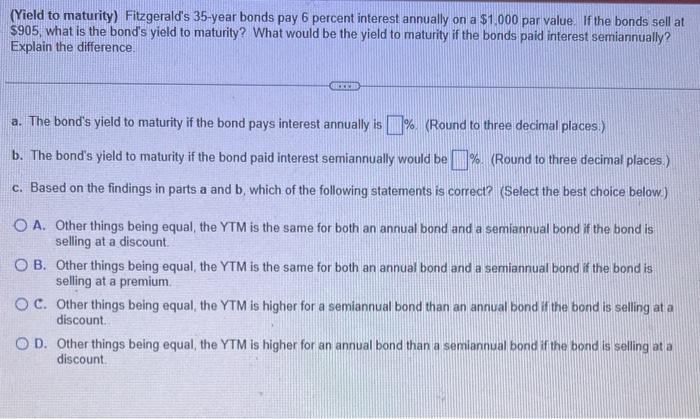
(Yield to maturity) Fitzgerald's 35 -year bonds pay 6 percent interest annually on a $1.000 par value. If the bonds sell at \$905, what is the bond's yield to maturity? What would be the yield to maturity if the bonds paid interest semiannually? Explain the difference. a. The bond's yield to maturity if the bond pays interest annually is \%. (Round to three decimal places:) b. The bond's yield to maturity if the bond paid interest semiannually would be \%. (Round to three decimal places.) c. Based on the findings in parts a and b, which of the following statements is correct? (Select the best choice below) A. Other things being equal, the YTM is the same for both an annual bond and a semiannual bond if the bond is selling at a discount. B. Other things being equal, the YTM is the same for both an annual bond and a semiannual bond if the bond is selling at a premium. C. Other things being equal, the YTM is higher for a semiannual bond than an annual bond if the bond is selling at a discount. D. Other things being equal, the YTM is higher for an annual bond than a semiannual bond if the bond is selling at a discount
Step by Step Solution
There are 3 Steps involved in it

Get step-by-step solutions from verified subject matter experts
 Study Help