







Question: I need help with this program. It must use a header file (Complex.h) and Complex.cpp. The main.cpp is for part a is #include using namespace
I need help with this program. It must use a header file (Complex.h) and Complex.cpp.
The main.cpp is for part a is
#include
#include "Complex.h"
int main(void) { double a, b; const int MAX_ITERATIONS = 255;
cout > a; cin >> b;
Complex c(a,b); Complex r(0,0);
int i = 1; while (true) { r = r*r; r = r+c; //cout 4) break; if (i == MAX_ITERATIONS) break; i++; }
cout
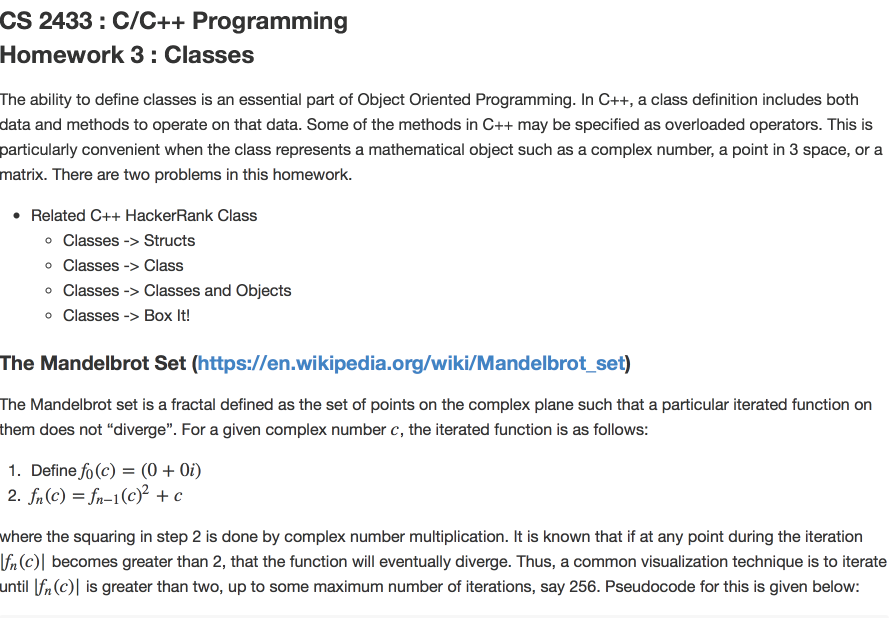
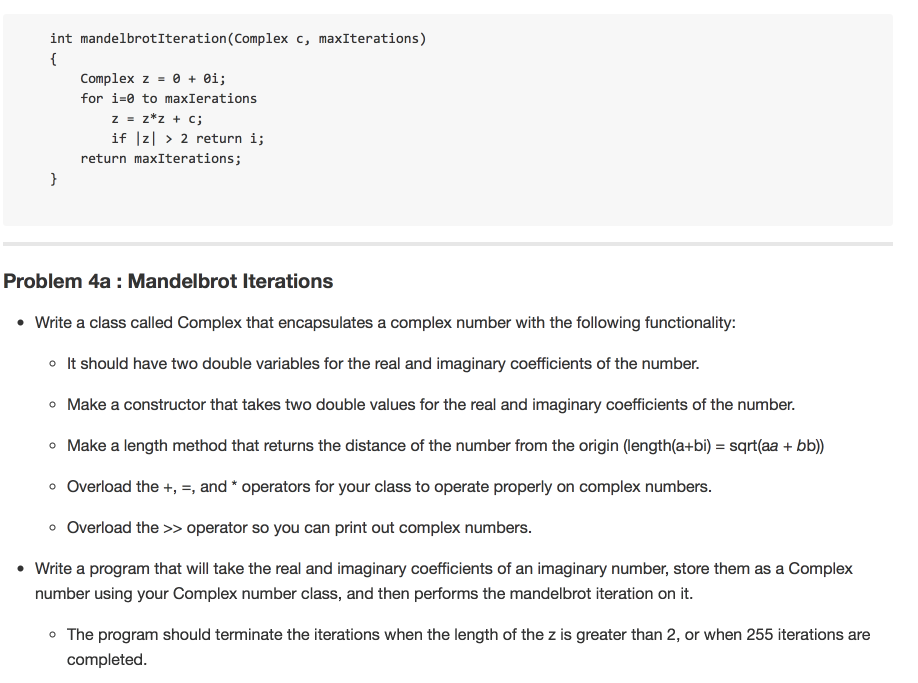
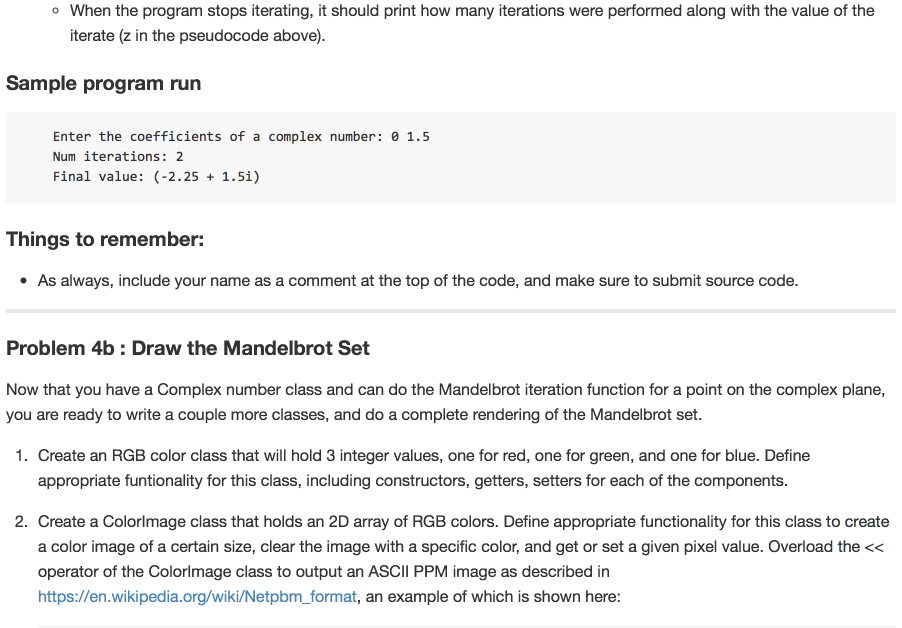
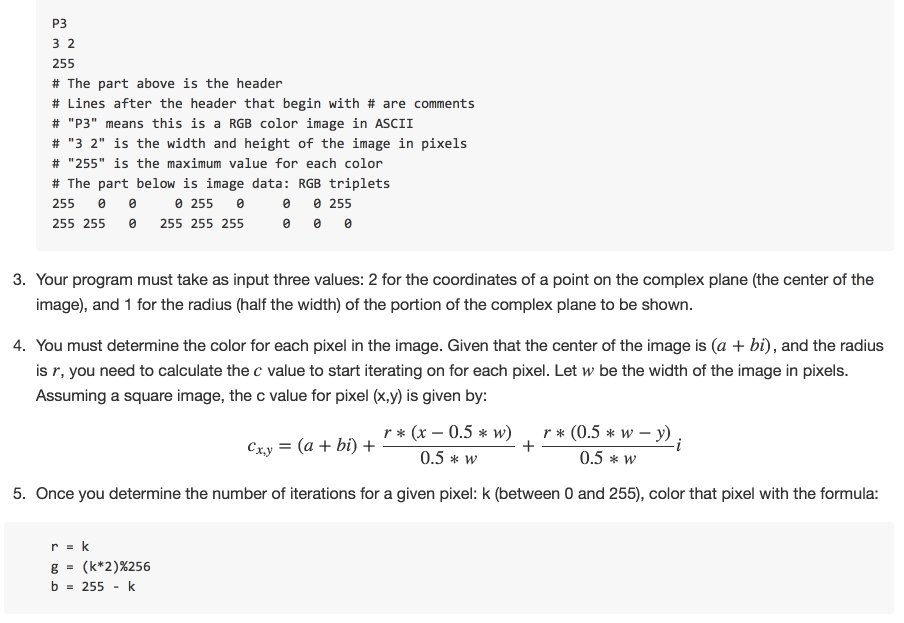

CS 2433:C/C++ Programming Homework 3 : Classes The ability to define classes is an essential part of Object Oriented Programming. In C++, a class definition includes both data and methods to operate on that data. Some of the methods in C++ may be specified as overloaded operators. This is particularly convenient when the class represents a mathematical object such as a complex number, a point in 3 space, or a matrix. There are two problems in this homework. Related C++ HackerRank Class o Classes-> Structs o Classes-Class o Classes-Classes and Objects o Classes->Box It! The Mandelbrot Set (https://en.wikipedia.org/wiki/Mandelbrot set) The Mandelbrot set is a fractal defined as the set of points on the complex plane such that a particular iterated function on them does not "diverge". For a given complex number c, the iterated function is as follows: 1. Define,6(c) = (0+00 where the squaring in step 2 is done by complex number multiplication. It is known that if at any point during the iteration n (c)] becomes greater than 2, that the function will eventually diverge. Thus, a common visualization technique is to iterate until a(c) is greater than two, up to some maximum number of iterations, say 256. Pseudocode for this is given below
Step by Step Solution
There are 3 Steps involved in it

Get step-by-step solutions from verified subject matter experts
 Study Help