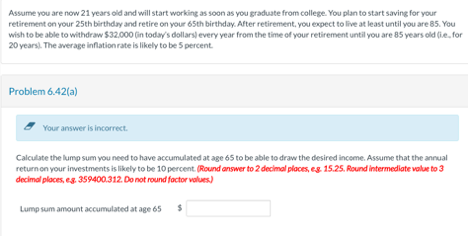
Question: i need help with this question. i have tried over 30 times and cannot get the correct answer. Assume you are now 21 years old
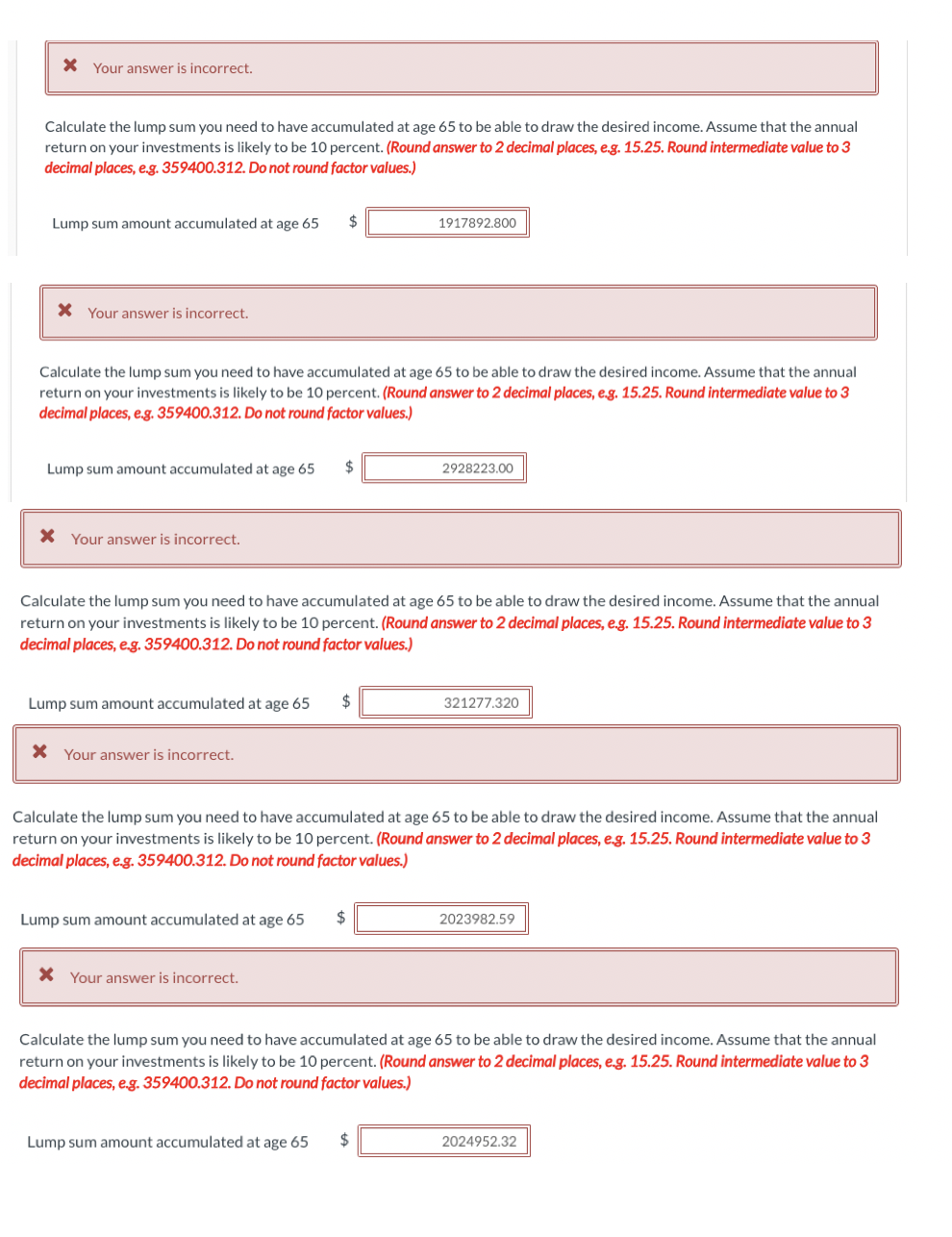
i need help with this question. i have tried over 30 times and cannot get the correct answer.
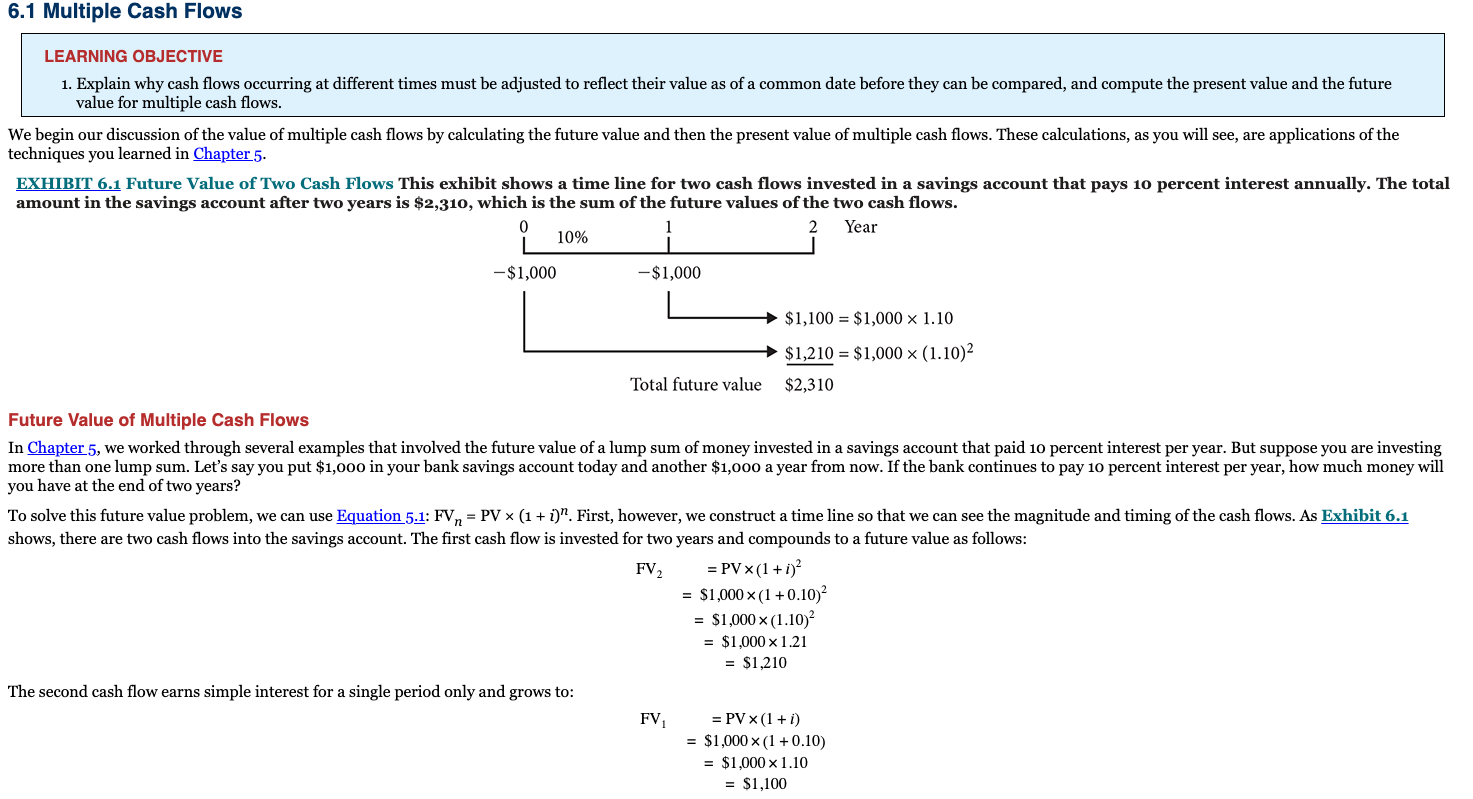
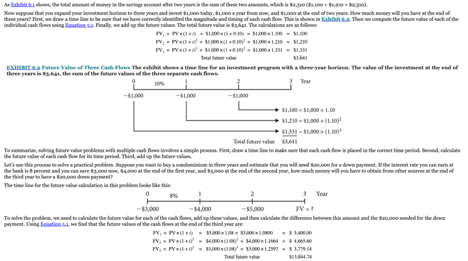
Assume you are now 21 years old and will start working as soon as you graduate from college. You plan to start saving for your retirement on your 25th birthday and retire on your 65th birthday. After retirement, you expect to live at least until you are 85. You wish to be able to withdraw $32.000 (in today's dollars every year from the time of your retirement until you are 85 years old jie, for 20 yearsl The average Inflation rate is likely to be 5 percent Problem 6.42(a) Your answer is Incorrect. Calculate the lump sum you need to have accumulated at age 65 to be able to draw the desired income. Assume that the annual return on your investments is likely to be 10 percent (Round answer to 2 dedimal places, e.g. 15.25. Round intermediate value to 3 decimal places, eg. 359400.312. Do not round factor values) Lump sum amount accumulated at age 656.1 Multiple Cash Flows LEARNING OBJECTIVE 1. Explain why cash flows occurring at different times must be adjusted to reflect their value as of a common date before they can be compared, and compute the present value and the future value for multiple cash flows. We begin our discussion of the value of multiple cash flows by calculating the future value and then the present value of multiple cash flows. These calculations, as you will see, are applications of the techniques you learned in Chapter 5. EXHIBIT 6.1 Future Value of Two Cash Flows This exhibit shows a time line for two cash flows invested in a savings account that pays 10 percent interest annually. The total amount in the savings account after two years is $2,310, which is the sum of the future values of the two cash flows. 0 10% 1 2 Year $1,000 $1,000 IP $1,100 = $1,000 x 1.10 $1,210 = $1,000 x (1.10)2 Total future value $2,310 Future Value of Multiple Cash Flows In Chapter 5, we worked through several examples that involved the future value of a lump sum of money invested in a savings account that paid 10 percent interest per year. But suppose you are investing more than one lump sum. Let's say you put $1,000 in your bank savings account today and another $1,000 a year from now. If the bank continues to pay 10 percent interest per year, how much money will you have at the end of two years? To solve this future value problem, we can use Equation 5.1: FV,, = PV x (1 + 1). First, however, we construct a time line so that we can see the magnitude and timing of the cash flows. As Exhibit 6.1 shows, there are two cash flows into the savings account. The first cash flow is invested for two years and compounds to a future value as follows: FV, =PVx(l+i) = $1,000% (1 +0.10* = $1,000% (1.10 = 51,000x1.21 = 1.210 The second cash flow earns simple interest for a single period only and grows to: FV, =PVx(l+i) = $1,000x (1 +0.10) = 1,000x1.10 = 51,100 EXHIBIT & a Future Valet of Theer Cash Flows The noback down a time line for an Imesimred program with a there year harboon. The value of the lovesimral if they red of Year The thee bing for the fobore value sabolition in this problem looks Whe this Year -HOO' X Your answer is incorrect. l Calculate the lump sum you need to have accumulated at age 65 to be able to draw the desired income. Assume that the annual return on your investments is likely to be 10 percent. (Round answer to 2 decimal places, e.g. 15.25. Round intermediate value to 3 decimal places, e.g. 359400.312. Do not round factor values.) Lump sum amount accumulated at age 65 $ 1917892.800 ' % Your answer is incorrect. ' Calculate the lump sum you need to have accumulated at age 65 to be able to draw the desired income. Assume that the annual return on your investments is likely to be 10 percent. (Round answer to 2 decimal places, e.g. 15.25. Round intermediate value to 3 decimal places, eg. 359400.312, Do not round factor values.) Lump sum amount accumulated at age 65 $ 2928223.00 % Your answer is incorrect. Calculate the lump sum you need to have accumulated at age 65 to be able to draw the desired income. Assume that the annual return on your investments is likely to be 10 percent. (Round answer to 2 decimal places, e.g. 15.25. Round intermediate value to 3 decimal places, e.g. 359400.312. Do not round factor values.) Lump sum amount accumulated at age 65 $ 321277.320 R vour answer is incorrect. Calculate the lump sum you need to have accumulated at age 65 to be able to draw the desired income. Assume that the annual return on your investments is likely to be 10 percent. (Round answer to 2 decimal places, e.g. 15.25. Round intermediate value to 3 decimal places, e.g. 359400.312. Do not round factor values.) Lump sum amount accumulated at age 65 $ 2023982.59 R Your answer is incorrect. Calculate the lump sum you need to have accumulated at age 65 to be able to draw the desired income. Assume that the annual return on your investments is likely to be 10 percent. (Round answer to 2 decimal places, e.g. 15.25. Round intermediate value to 3 decimal places, e.g. 359400.312. Do not round factor values.) Lump sum amount accumulated at age 65 $ 202495232
Step by Step Solution
There are 3 Steps involved in it
1 Expert Approved Answer
Step: 1 Unlock
Question Has Been Solved by an Expert!
Get step-by-step solutions from verified subject matter experts
Step: 2 Unlock
Step: 3 Unlock
Students Have Also Explored These Related Finance Questions!









 Study Help