







Question: I need help with this question. While it is often assumed that the probabilities of having a boy or a girl are the same, the
I need help with this question.
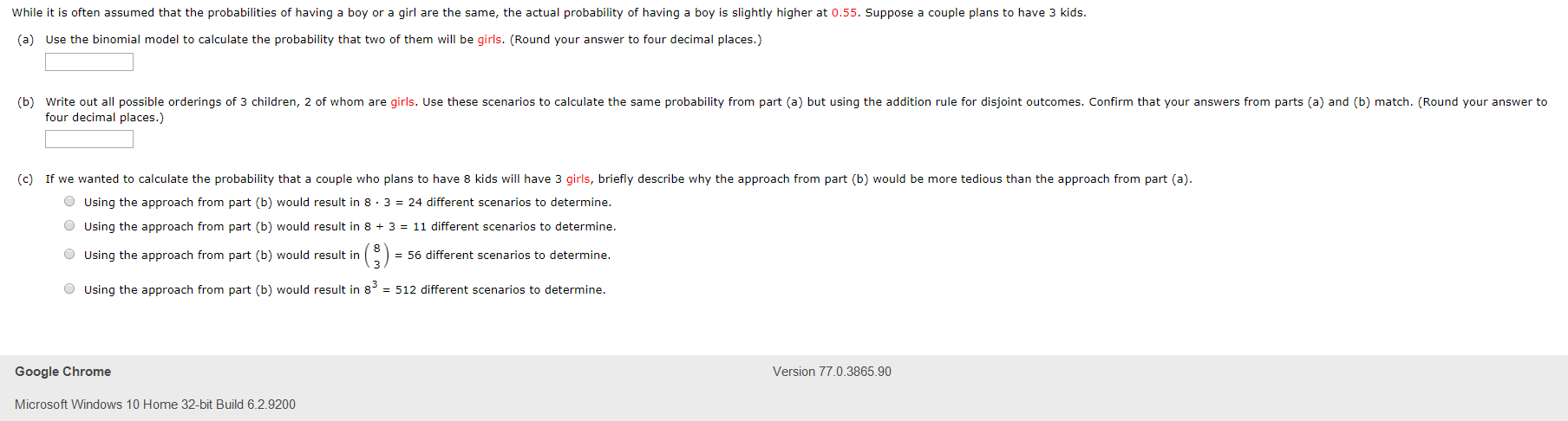
While it is often assumed that the probabilities of having a boy or a girl are the same, the actual probability of having a boy is slightly higher at 0.55. Suppose a couple plans to have 3 kids. (a) Use the binomial model to calculate the probability that two of them will be girls. (Round your answer to four decimal places.) (b) Write out all possible orderings of 3 children, 2 of whom are girls. Use these scenarios to calculate the same probability from part (a) but using the addition rule for disjoint outcomes. Confirm that your answers from parts (a) and (b) match. (Round your answer to four decimal places.) (c) If we wanted to calculate the probability that a couple who plans to have 8 kids will have 3 girls, briefly describe why the approach from part (b) would be more tedious than the approach from part (a). Using the approach from part (b) would result in 8 . 3 = 24 different scenarios to determine. Using the approach from part (b) would result in 8 + 3 = 11 different scenarios to determine. Using the approach from part (b) would result in (, ) = 56 different scenarios to determine. Using the approach from part (b) would result in 8 = 512 different scenarios to determine. Google Chrome Version 77.0.3865.90 Microsoft Windows 10 Home 32-bit Build 6.2.9200
Step by Step Solution
There are 3 Steps involved in it

Get step-by-step solutions from verified subject matter experts
 Study Help