







Question: I need help with this STAT problem in the screenshot below: An association of college bookstores reported that the average amount of money spent by
I need help with this STAT problem in the screenshot below:
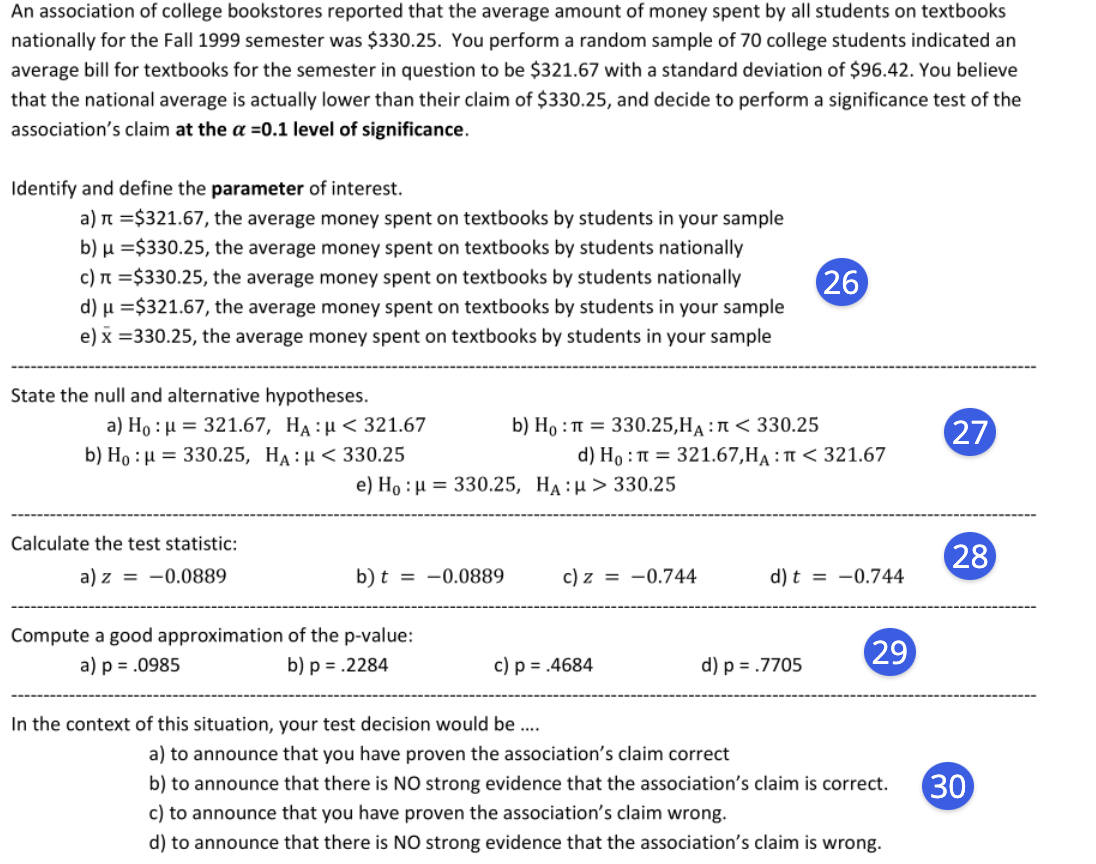
An association of college bookstores reported that the average amount of money spent by all students on textbooks nationally for the Fall 1999 semester was $330.25. You perform a random sample of 70 college students indicated an average bill for textbooks for the semester in question to be $321.67 with a standard deviation of $96.42. You believe that the national average is actually lower than their claim of $330.25, and decide to perform a significance test of the association's claim at the a =0.1 level of significance. Identify and define the parameter of interest. a) It =$321.67, the average money spent on textbooks by students in your sample b) u =$330.25, the average money spent on textbooks by students nationally c) it =$330.25, the average money spent on textbooks by students nationally 26 d) u =$321.67, the average money spent on textbooks by students in your sample e) x =330.25, the average money spent on textbooks by students in your sample State the null and alternative hypotheses. a) Ho: H = 321.67, HA : H 330.25 Calculate the test statistic: 28 a) z = -0.0889 b) t = -0.0889 c) z = -0.744 d) t = -0.744 Compute a good approximation of the p-value: a) p = .0985 b) p =.2284 c) p = .4684 d) p= .7705 29 In the context of this situation, your test decision would be .... a) to announce that you have proven the association's claim correct b) to announce that there is NO strong evidence that the association's claim is correct. 30 c) to announce that you have proven the association's claim wrong. d) to announce that there is NO strong evidence that the association's claim is wrong
Step by Step Solution
There are 3 Steps involved in it

Get step-by-step solutions from verified subject matter experts
 Study Help