Question: I need help with this worksheet please. It due at 11:59ET Tonight!! I need all answers correct please. Theoretical vs Empirical Probability Theoretical Probability: Find

I need help with this worksheet please. It due at 11:59ET Tonight!! I need all answers correct please.
I need help with this worksheet please. It due atI need help with this worksheet please. It due atI need help with this worksheet please. It due atI need help with this worksheet please. It due at
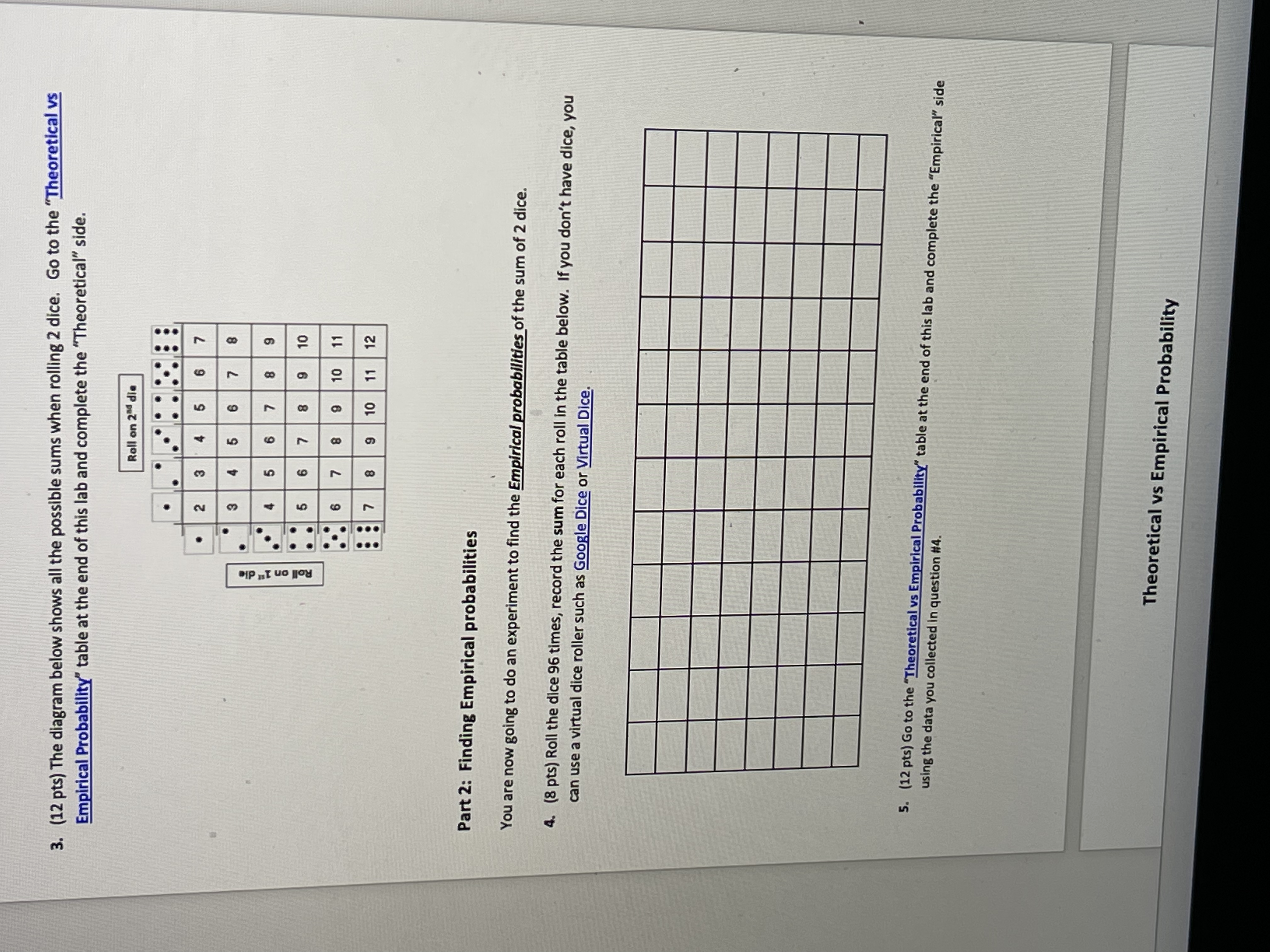
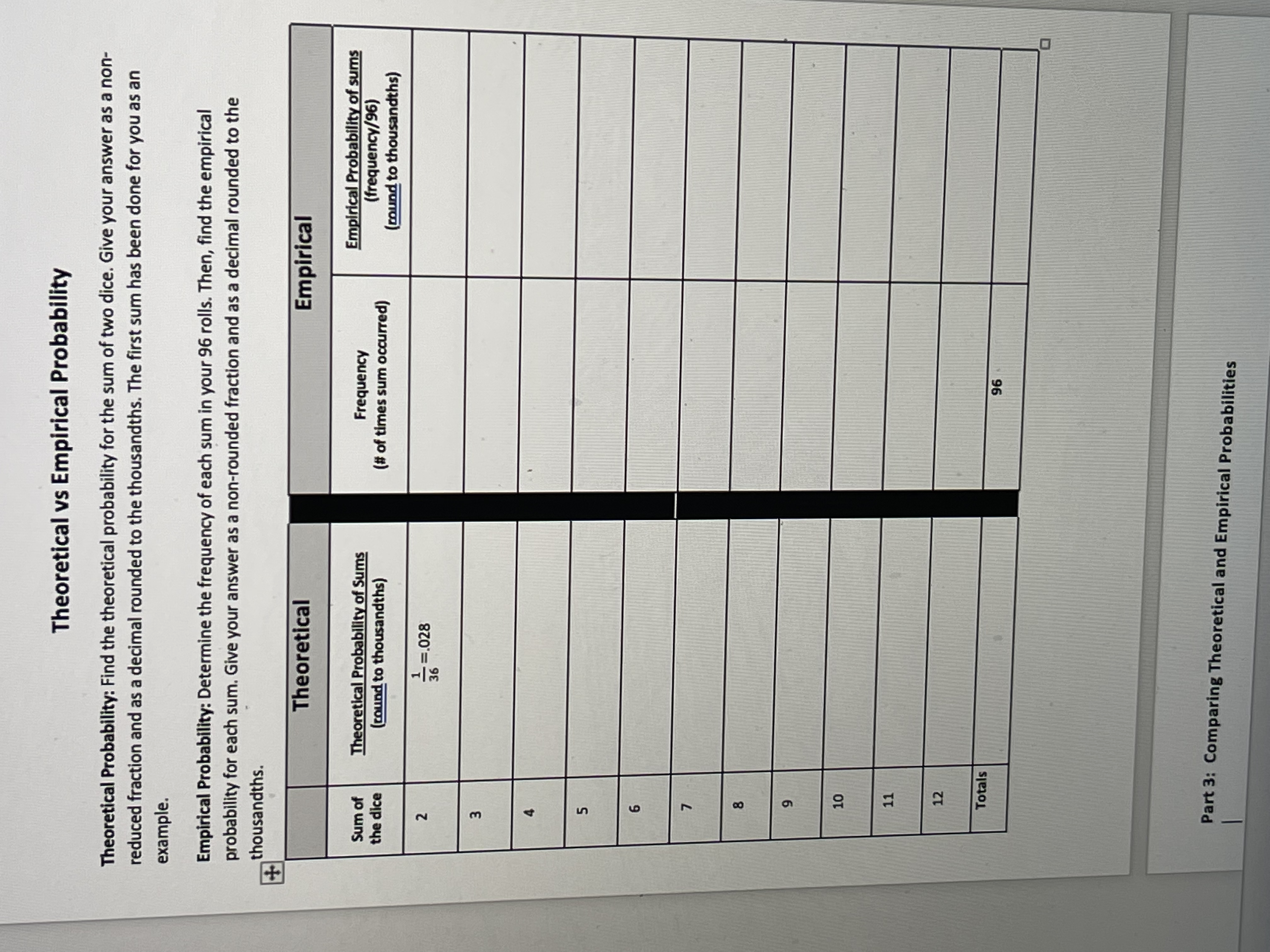
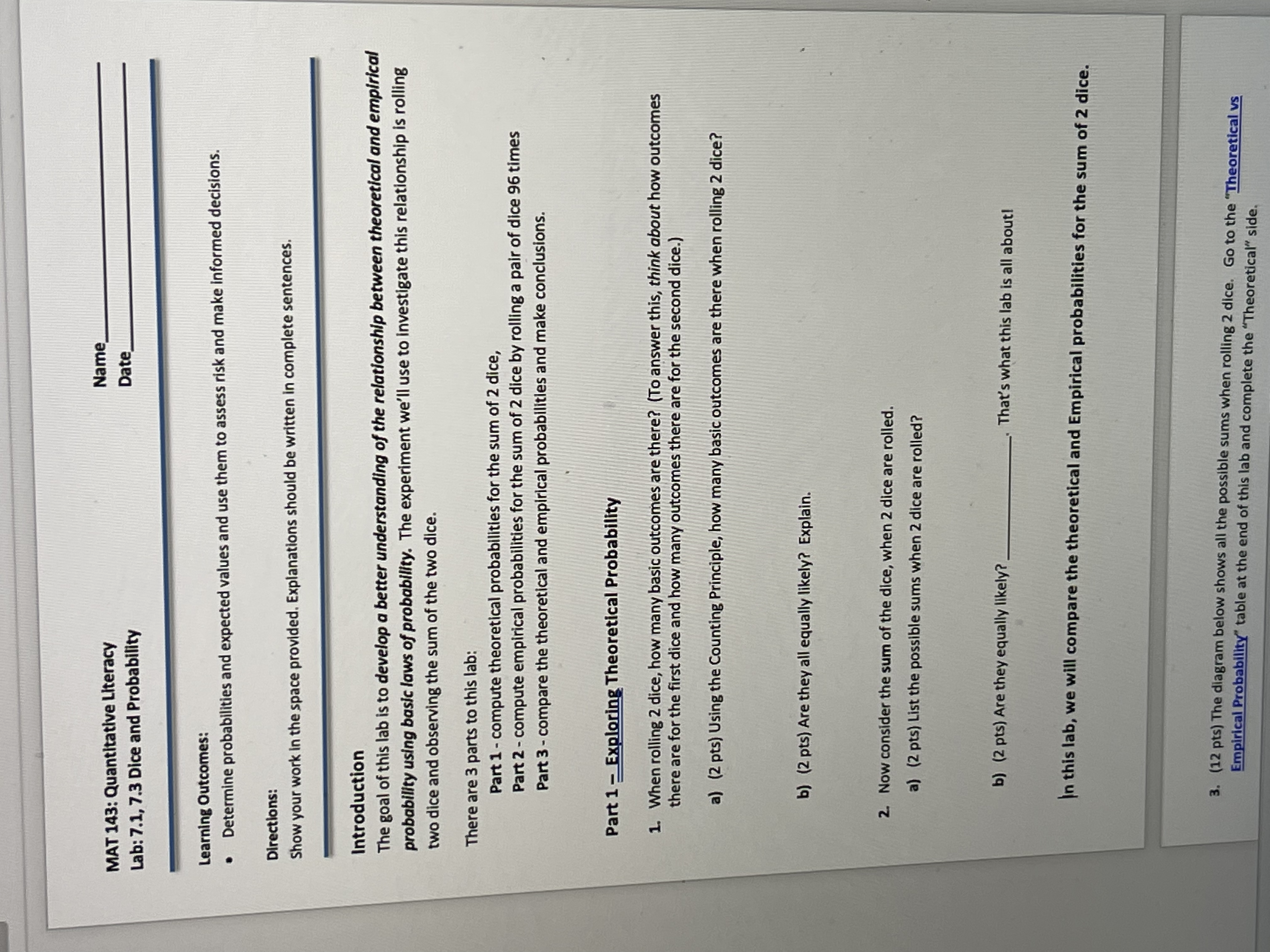
Theoretical vs Empirical Probability Theoretical Probability: Find the theoretical probability for the sum of two dice. Give your answer as a non- reduced fraction and as a decimal rounded to the thousandths. The first sum has been done for you as an example. Empirical Probability: Determine the frequency of each sum in your 96 rolls. Then, find the empirical probability for each sum. Give your answer as a non-rounded fraction and as a decimal rounded to the thousandths. + Theoretical Empirical Sum of Theoretical Probability of Sums Frequency Empirical Probability of sums the dice (round to thousandths) (# of times sum occurred) (frequency/96) (round to thousandths) V 1 =.028 Totals Part 3: Comparing Theoretical and Empirical ProbabilitiesMAT 143: Quantitative Literacy Name Lab: 7.1, 7.3 Dice and Probability Date Learning Outcomes: . Determine probabilities and expected values and use them to assess risk and make informed decisions. Directions: Show your work in the space provided. Explanations should be written in complete sentences. Introduction The goal of this lab is to develop a better understanding of the relationship between theoretical and empirical probability using basic laws of probability. The experiment we'll use to investigate this relationship is rolling two dice and observing the sum of the two dice. There are 3 parts to this lab: Part 1 - compute theoretical probabilities for the sum of 2 dice, Part 2 - compute empirical probabilities for the sum of 2 dice by rolling a pair of dice 96 times Part 3 - compare the theoretical and empirical probabilities and make conclusions. Part 1= Exploring Theoretical Probability 1. When rolling 2 dice, how many basic outcomes are there? (To answer this, think about how outcomes there are for the first dice and how many outcomes there are for the second dice.) a) (2 pts) Using the Counting Principle, how many basic outcomes are there when rolling 2 dice? b) (2 pts) Are they all equally likely? Explain. 2. Now consider the sum of the dice, when 2 dice are rolled. a) (2 pts) List the possible sums when 2 dice are rolled? b) (2 pts) Are they equally likely? That's what this lab is all about! In this lab, we will compare the theoretical and Empirical probabilities for the sum of 2 dice. 3. (12 pts) The diagram below shows all the possible sums when rolling 2 dice. Go to the "Theoretical vs Empirical Probability' table at the end of this lab and complete the "Theoretical" side.Part 3: Comparing Theoretical and Empirical Probabilities Please answer these questions using complete sentences. Be specific about the similarities and differences you discovered in your experiment 6. (5 pts) Look at each sum, how do your empirical probabilities compare to the theoretical probabilities in the previous chart? To answer this, make observations related to how similar/dissimilar the 2 probabilities are. 7. (5 pts) How do you think the theoretical probabilities would compare to the empirical probabilities if we rolled the pair of dice 500 times? 1,000 times? 1,000,000 times? This is called the "Law of Large Numbers". FA F7 DI

Step by Step Solution

There are 3 Steps involved in it

1 Expert Approved Answer
Step: 1 Unlock blur-text-image

Question Has Been Solved by an Expert!

Get step-by-step solutions from verified subject matter experts

Step: 2 Unlock
Step: 3 Unlock

Students Have Also Explored These Related Mathematics Questions!