







Question: I need help with using the information from the scenario case to filling this out Scenario: Veronica Sarkozy, the CFO for the firm PSUWC Designer
 I need help with using the information from the scenario case to filling this out
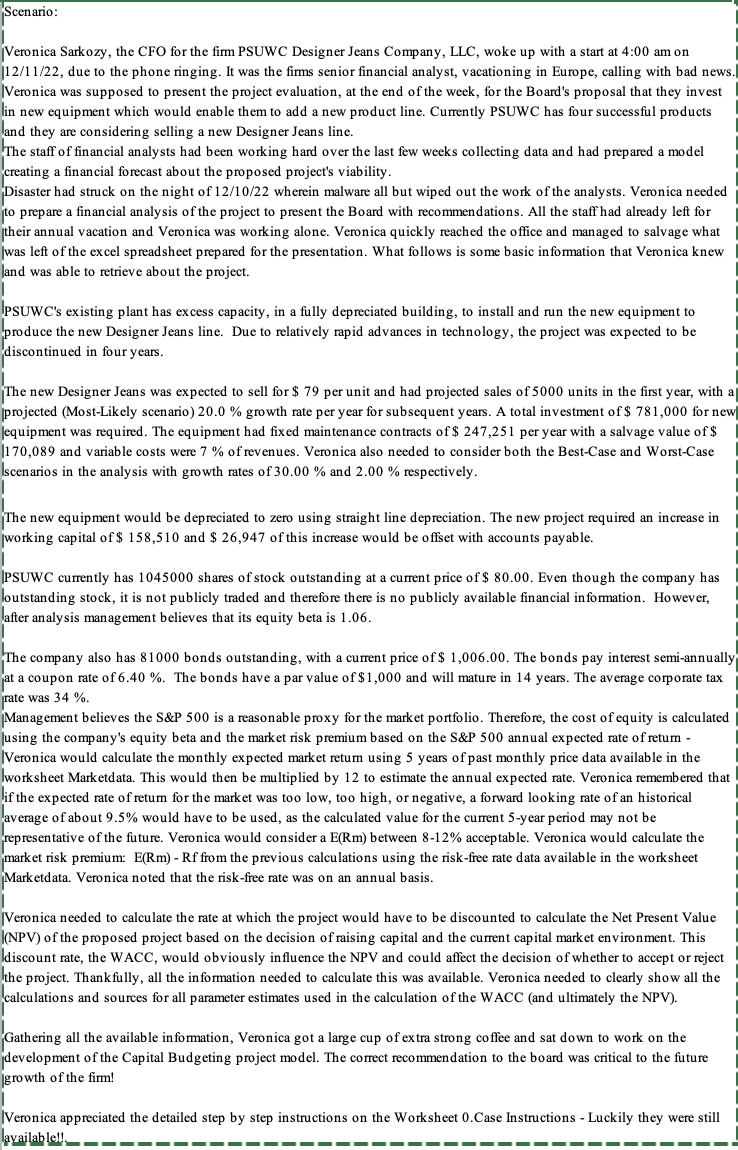
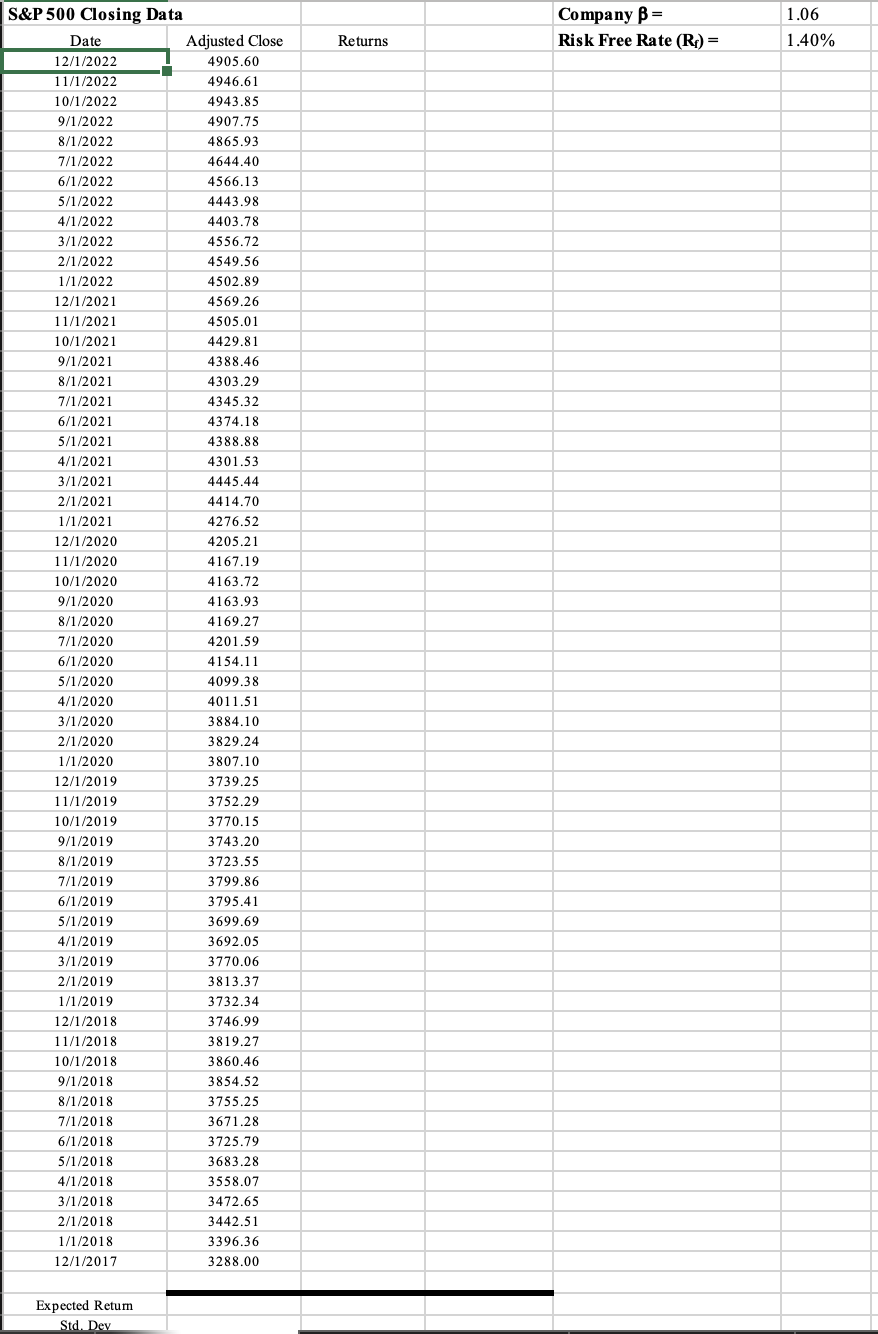
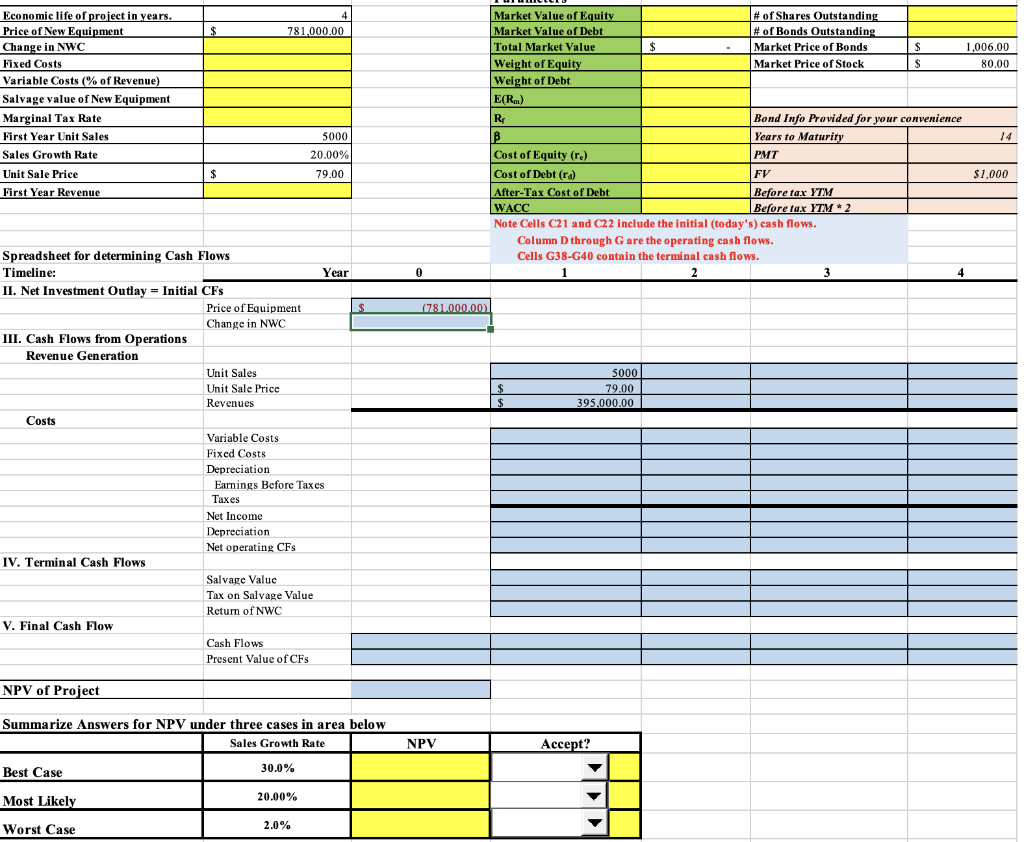
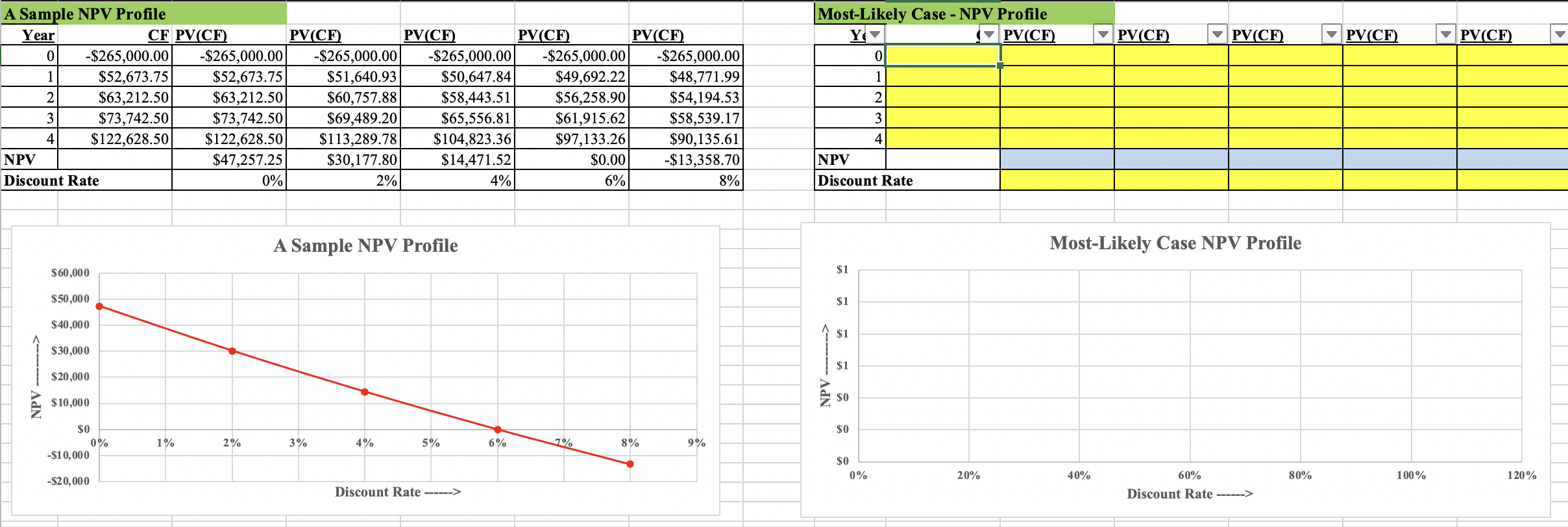
Scenario: Veronica Sarkozy, the CFO for the firm PSUWC Designer Jeans Company, LLC, woke up with a start at 4:00 am on |12/11/22, due to the phone ringing. It was the firms senior financial analyst, vacationing in Europe, calling with bad news. |Veronica was supposed to present the project evaluation, at the end of the week, for the Board's proposal that they invest lin new equipment which would enable them to add a new product line. Currently PSUWC has four successful products land they are considering selling a new Designer Jeans line. The staff of financial analysts had been working hard over the last few weeks collecting data and had prepared a model creating a financial forecast about the proposed project's viability. Disaster had struck on the night of 12/10/22 wherein malware all but wiped out the work of the analysts. Veronica needed to prepare a financial analysis of the project to present the Board with recommendations. All the staff had already left for their annual vacation and Veronica was working alone. Veronica quickly reached the office and managed to salvage what |was left of the excel spreadsheet prepared for the presentation. What follows is some basic information that Veronica knew land was able to retrieve about the project. PSUWC's existing plant has excess capacity, in a fully depreciated building, to install and run the new equipment to produce the new Designer Jeans line. Due to relatively rapid advances in technology, the project was expected to be discontinued in four years. The new Designer Jeans was expected to sell for $79 per unit and had projected sales of 5000 units in the first year, with a projected (Most-Likely scenario) 20.0% growth rate per year for subsequent years. A total investment of $781,000 for new lequipment was required. The equipment had fixed maintenance contracts of $247,251 per year with a salvage value of $ |170,089 and variable costs were 7% of revenues. Veronica also needed to consider both the Best-Case and Worst-Case Iscenarios in the analysis with growth rates of 30.00% and 2.00% respectively. The new equipment would be depreciated to zero using straight line depreciation. The new project required an increase in porking capital of $158,510 and $26,947 of this increase would be offset with accounts payable. |PSUWC currently has 1045000 shares of stock outstanding at a current price of $80.00. Even though the company has loutstanding stock, it is not publicly traded and therefore there is no publicly available financial information. However, lafter analysis management believes that its equity beta is 1.06. The company also has 81000 bonds outstanding, with a current price of $1,006.00. The bonds pay interest semi-annually at a coupon rate of 6.40%. The bonds have a par value of $1,000 and will mature in 14 years. The average corporate tax rate was 34%. Management believes the S\&P 500 is a reasonable proxy for the market portfolio. Therefore, the cost of equity is calculated fusing the company's equity beta and the market risk premium based on the S\&P 500 annual expected rate of retum Veronica would calculate the monthly expected market retum using 5 years of past monthly price data available in the lworksheet Marketdata. This would then be multiplied by 12 to estimate the annual expected rate. Veronica remembered that if the expected rate of retum for the market was too low, too high, or negative, a forward looking rate of an historical average of about 9.5% would have to be used, as the calculated value for the current 5 -year period may not be representative of the future. Veronica would consider a E(Rm) between 8-12\% acceptable. Veronica would calculate the market risk premium: E(Rm) - Rf from the previous calculations using the risk-free rate data available in the worksheet Marketdata. Veronica noted that the risk-free rate was on an annual basis. |Veronica needed to calculate the rate at which the project would have to be discounted to calculate the Net Present Value INPV) of the proposed project based on the decision of raising capital and the current capital market environment. This Idiscount rate, the WACC, would obviously influence the NPV and could affect the decision of whether to accept or reject the project. Thankfully, all the information needed to calculate this was available. Veronica needed to clearly show all the calculations and sources for all parameter estimates used in the calculation of the WACC (and ultimately the NPV). Gathering all the available information, Veronica got a large cup of extra strong coffee and sat down to work on the development of the Capital Budgeting project model. The correct recommendation to the board was critical to the future growth of the firm! Veronica appreciated the detailed step by step instructions on the Worksheet 0.Case Instructions - Luckily they were still layailable!! Note Cells C21 and C22 include the initial (today's) cash flows. Column D through G are the operating cash flows. Spreadsheet for determining Cash Flows Cells G38-G40 contain the terminal cash flows. Timeline: Year 1 2 II. Net Investment Outlay = Initial CFs \begin{tabular}{|l|} \hline$(781.000.00) \\ \hline \\ \hline \end{tabular} III. Cash Flows from Operations Change in NWC Revenue Generation Unit Sales Unit Sale Price Revenues NPV of Project Summarize Answers for NPV under three cases in area below \begin{tabular}{|l|c|c|c|c|} \hline & Sales Growth Rate & NPV & Accept? \\ \hline Best Case & 30.0% & & & \\ \hline Most Likely & 20.00% & & & \\ \hline Worst Case & 2.0% & & & \\ \hline \end{tabular} \begin{tabular}{r|r|r|r|r|r|r|} \hline A Sample NPV Profile & & & & & \\ \hline Year & \multicolumn{1}{|c|}{ CF } & PV(CF) & \multicolumn{1}{l|}{ PV(CF) } & \multicolumn{1}{l|}{ PV(CF) } & \multicolumn{1}{l|}{ PV(CF) } & \multicolumn{1}{l|}{ PV(CF) } \\ \hline 0 & $265,000.00 & $265,000.00 & $265,000.00 & $265,000.00 & $265,000.00 & $265,000.00 \\ \hline 1 & $52,673.75 & $52,673.75 & $51,640.93 & $50,647.84 & $49,692.22 & $48,771.99 \\ \hline 2 & $63,212.50 & $63,212.50 & $60,757.88 & $58,443.51 & $56,258.90 & $54,194.53 \\ \hline 3 & $73,742.50 & $73,742.50 & $69,489.20 & $65,556.81 & $61,915.62 & $58,539.17 \\ \hline 4 & $122,628.50 & $122,628.50 & $113,289.78 & $104,823.36 & $97,133.26 & $90,135.61 \\ \hline NPV & & $47,257.25 & $30,177.80 & $14,471.52 & $0.00 & $13,358.70 \\ \hline Discount Rate & 0% & 2% & 4% & 6% & 8% \\ \hline \end{tabular} A Sample NPV Profile Most-Likely Case NPV Profile
Step by Step Solution
There are 3 Steps involved in it

Get step-by-step solutions from verified subject matter experts
 Study Help