Question: I need help writing this assignment. Everything you need to know for the assignment is mentioned in the photos below. The bottom picture is first
I need help writing this assignment. Everything you need to know for the assignment is mentioned in the photos below. The bottom picture is first on the first three pictures.
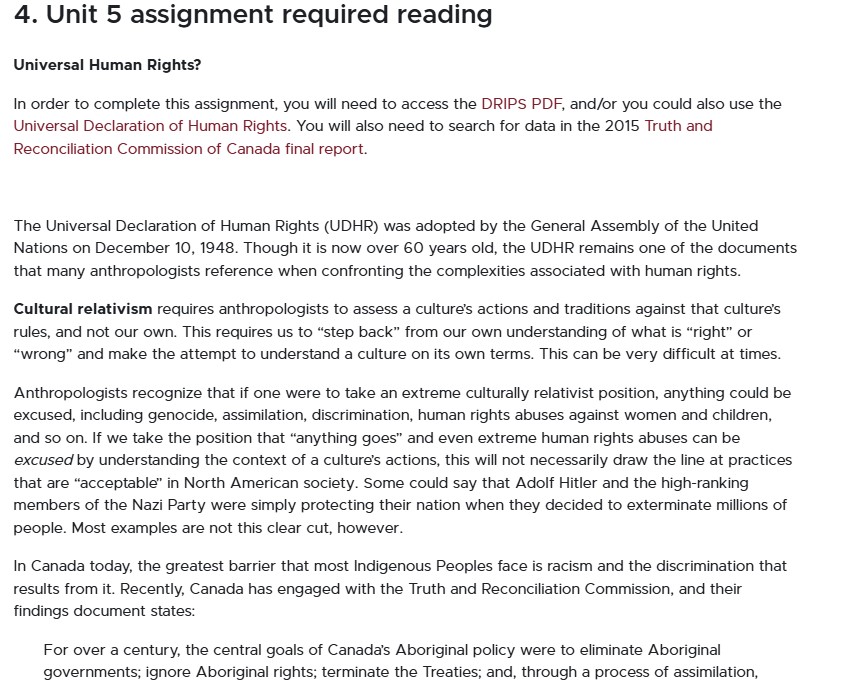
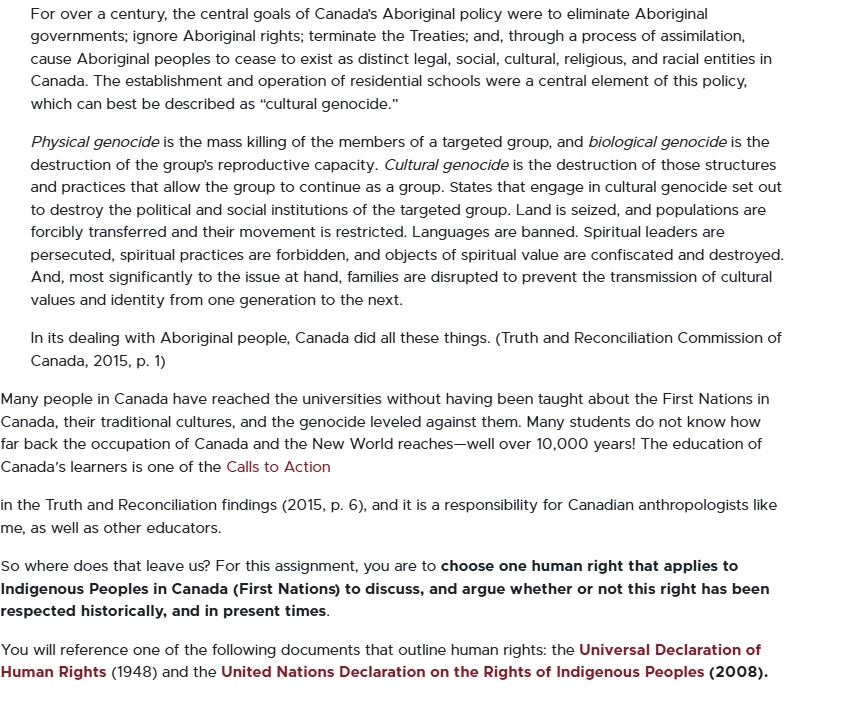
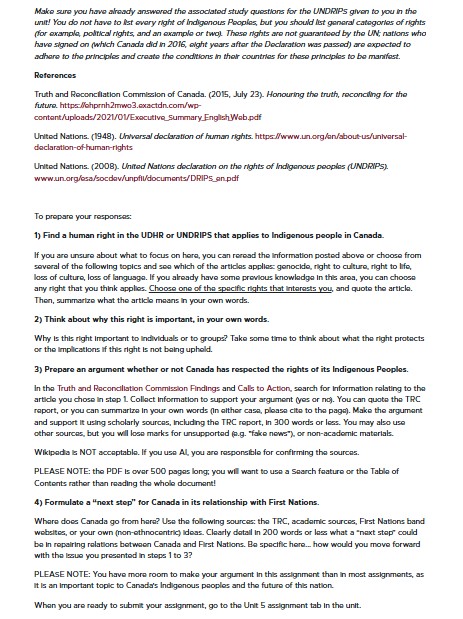
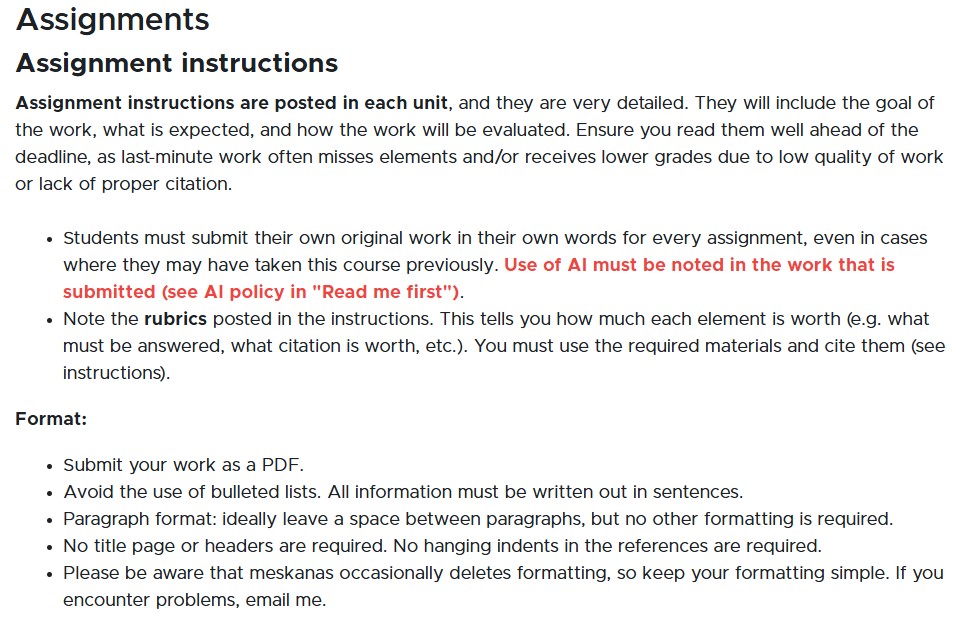
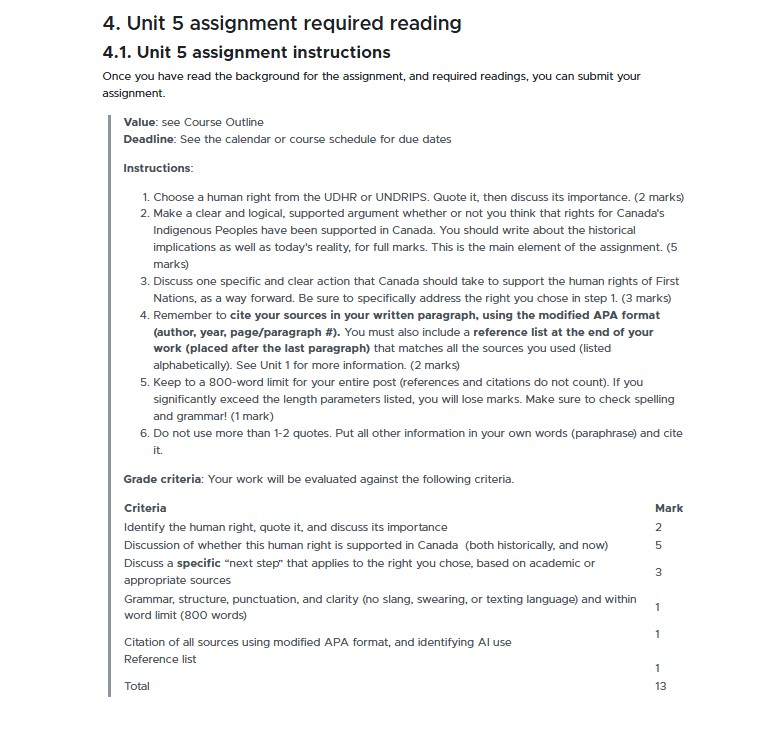
4. Unit 5 assignment required reading Universal Human Rights? In order to complete this assignment, you will need to access the DRIPS PDF, and/or you could also use the Universal Declaration of Human Rights. You will also need to search for data in the 2015 Truth and Reconciliation Commission of Canada final report. The Universal Declaration of Hurnan Rights (UDHR) was adopted by the General Assembly of the United Nations on December 10, 1948. Though it is now over 60 years old, the UDHR remains one of the documents that many anthropologists reference when confronting the complexities associated with human rights. Cultural relativism requires anthropologists to assess a culture's actions and traditions against that culture's rules, and not our own. This requires us to \"step back\" from our own understanding of what is \"right\" or \"wrong\" and make the attempt to understand a culture on its own terms. This can be very difficult at times. Anthropologists recognize that if one were to take an extreme culturally relativist position, anything could be excused, including genocide, assimilation, discrimination, human rights abuses against women and children, and 50 on. If we take the position that \"anything goes" and even extreme human rights abuses can be excused by understanding the context of a culture's actions, this will not necessarily draw the line at practices that are \"acceptable\" in North American society. Some could say that Adolf Hitler and the high-ranking members of the Nazi Party were simply protecting their nation when they decided to exterminate millions of people. Most examples are not this clear cut, however. In Canada today, the greatest barrier that most Indigenous Peoples face is racism and the discrimination that results from it. Recently, Canada has engaged with the Truth and Reconciliation Commission, and their findings document states: For over a century, the central goals of Canada's Aboriginal policy were to eliminate Aboriginal governments; ignore Aboriginal rights; terminate the Treaties; and, through a process of assimilation, For over a century, the central goals of Canada's Aboriginal policy were to eliminate Aboriginal governments; ignore Aboriginal rights; terminate the Treaties; and, through a process of assimilation, cause Aboriginal peoples to cease to exist as distinct legal, social, cultural, religious, and racial entities in Canada. The establishment and operation of residential schools were a central element of this policy, which can best be described as \"cultural genocide.\" Physical genocide is the mass killing of the members of a targeted group, and biological genocide is the destruction of the group's reproductive capacity. Cultural genocide is the destruction of those structures and practices that allow the group to continue as a group. States that engage in cultural genocide set out to destroy the political and social institutions of the targeted group. Land is seized, and populations are forcibly transferred and their movement is restricted. Languages are banned. Spiritual leaders are persecuted, spiritual practices are forbidden, and objects of spiritual value are confiscated and destroyed. And, most significantly to the issue at hand, families are disrupted to prevent the transmission of cultural values and identity from one generation to the next. In its dealing with Aboriginal people, Canada did all these things. (Truth and Reconciliation Commission of Canada, 2015, p. 1) Many people in Canada have reached the universities without having been taught about the First Nations in Canada, their traditional cultures, and the genocide leveled against them. Many students do not know how far back the occupation of Canada and the New World reacheswell over 10,000 years! The education of Canada's learners is one of the Calls to Action in the Truth and Reconciliation findings (2015, p. 6), and it is a responsibility for Canadian anthropologists like me, as well as other educators. So where does that leave us? For this assignment, you are to choose one human right that applies to Indigenous Peoples in Canada (First Nations) to discuss, and argue whether or not this right has been respected historically, and in present times. You will reference one of the following documents that outline human rights: the Universal Declaration of Human Rights (1948) and the United Nations Declaration on the Rights of Indigenous Peoples (2008). Make sure you have already answered the associated study questions for the UNDRIPS given to you in the unit! You do not have to Ist every right of Indigenous Peoples, but you should list general categories of rights for example, political rights, and an example or twol These rights are not guaranteed by the UN, nations who have signed on (which Canada did in 2016, eight years after the Declaration was passed) are expected to achore to the principles and create the conditions in their countries for these principles to be manifest. References Truth and Reconciliation Commission of Canada. (2015, July 23). Honouring the truth, reconciling for the future. https/ohpmh2mwo3.exactdn.com/wp- contant/uploads/2021/QVExecutive_Summary English Wab.pdf United Nations. (1948). Universal declaration of human rights. https /www.un.org/an/shout-us/universal- declaration-of human rights United Nations. (2008). United Nations declaration on the rights of Indigenous peoples (UNDRIPS). www.un.org/osa/socdaw/upfil/documents/DRIPs_on.pdf To prepare your responses I) Find a human right in the UDHR or UNDRIPS that applies to Indigenous people in Canada. If you are unsure about what to focus on hora, you can reread the Information posted above or choose from several of the following topics and sea which of the articles applies genocide, right to culture, right to life, loss of culture, loss of language. If you already have some previous knowledge In this area, you can choose any right that you think applies. Choose one of the specific rights that Interests you, and quote the article. Then, summarize what the article means In your own words. 2) Think about why this right is important, in your own words. Why Is this right Important to Individuals or to groups? Take some time to think about what the right protects or the Implications if this right is not baing uphold. 3) Prepare an argument whether or not Canada has respected the rights of its Indigenous Peoples. In the Truth and Recondlistion Commission Findings and Calls to Action, search for Information relating to the article you chose In stop L Collect Information to support your argument (yes or no). You can quote the TRC raport, or you can summarize In your own words (In alther casa, please cite to the page). Make the argument and support it using scholarly sources, Including the TRC report, In 300 words or less. You may also use other sources, but you will lose marks for unsupported (a.g. "fake nows"), or non-academic materials. Wikipedia Is NOT acceptable. If you use Al, you are responsible for confirming the sources. PLEASE NOTE: the PDF is over 500 pages long, you will want to use a Search feature or the Table of Contents rather than reading the whole document! 4) Formulate a "next stop" for Canada in its relationship with First Nations. Where does Canada go from here? Use the following sources: the TRC, academic sources, First Nations band websites, or your own (non-ethnocentric) Ideas. Clearly datall in 200 words or less what a "next stop" could ba In repairing relations between Canada and First Nations. Be specific here.. how would you move forward with the lasue you presented In stops 1 to 3? PLEASE NOTE: You have more room to make your argument In this assignment than In most assignments, as It Is an Important topic to Canada's Indigenous peoples and the future of this nation. When you are ready to submit your assignment, go to the Unit 5 assignment tab in the unit.Assignments Assignment instructions Assignment instructions are posted in each unit, and they are very detailed. They will include the goal of the work, what is expected, and how the work will be evaluated. Ensure you read them well ahead of the deadline, as last-minute work often misses elements and/or receives lower grades due to low quality of work or lack of proper citation. Students must submit their own original work in their own words for every assignment, even in cases where they may have taken this course previously. Use of Al must be noted in the work that is submitted (see Al policy in "Read me first"). * Note the rubrics posted in the instructions. This tells you how much each element is worth (e.g. what must be answered, what citation is worth, etc.). You must use the required materials and cite them (see instructions). Format: Submit your work as a PDF. Avoid the use of bulleted lists. All information must be written out in sentences. Paragraph format: ideally leave a space between paragraphs, but no other formatting is required. + No title page or headers are required. No hanging indents in the references are required. Please be aware that meskanas occasionally deletes formatting, so keep your formatting simple. If you encounter problems, email me. 4. Unit 5 assignment required reading 4.1. Unit 5 assignment instructions Once you have read the background for the assignment, and required readings, you can submit your assignment. Value: see Course Outline Deadline: See the calendar or course schedule for due dates Instructions: 1. Choose a human right from the UDHR or UNDRIPS. Quote it, then discuss its importance. (2 marks} 2. Make a clear and logical, supported argument whether or not you think that rights for Canada's Indigenous Peoples have been supported in Canada. You should write about the historical implications as well as today's reality, for full marks. This is the main element of the assignment. (5 marks) 3. Discuss one specific and clear action that Canada should take to support the human rights of First Nations, as a way forward. Be sure to specifically address the right you chose in step 1. (3 marks) 4. Remember to cite your sources in your written paragraph, using the modified APA format (author, year, page/paragraph #). You must also include a reference list at the end of your work (placed after the last paragraph) that matches all the sources you used (listed alphabetically). See Unit 1 for more information. (2 marks) 5. Keep to a 800-word limit for your entire post (references and citations do not count). If you significantly exceed the length parameters listed, you will lose marks. Make sure to check spelling and grammar! (1 mark) '6. Do not use more than 1-2 quotes. Put all other information in your own words (paraphrase) and cite it. Grade criteria: Your work will be evaluated against the following criteria. Criteria Mark Identify the human right, quote it, and discuss its importance 2 Discussion of whether this human right is supported in Canada (both historically, and now) 5 Discuss a specific \"next step\" that applies to the right you chose. based on academic or 7 appropriate sources Grammar, structure, punctuation, and clarity (no slang, swearing, or texting language} and within word limit (200 words) Citation of all sources using modified APA format, and identifying Al use Reference list Total B
Step by Step Solution
There are 3 Steps involved in it
1 Expert Approved Answer
Step: 1 Unlock
Question Has Been Solved by an Expert!
Get step-by-step solutions from verified subject matter experts
Step: 2 Unlock
Step: 3 Unlock
Students Have Also Explored These Related Sociology Questions!









 Study Help