







Question: i need it in python program thanks Exercise 7.3 (5 points) The relaxation method used for nonlinear equations can be easily extended to equations of
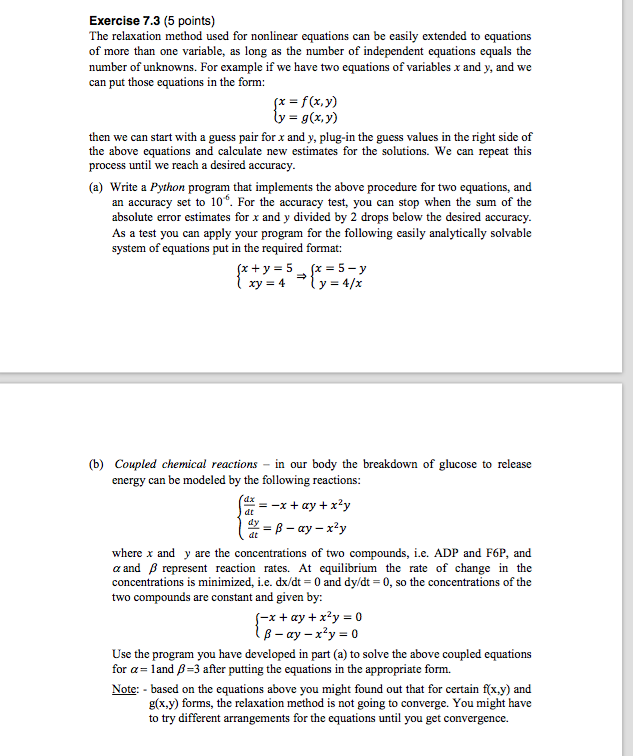
i need it in python program
thanks
Exercise 7.3 (5 points) The relaxation method used for nonlinear equations can be easily extended to equations of more than one variable, as long as the number of independent equations equals the number of unknowns. For example if we have two equations of variables x and y, and we can put those equations in the form: x-f(x,y) = g(x,y) values in the right side of then we can start with a guess pair for x and y, plug-in the guess the above equations and calculate new estimates for the solutions. We can repeat this process until we reach a desired a ccuracy (a) Write a Python program that implements the above procedure for two equations, and an accuracy set to 10. For the accuracy test, you can stop when the sum of the absolute error estimates for x and y divided by 2 drops below the desired accuracy As a test you can apply your program for the following easily analytically solvable system of equations put in the required format: (b) Coupled chemical reactions - in our body the breakdown of glucose to release energy can be modeled by the following reactions: where x and y are the concentrations of two compounds, i.e. ADP and F6P, and and represent reaction rates. At equilibrium the rate of change in the concentrations is minimized, i.e. dx/dt 0 and dy/dt-0, so the concentrations of the two compounds are constant and given by: Use the program you have developed in part (a) to solve the above coupled equations for -1 and A-3 after putting the equations in the appropriate form. Note: based on the equations above you might found out that for certain fx.y) and g(x,y) forms, the relaxation method is not going to converge. You might have to try different arrangements for the equations until you get convergence. Exercise 7.3 (5 points) The relaxation method used for nonlinear equations can be easily extended to equations of more than one variable, as long as the number of independent equations equals the number of unknowns. For example if we have two equations of variables x and y, and we can put those equations in the form: x-f(x,y) = g(x,y) values in the right side of then we can start with a guess pair for x and y, plug-in the guess the above equations and calculate new estimates for the solutions. We can repeat this process until we reach a desired a ccuracy (a) Write a Python program that implements the above procedure for two equations, and an accuracy set to 10. For the accuracy test, you can stop when the sum of the absolute error estimates for x and y divided by 2 drops below the desired accuracy As a test you can apply your program for the following easily analytically solvable system of equations put in the required format: (b) Coupled chemical reactions - in our body the breakdown of glucose to release energy can be modeled by the following reactions: where x and y are the concentrations of two compounds, i.e. ADP and F6P, and and represent reaction rates. At equilibrium the rate of change in the concentrations is minimized, i.e. dx/dt 0 and dy/dt-0, so the concentrations of the two compounds are constant and given by: Use the program you have developed in part (a) to solve the above coupled equations for -1 and A-3 after putting the equations in the appropriate form. Note: based on the equations above you might found out that for certain fx.y) and g(x,y) forms, the relaxation method is not going to converge. You might have to try different arrangements for the equations until you get convergence
Step by Step Solution
There are 3 Steps involved in it

Get step-by-step solutions from verified subject matter experts
 Study Help