







Question: I need it Urgently in an hour.I shall be really grateful.Thanks Question is complete. As an analyst at the Competition Bureau, you are tasked to
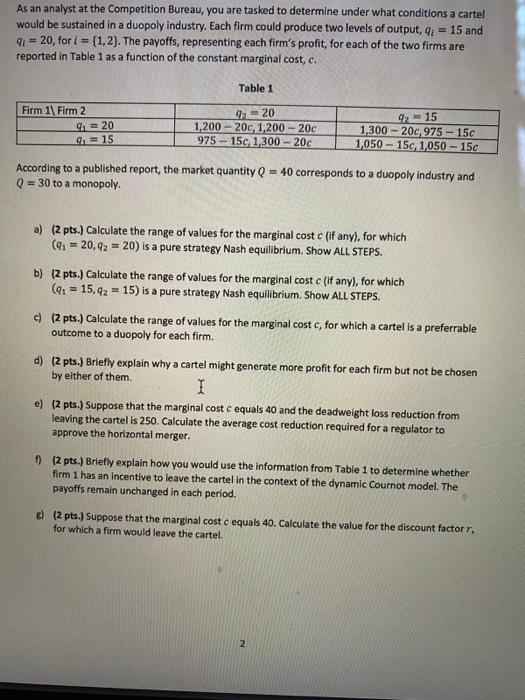
As an analyst at the Competition Bureau, you are tasked to determine under what conditions a cartel would be sustained in a duopoly industry. Each firm could produce two levels of output, = 15 and 91 = 20, for i = (1,2). The payoffs, representing each firm's profit, for each of the two firms are reported in Table 1 as a function of the constant marginal cost, c. Table 1 Firm 1 Firm 2 9 20 9 = 15 0 = 20 215 1,200-20c, 1,200 - 200 975 - 150 1,300 - 200 1,300 - 20c,975 - 150 1,050 - 15c 1,050 - 150 According to a published report, the market quantity Q = 40 corresponds to a duopoly Industry and Q = 30 to a monopoly, a) (2 pts.) Calculate the range of values for the marginal cost c (if any), for which (41 = 20,92 = 20) is a pure strategy Nash equilibrium. Show ALL STEPS. b) (2 pts.) Calculate the range of values for the marginal cost c (if any), for which (91 = 15.42 = 15) is a pure strategy Nash equilibrium. Show ALL STEPS. c) (2 pts.) Calculate the range of values for the marginal cost c, for which a cartel is a preferrable outcome to a duopoly for each firm. d) (2 pts.) Briefly explain why a cartel might generate more profit for each firm but not be chosen by either of them. I e) (2 pts.) Suppose that the marginal cost c equals 40 and the deadweight loss reduction from leaving the cartel is 250. Calculate the average cost reduction required for a regulator to approve the horizontal merger. n (2 pts.) Briefly explain how you would use the information from Table 1 to determine whether firm 1 has an incentive to leave the cartel in the context of the dynamic Cournot model. The payoffs remain unchanged in each period. B) (2 pts.) Suppose that the marginal cost c equals 40. Calculate the value for the discount factor, for which a firm would leave the cartel 2 As an analyst at the Competition Bureau, you are tasked to determine under what conditions a cartel would be sustained in a duopoly industry. Each firm could produce two levels of output, = 15 and 91 = 20, for i = (1,2). The payoffs, representing each firm's profit, for each of the two firms are reported in Table 1 as a function of the constant marginal cost, c. Table 1 Firm 1 Firm 2 9 20 9 = 15 0 = 20 215 1,200-20c, 1,200 - 200 975 - 150 1,300 - 200 1,300 - 20c,975 - 150 1,050 - 15c 1,050 - 150 According to a published report, the market quantity Q = 40 corresponds to a duopoly Industry and Q = 30 to a monopoly, a) (2 pts.) Calculate the range of values for the marginal cost c (if any), for which (41 = 20,92 = 20) is a pure strategy Nash equilibrium. Show ALL STEPS. b) (2 pts.) Calculate the range of values for the marginal cost c (if any), for which (91 = 15.42 = 15) is a pure strategy Nash equilibrium. Show ALL STEPS. c) (2 pts.) Calculate the range of values for the marginal cost c, for which a cartel is a preferrable outcome to a duopoly for each firm. d) (2 pts.) Briefly explain why a cartel might generate more profit for each firm but not be chosen by either of them. I e) (2 pts.) Suppose that the marginal cost c equals 40 and the deadweight loss reduction from leaving the cartel is 250. Calculate the average cost reduction required for a regulator to approve the horizontal merger. n (2 pts.) Briefly explain how you would use the information from Table 1 to determine whether firm 1 has an incentive to leave the cartel in the context of the dynamic Cournot model. The payoffs remain unchanged in each period. B) (2 pts.) Suppose that the marginal cost c equals 40. Calculate the value for the discount factor, for which a firm would leave the cartel 2
Step by Step Solution
There are 3 Steps involved in it

Get step-by-step solutions from verified subject matter experts
 Study Help