







Question: I need java code ,simple and short code Objectives: - Building Blocks - The student will learn how to transfer UML diagrams and their relations
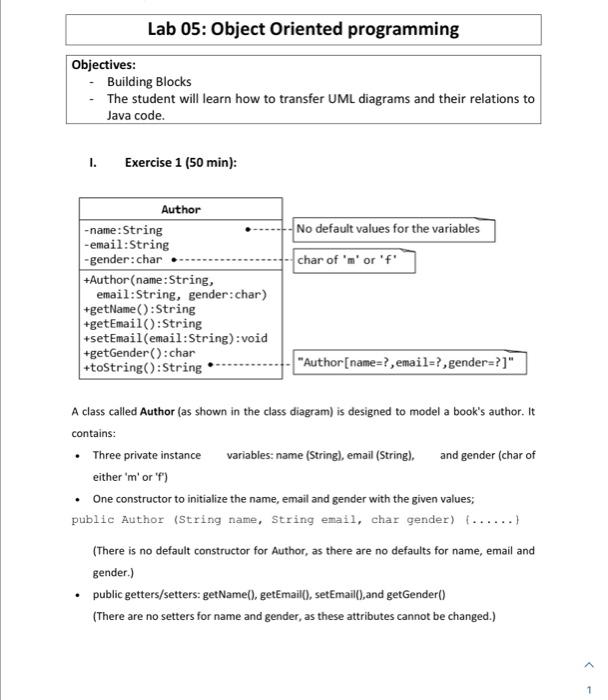
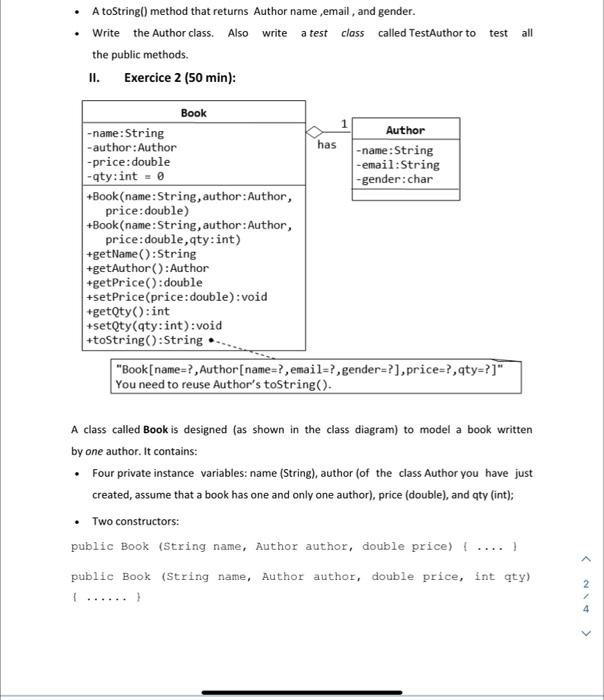
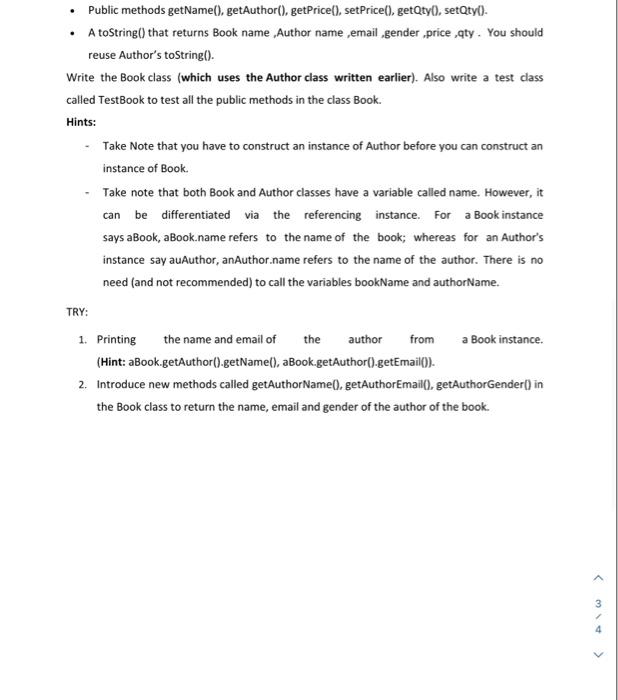
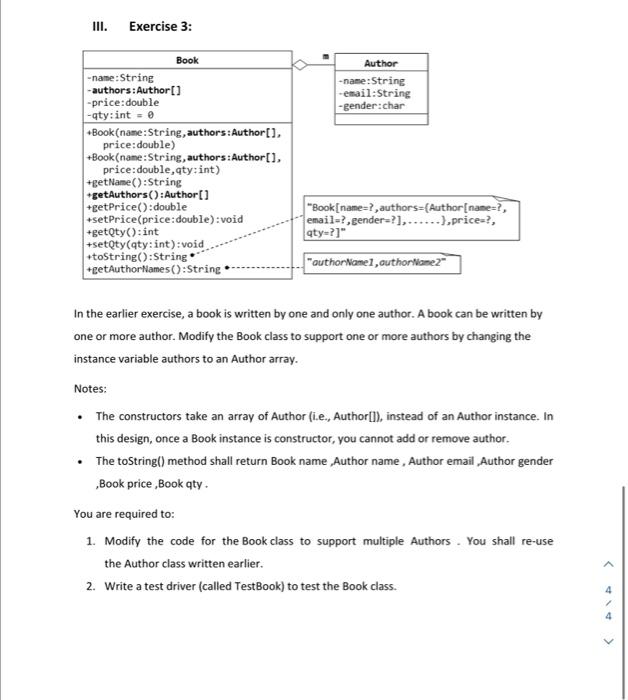
Objectives: - Building Blocks - The student will learn how to transfer UML diagrams and their relations to Java code. 1. Exercise 1(50min) : A class called Author (as shown in the class diagram) is designed to model a book's author. It contains: - Three private instance variables: name (String), email (String), and gender (char of either ' m ' or ' f ') - One constructor to initialize the name, email and gender with the given values; public Author (String name, String email, char gender) (.. (There is no default constructor for Author, as there are no defaults for name, email and gender.) - public getters/setters: getName(), getEmail), setEmail(), and getGender() (There are no setters for name and gender, as these attributes cannot be changed.) - A tostring() method that returns Author name ,email, and gender. - Write the Author class. Also write a test class called TestAuthor to test all the public methods. II. Exercice 2 (50 min): You need to reuse Author's tostring(). A class called Book is designed (as shown in the class diagram) to model a book written by one author. It contains: - Four private instance variables: name (String), author (of the class Author you have just created, assume that a book has one and only one author), price (double), and qty (int); - Two constructors: public Book (String name, Author author, double price) ( ... ) public Book (String name, Author author, double price, int qty) 11 - Public methods getName(), getAuthor(), getPrice(), setPrice(), getQty(), setQty(). - A toString() that returns Book name ,Author name, email ,gender, price, ,qty. You should reuse Author's tostring(). Write the Book class (which uses the Author class written earlier). Also write a test class called TestBook to test all the public methods in the class Book. Hints: - Take Note that you have to construct an instance of Author before you can construct an instance of Book. - Take note that both Book and Author classes have a variable called name. However, it can be differentiated via the referencing instance. For a Bookinstance says aBook, aBook.name refers to the name of the book; whereas for an Author's instance say auAuthor, anAuthor.name refers to the name of the author. There is no need (and not recommended) to call the variables bookName and authorName. TRY: 1. Printing the name and email of the author from a Bookinstance. (Hint: aBook.getAuthor().getName(), aBook.getAuthor().getEmail()). 2. Introduce new methods called getAuthorName(), getAuthorEmail(), getAuthorGender() in III. Exercise 3: In the earlier exercise, a book is written by one and only one author. A book can be written by one or more author. Modify the Book class to support one or more authors by changing the instance variable authors to an Author array. Notes: - The constructors take an array of Author (i.e., Author[]), instead of an Author instance. In this design, once a Book instance is constructor, you cannot add or remove author. - The toString() method shall return Book name ,Author name, Author email ,Author gender ,Book price, Book qty. You are required to: 1. Modify the code for the Book class to support multiple Authors. You shall re-use the Author class written earlier. 2. Write a test driver (called TestBook) to test the Book class
Step by Step Solution
There are 3 Steps involved in it

Get step-by-step solutions from verified subject matter experts
 Study Help