







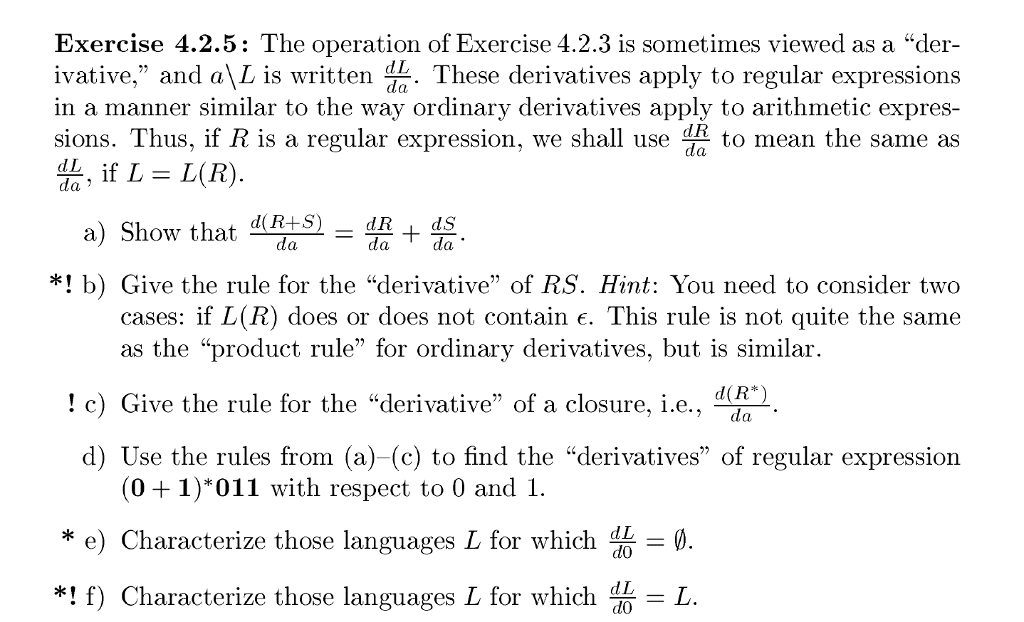
Question: I need only 4.2.5 above 4.2.3 answer: Exercise 4.2.5: The operation of Exercise 4.2.3 is sometimes viewed as a der- ivative, and aL is written
I need only 4.2.5 above


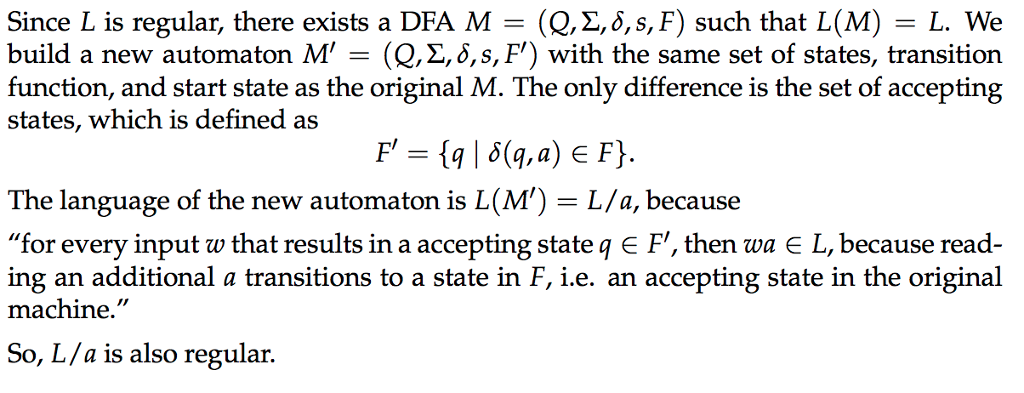
4.2.3 answer:
Exercise 4.2.5: The operation of Exercise 4.2.3 is sometimes viewed as a "der- ivative," and a\L is written d. These derivatives apply to regular expressions in a manner similar to the way ordinary derivatives apply to arithmetic expres- sions. Thus, if R is a regular expression, we shall use d to mean the same as d.R ,if L = L(R) a) Show that d 4+4 d(R-S dRdS da da' *! b) Give the rule for the "derivative" of RS. Hint: You need to consider two cases: if L(R) does or does not contain e. This rule is not quite the same as the "product rule" for ordinary derivatives, but is similar ! c) Give the rule for the "derivative" of a closure, i.e dR) ., da d) Use the rules from (a)-(c) to find the "derivatives" of regular expression (0+1)*011 with respect to 0 and 1. dL * e) Characterize those languages L for which dL d0 aracterize those languages Exercise 4.2.5: The operation of Exercise 4.2.3 is sometimes viewed as a "der- ivative," and a\L is written d. These derivatives apply to regular expressions in a manner similar to the way ordinary derivatives apply to arithmetic expres- sions. Thus, if R is a regular expression, we shall use d to mean the same as d.R ,if L = L(R) a) Show that d 4+4 d(R-S dRdS da da' *! b) Give the rule for the "derivative" of RS. Hint: You need to consider two cases: if L(R) does or does not contain e. This rule is not quite the same as the "product rule" for ordinary derivatives, but is similar ! c) Give the rule for the "derivative" of a closure, i.e dR) ., da d) Use the rules from (a)-(c) to find the "derivatives" of regular expression (0+1)*011 with respect to 0 and 1. dL * e) Characterize those languages L for which dL d0 aracterize those languages
Step by Step Solution
There are 3 Steps involved in it

Get step-by-step solutions from verified subject matter experts
 Study Help