







Question: I need questions a,b,c,d, and e. Really appreciate it if you can solve these with a proper explanation. So that I can understand how to
I need questions a,b,c,d, and e. Really appreciate it if you can solve these with a proper explanation. So that I can understand how to do them. Thank you.
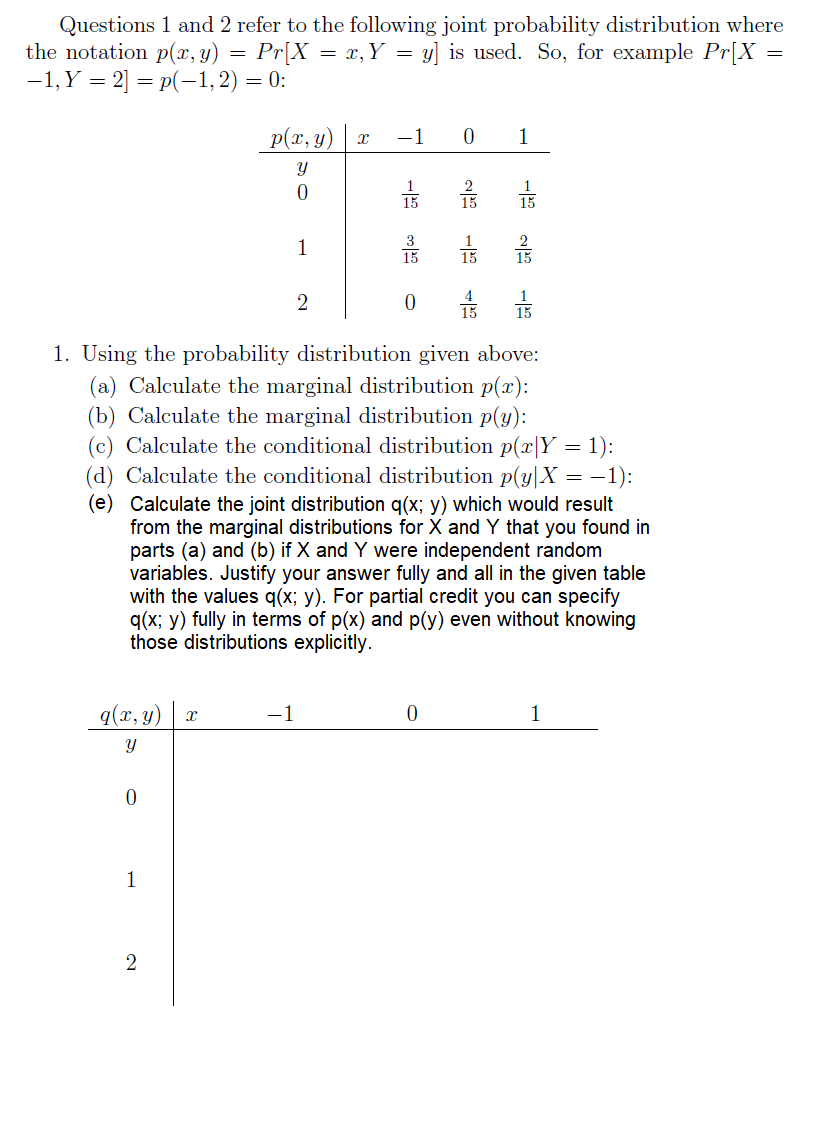
Questions 1 and 2 refer to the following joint probability distribution where the notation p(:r:,y) = Pr[X = :13,Y = y] is used. So, for example PrlX = 1,Y = 2]=p(1,2)= U: p(:r,y) l :r l 0 1 y 1 2 1 0 s E s 3 1 2 1 s s s 4 1 2 U E E 1. Using the probability distribution given above: (a) Calculate the marginal distribution 13(33): (b) Calculate the marginal distribution My): (c) Calculate the conditional distribution p(:r|Y = l): (d) Calculate the conditional distribution p(y|X = 1): (e) Calculate the joint distribution q(x; y) which would result from the marginal distributions for X and Y that you found in parts (a) and (b) if X and Y were independent random variables. Justify your answer fully and all in the given table with the values q(x; y). For partial credit you can specify q(x; y) fully in terms of p(x) and p(y) even without knowing those distributions explicitly. 13(1):, y) 9.: 1 U 1 y 0
Step by Step Solution
There are 3 Steps involved in it

Get step-by-step solutions from verified subject matter experts
 Study Help