







Question: I need some help!! 5. Correcting for negative externalities - Regulation versus tradablepermits Suppose the government wants to reduce the total pollution emitted by three
I need some help!!
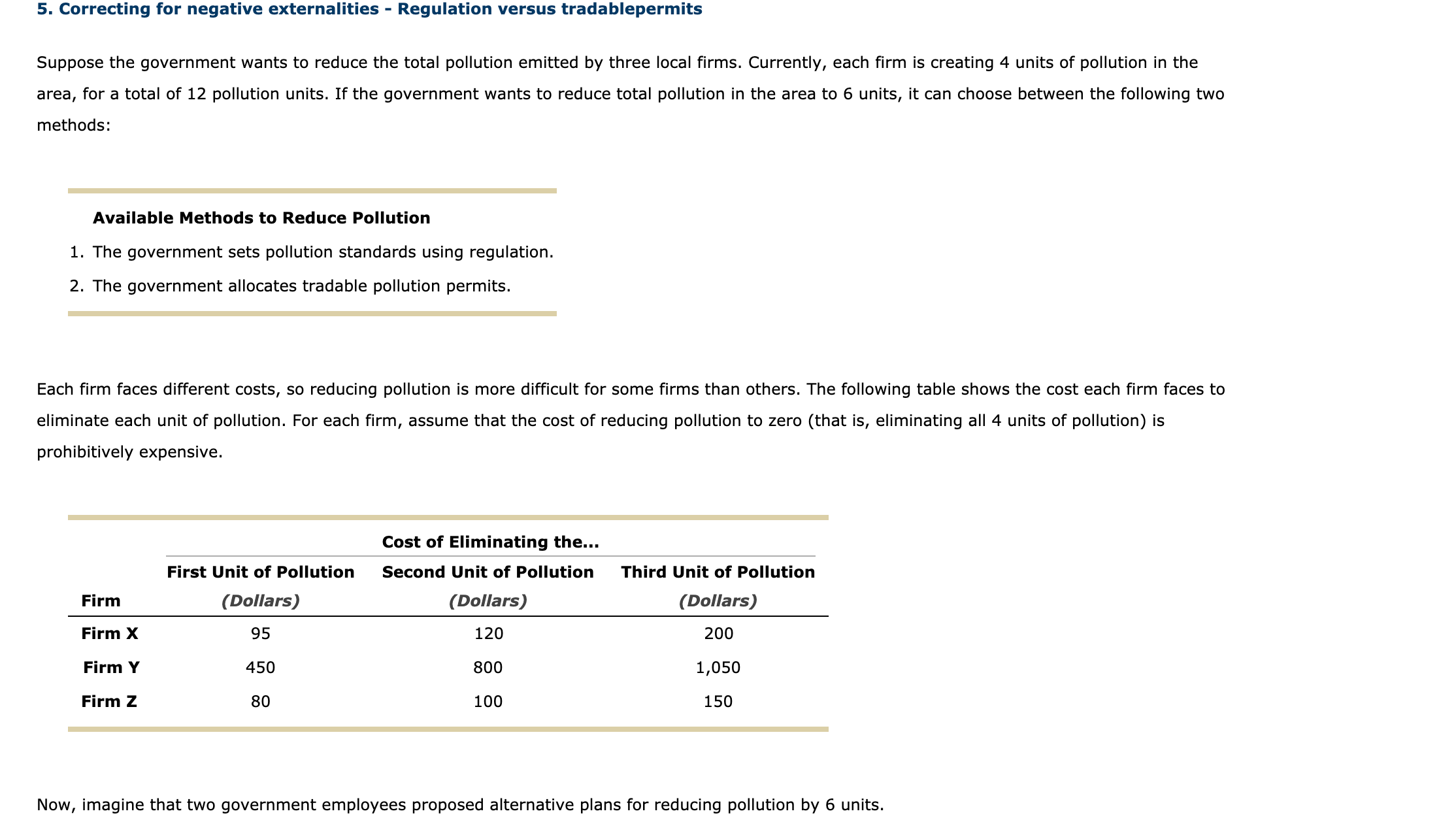
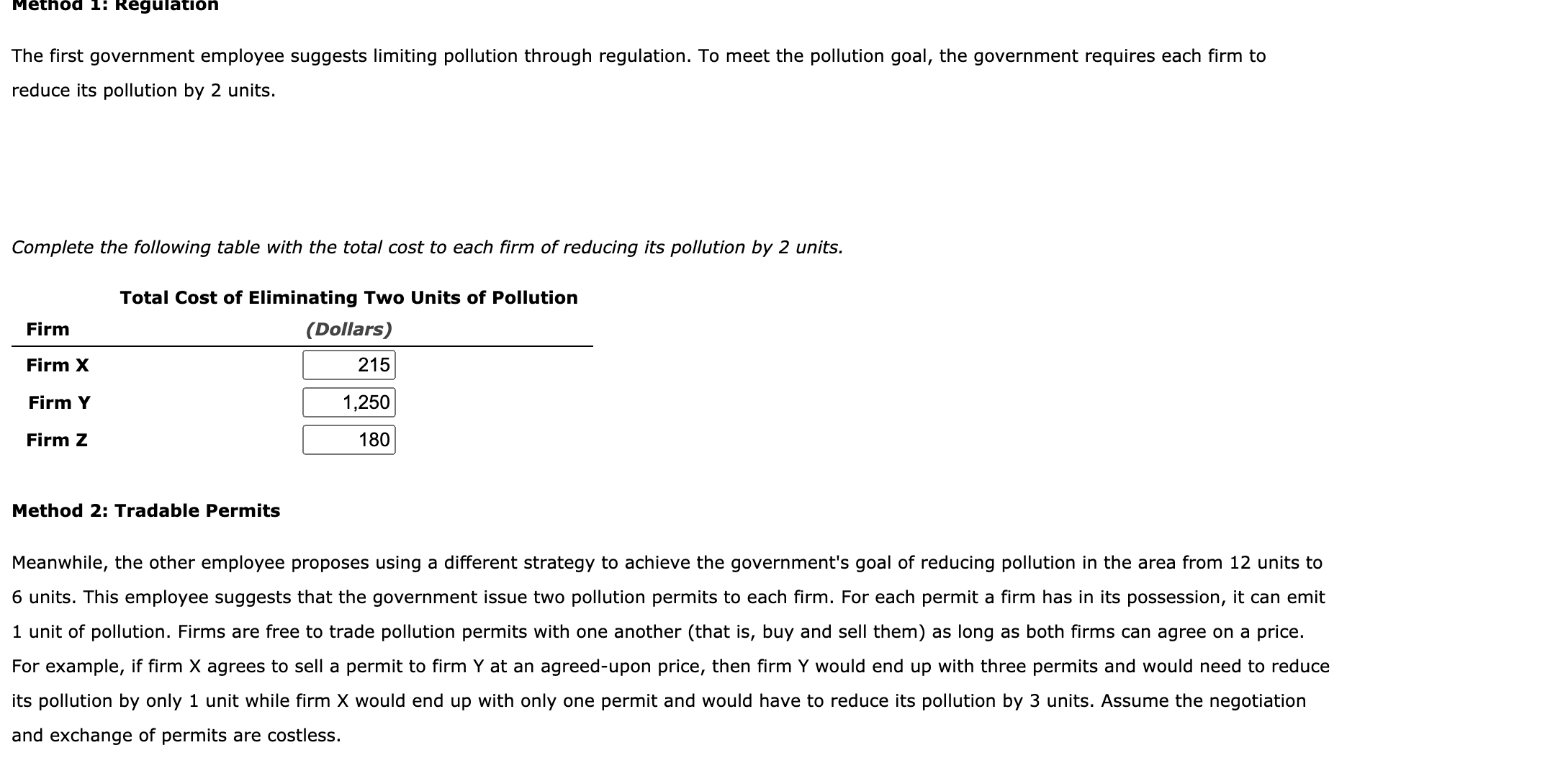
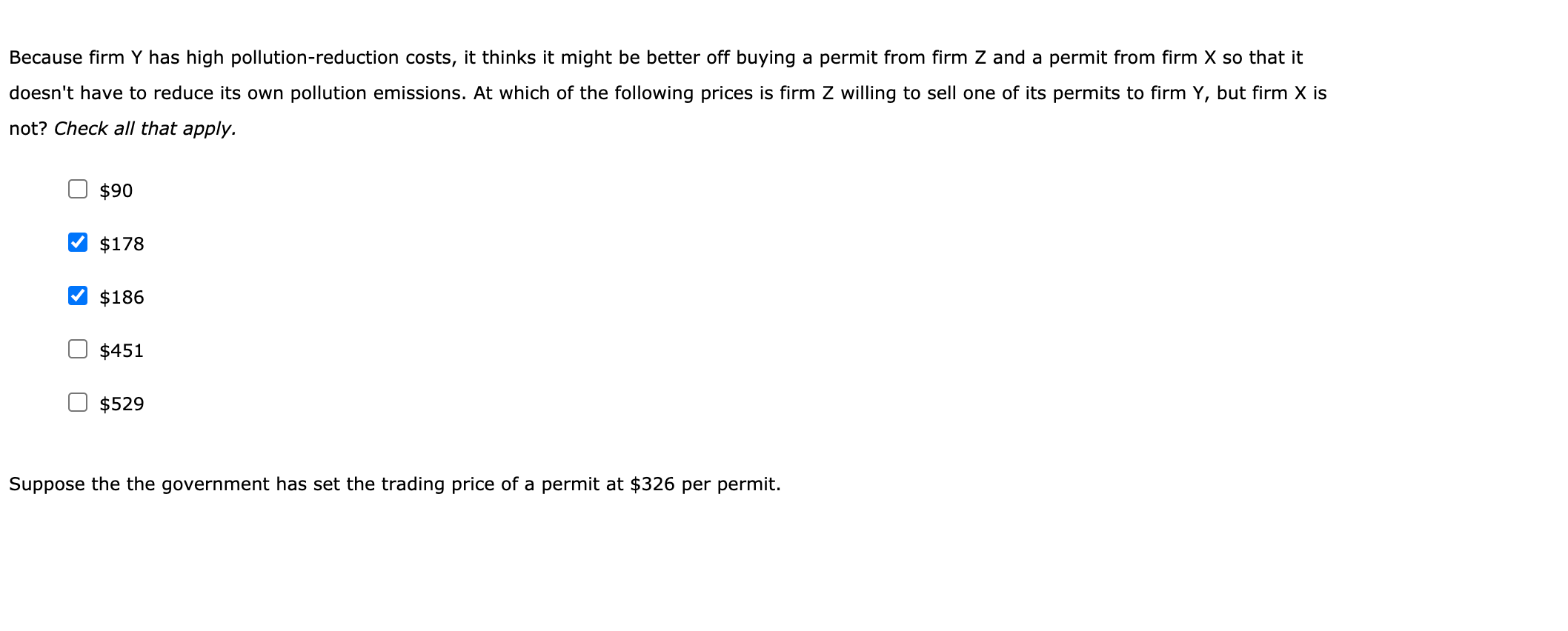
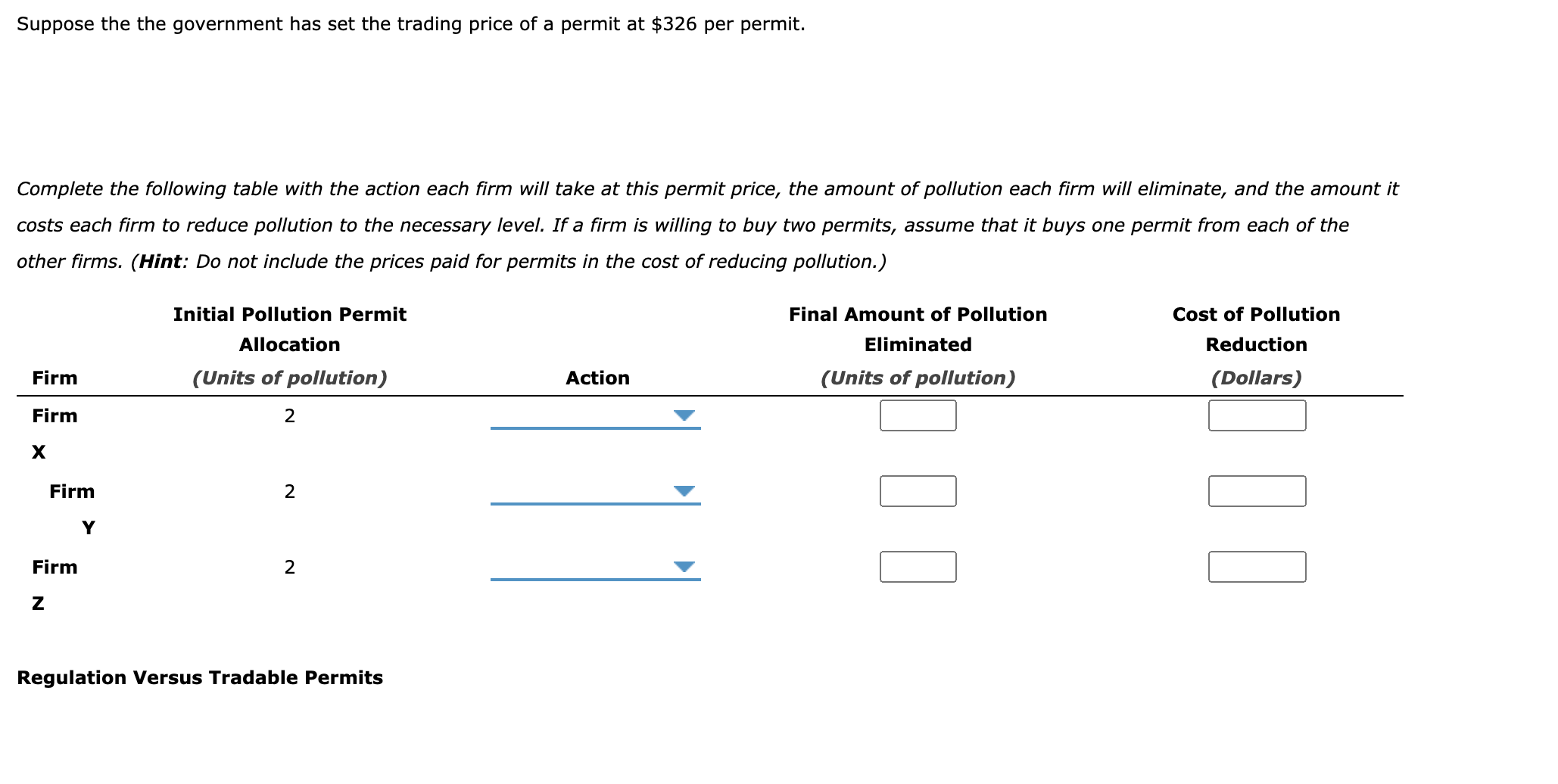
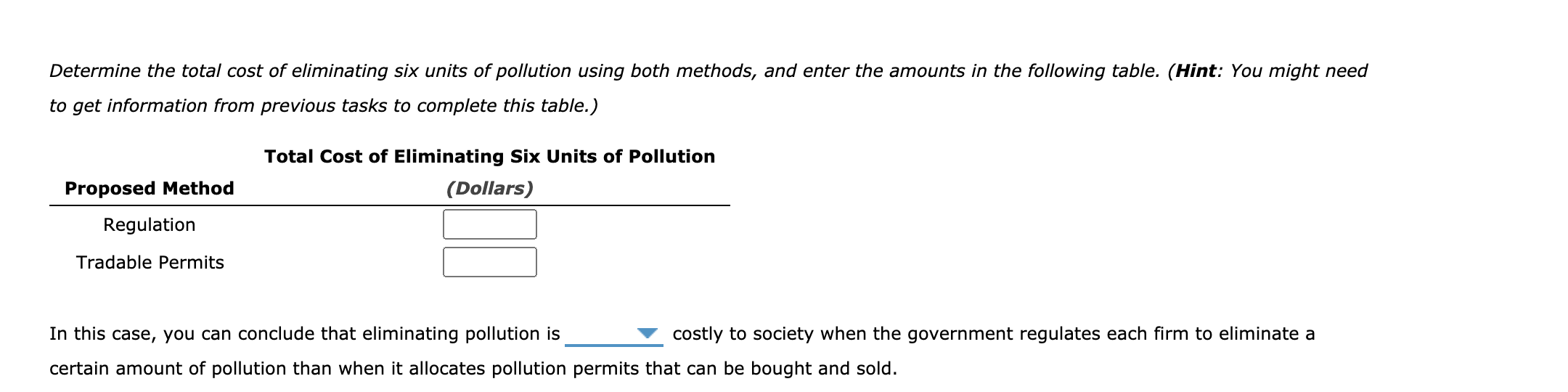
5. Correcting for negative externalities - Regulation versus tradablepermits Suppose the government wants to reduce the total pollution emitted by three local firms. Currently, each rm is creating 4 units of pollution in the area, for a total of 12 pollution units. If the government wants to reduce total pollution in the area to 6 units, it can choose between the following two methods: Available Methods to Reduce Pollution 1. The government sets pollution standards using regulation. 2. The government allocates tradable pollution permits. Each firm faces different costs, so reducing pollution is more difficult for some firms than others. The following table shows the cost each rm faces to eliminate each unit of pollution. For each rm, assume that the cost of reducing pollution to zero (that is, eliminating all 4 units of pollution) is prohibitively expensive. Cost of Eliminating the... First Unit of Pollution Second Unit of Pollution Third Unit of Pollution Firm (Dollars) (Dollars) (Dollars) Firm X 95 120 200 Firm Y 450 800 1,050 Firm 2 80 100 150 Now, imagine that two government employees proposed alternative plans for reducing pollution by 6 units. netnoa 1: Kegmatlon The first government employee suggests limiting pollution through regulation. To meet the pollution goal, the government requires each rm to reduce its pollution by 2 units. Complete the following table with the total cost to each rm of reducing its pollution by 2 units. Total Cost of Eliminating Two Units of Pollution Firm (Dollars) Firm X 215 Firm Y W Firm 2 180 Method 2: Tradable Permits Meanwhile, the other employee proposes using a different strategy to achieve the government's goal of reducing pollution in the area from 12 units to 6 units. This employee suggests that the government issue two pollution permits to each rm. For each permit a rm has in its possession, it can emit 1 unit of pollution. Firms are free to trade pollution permits with one another (that is, buy and sell them) as long as both firms can agree on a price. For example, if firm X agrees to sell a permit to rm Y at an agreed-upon price, then firm Y would end up with three permits and would need to reduce its pollution by only 1 unit while rm X would end up with only one permit and would have to reduce its pollution by 3 units. Assume the negotiation and exchange of permits are costless. Because rm Y has high pollution-reduction costs, it thinks it might be better off buying a permit from firm 2 and a permit from rm X so that it doesn't have to reduce its own pollution emissions. At which of the following prices is rm 2 willing to sell one of its permits to firm Y, but firm X is not? Check all that apply. C $90 $178 $186 C $451 C $529 Suppose the the government has set the trading price of a permit at $326 per permit. Suppose the the government has set the trading price of a permit at $326 per permit. Complete the following table with the action each rm will take at this permit price, the amount of pollution each rm will eliminate, and the amount it costs each rm to reduce pollution to the necessary level. If a rm is willing to buy two permits, assume that it buys one permit from each of the other rms. (Hint: Do not include the prices paid for permits in the cost of reducing pollution.) Initial Pollution Permit Final Amount of Pollution Cost of Pollution Allocation Eliminated Reduction Firm (Units of pollution) Action (Units of pollution) (Dollars) Firm 2 V X Firm 2 V Y Firm 2 V 2 Regulation Versus Tradable Permits Determine the total cost of eliminating six units of pollution using both methods, and enter the amounts in the following table. (Hint: You might need to get information from previous tasks to complete this table.) Total Cost of Eliminating Six Units of Pollution Proposed Method (Dollars) Regulation Tradable Permits In this case, you can conclude that eliminating pollution is V costly to society when the government regulates each rm to eliminate a certain amount of pollution than when it allocates pollution permits that can be bought and sold
Step by Step Solution
There are 3 Steps involved in it

Get step-by-step solutions from verified subject matter experts
 Study Help