







Question: I need some help on working through mostly part b and c. I'm looking for an algebraic/formula approach versus using derivatives, that's all I can
I need some help on working through mostly part b and c. I'm looking for an algebraic/formula approach versus using derivatives, that's all I can find online and it makes the information more confusing to understand. Thank you.
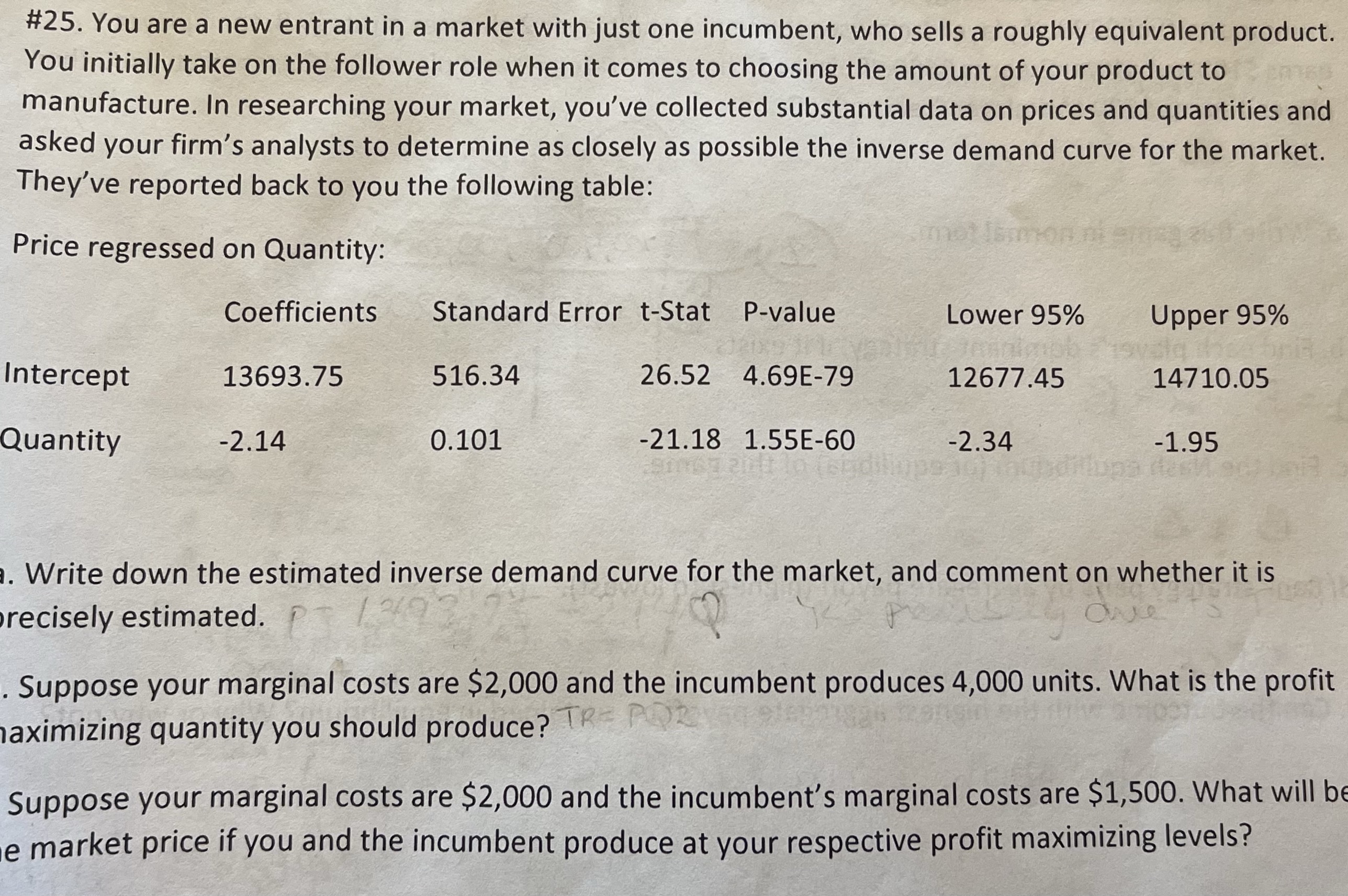
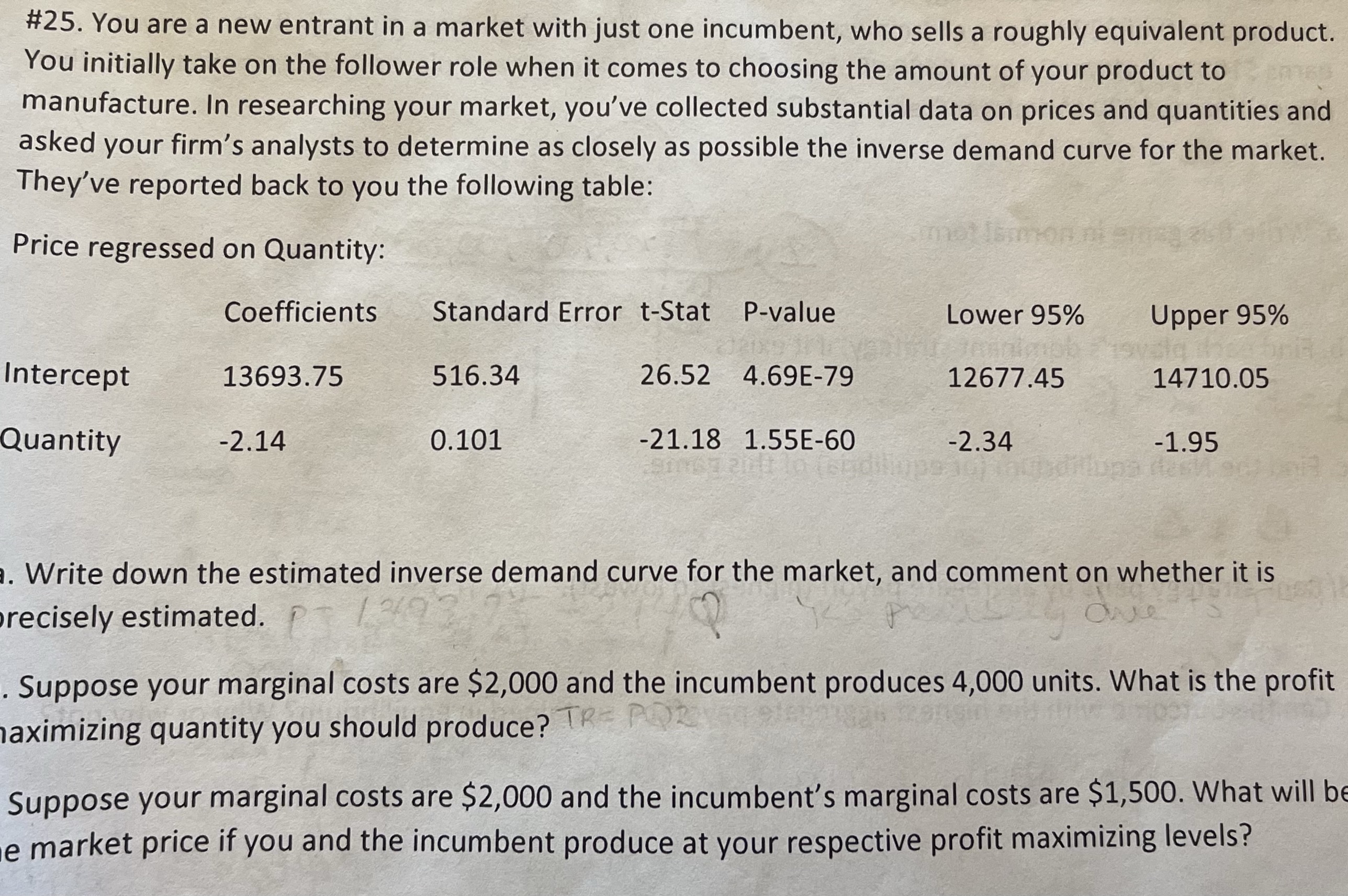
#25. You are a new entrant in a market with just one incumbent, who sells a roughly equivalent product. You initially take on the follower role when it comes to choosing the amount of your product to manufacture. In researching your market, you've collected substantial data on prices and quantities and asked your firm's analysts to determine as closely as possible the inverse demand curve for the market. They've reported back to you the following table: Price regressed on Quantity: Coefficients Standard Error t-Stat P-value Lower 95% Upper 95% Intercept 13693.75 516.34 26.52 4.69E-79 12677.45 14710.05 Quantity -2.14 0.101 -21.18 1.55E-60 -2.34 -1.95 . Write down the estimated inverse demand curve for the market, and comment on whether it is recisely estimated. 1292 Suppose your marginal costs are $2,000 and the incumbent produces 4,000 units. What is the profit maximizing quantity you should produce? TRE PR Suppose your marginal costs are $2,000 and the incumbent's marginal costs are $1,500. What will be e market price if you and the incumbent produce at your respective profit maximizing levels
Step by Step Solution
There are 3 Steps involved in it

Get step-by-step solutions from verified subject matter experts
 Study Help