







Question: I need some help solving this. Cant figure it out. thank you Sheridan Corporation produces two grades of non-alcoholic wine from grapes that it buys
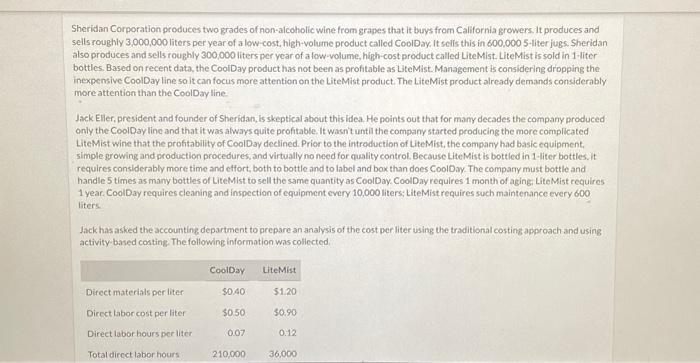
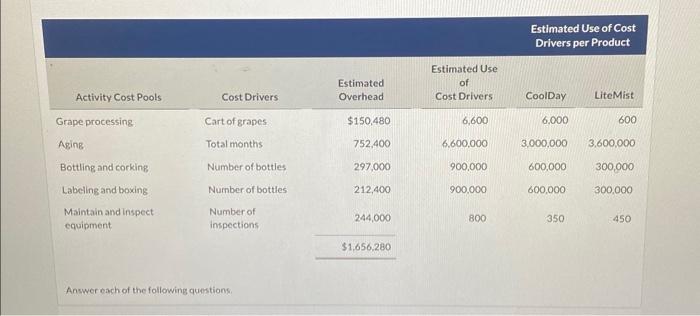
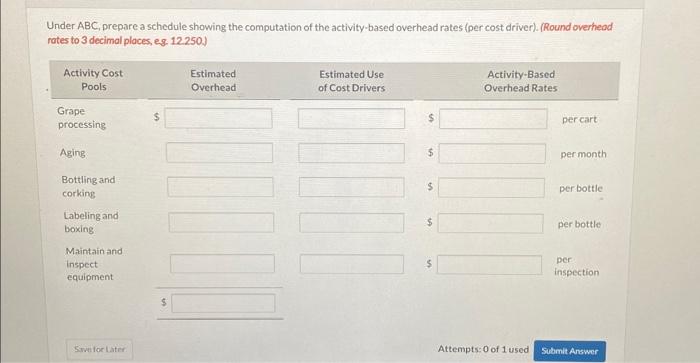
Sheridan Corporation produces two grades of non-alcoholic wine from grapes that it buys from California growers. It produces and sells roughly 3,000,000 liters per year of a low-cost, high-volume product called CoolDay. It sells this in 600,0005 -liter jugs. Sheridan also produces and sells roughly 300,000 liters per year of a low-volume, high-cost product called LiteMist. LiteMist is sold in 1 -liter bottles. Based on recent data, the CoolDay product has not been as profitable as LiteMist. Management is considering dropping the inexpensive CoolDay line so it can focus more attention on the LiteMist product. The LiteMist product already demands considerably more attention than the CoolDay line. Jack Elier, president and founder of Sheridan, is skeptical about this lidea. He points out that for mamy decades the company produced only the CoolDay line and that it was always quite profitable. It wasn't until the company started producing the more complicated LiteMist wine that the profitability of CoolDay deelined. Prior to the introduction of Lite Mist, the company had basic equipment, simple growing and production procedures, and virtually no need for quality controL Because LiteMist is bottled in 1 -liter bottles. it requires considerably more time and effort, both to bottle and to label and box than does CoolDay. The company must bottle and handie 5 times as many bottles of LiteMist to sell the same quantity as CoolDay. CoolDay requires 1 month of aging: LiteMist requires 1 year. CoolDay requires cleaning and inspection of equipment every 10,000 liters; LiteMist requires such maintenance every 600 liters Jack has asked the accounting department to prepare an analysis of the cost per liter using the traditionalcostingapproach and using activity-based costing. The following information was collected Anwer each of the following questions. Under ABC, prepare a schedule showing the computation of the activity-based overhead rates (per cost driver). (Round overheod rotes to 3 decimal places, eg. 12.250
Step by Step Solution
There are 3 Steps involved in it

Get step-by-step solutions from verified subject matter experts
 Study Help