







Question: i need step by step solution example by using method 1) charnes and cooper 2) denominator function restriction 5.3 Product Planning Suppose that a refrigerator
i need step by step solution example by using method 1) charnes and cooper 2) denominator function restriction
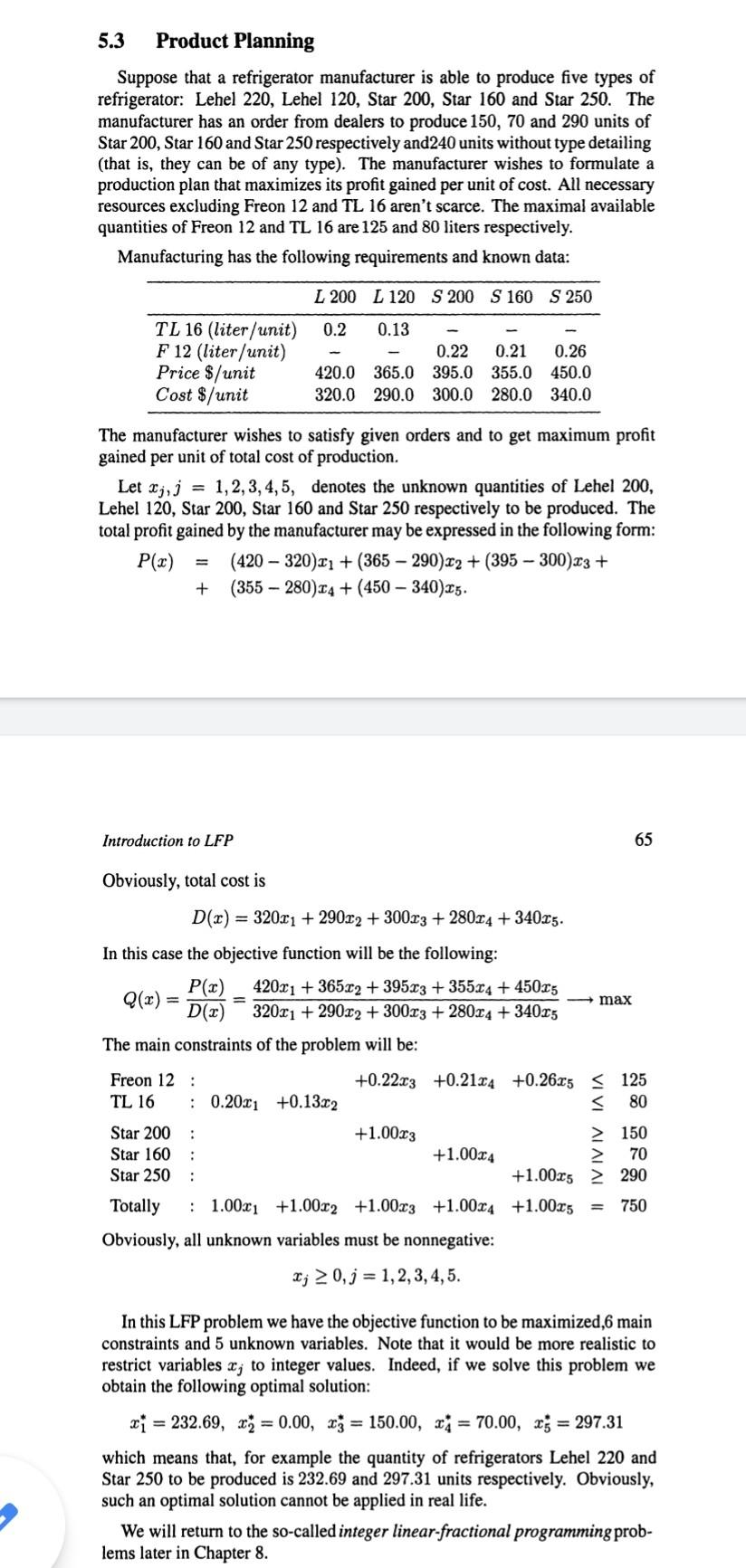
5.3 Product Planning Suppose that a refrigerator manufacturer is able to produce five types of refrigerator: Lehel 220, Lehel 120, Star 200, Star 160 and Star 250. The manufacturer has an order from dealers to produce 150, 70 and 290 units of Star 200, Star 160 and Star 250 respectively and240 units without type detailing (that is, they can be of any type). The manufacturer wishes to formulate a production plan that maximizes its profit gained per unit of cost. All necessary resources excluding Freon 12 and TL 16 aren't scarce. The maximal available quantities of Freon 12 and TL 16 are 125 and 80 liters respectively. Manufacturing has the following requirements and known data: L 200 L 120 S 200 S 160 S 250 TL 16 (liter/unit) F 12 (liter/unit) Price $/unit Cost $/unit 0.2 0.13 0.22 0.21 0.26 420.0 365.0 395.0 355.0 450.0 320.0 290.0 300.0 280.0 340.0 The manufacturer wishes to satisfy given orders and to get maximum profit gained per unit of total cost of production. Let xj, j = 1,2,3,4,5, denotes the unknown quantities of Lehel 200, Ij Lehel 120, Star 200, Star 160 and Star 250 respectively to be produced. The total profit gained by the manufacturer may be expressed in the following form: P(x) (420 320)71 + (365 - 290).x2 + (395 300)23 + (355 - 280)14 + (450 - 340).15. + - Introduction to LFP 65 Obviously, total cost is D(r) = 320r1 + 290x2 + 30013 +28014 + 34025. In this case the objective function will be the following: P(1) 420x1 + 365.22 + 395.33 +35524 + 45015 Q(x) = Dr) 32021 +290x2 + 30003 + 28014 + 34025 = max The main constraints of the problem will be: Freon 12 : +0.22x3 +0.2134 +0.26.25 150 Star 160 : +1.00.34 > 70 Star 250 : +1.00x5 > 290 Totally : 1.0001 +1.00 +2 +1.00x3 +1.0004 +1.00x5 = 750 Obviously, all unknown variables must be nonnegative: X; > 0, j = 1,2,3,4,5. In this LFP problem we have the objective function to be maximized,6 main constraints and 5 unknown variables. Note that it would be more realistic to restrict variables x; to integer values. Indeed, if we solve this problem we obtain the following optimal solution: xi = 232.69, x = 0.00, x5 = 150.00, x4 = 70.00, x5 = 297.31 which means that, for example the quantity of refrigerators Lehel 220 and Star 250 to be produced is 232.69 and 297.31 units respectively. Obviously, such an optimal solution cannot be applied in real life. We will return to the so-called integer linear-fractional programming prob- lems later in Chapter 8. 5.3 Product Planning Suppose that a refrigerator manufacturer is able to produce five types of refrigerator: Lehel 220, Lehel 120, Star 200, Star 160 and Star 250. The manufacturer has an order from dealers to produce 150, 70 and 290 units of Star 200, Star 160 and Star 250 respectively and240 units without type detailing (that is, they can be of any type). The manufacturer wishes to formulate a production plan that maximizes its profit gained per unit of cost. All necessary resources excluding Freon 12 and TL 16 aren't scarce. The maximal available quantities of Freon 12 and TL 16 are 125 and 80 liters respectively. Manufacturing has the following requirements and known data: L 200 L 120 S 200 S 160 S 250 TL 16 (liter/unit) F 12 (liter/unit) Price $/unit Cost $/unit 0.2 0.13 0.22 0.21 0.26 420.0 365.0 395.0 355.0 450.0 320.0 290.0 300.0 280.0 340.0 The manufacturer wishes to satisfy given orders and to get maximum profit gained per unit of total cost of production. Let xj, j = 1,2,3,4,5, denotes the unknown quantities of Lehel 200, Ij Lehel 120, Star 200, Star 160 and Star 250 respectively to be produced. The total profit gained by the manufacturer may be expressed in the following form: P(x) (420 320)71 + (365 - 290).x2 + (395 300)23 + (355 - 280)14 + (450 - 340).15. + - Introduction to LFP 65 Obviously, total cost is D(r) = 320r1 + 290x2 + 30013 +28014 + 34025. In this case the objective function will be the following: P(1) 420x1 + 365.22 + 395.33 +35524 + 45015 Q(x) = Dr) 32021 +290x2 + 30003 + 28014 + 34025 = max The main constraints of the problem will be: Freon 12 : +0.22x3 +0.2134 +0.26.25 150 Star 160 : +1.00.34 > 70 Star 250 : +1.00x5 > 290 Totally : 1.0001 +1.00 +2 +1.00x3 +1.0004 +1.00x5 = 750 Obviously, all unknown variables must be nonnegative: X; > 0, j = 1,2,3,4,5. In this LFP problem we have the objective function to be maximized,6 main constraints and 5 unknown variables. Note that it would be more realistic to restrict variables x; to integer values. Indeed, if we solve this problem we obtain the following optimal solution: xi = 232.69, x = 0.00, x5 = 150.00, x4 = 70.00, x5 = 297.31 which means that, for example the quantity of refrigerators Lehel 220 and Star 250 to be produced is 232.69 and 297.31 units respectively. Obviously, such an optimal solution cannot be applied in real life. We will return to the so-called integer linear-fractional programming prob- lems later in Chapter 8
Step by Step Solution
There are 3 Steps involved in it

Get step-by-step solutions from verified subject matter experts
 Study Help